

The best way to bring people closer may be to leave a little room for silence. A gathering doesn’t need a game or a round of introductions to feel warm. Sometimes, the right coffee table conversation starters simply give a story somewhere to begin.
It’s natural to wonder whether guests who don’t know one another will run out of things to say. Yet a question that feels too personal, or too much like an activity, can make conversation less comfortable. The gentlest prompts meet people where they are, inviting a small memory or passing thought without asking anyone to perform.
Here, you’ll find coffee table conversation starters for different moods and gatherings, from light first questions to memories, daydreams and wishes. You’ll also find ways to choose a prompt, offer it without pressure and let the conversation find its own pace. A shared moment of attention can be enough. The rest may unfold naturally.
Key Takeaways
- Thoughtful coffee table conversation starters can open a door to connection without turning an evening into a game.
- Explore five kinds of prompts, from easy observations to questions that invite memories and wishes.
- Choose questions to suit how well guests know one another and the mood of the gathering.
- Offer a prompt naturally, then leave room for people to join in or simply listen.
- A preserved dandelion can offer a shared point of attention and a gentle path towards stories of time, seasons and childhood.
Why coffee table conversation starters can make a gathering feel more welcoming
Coats are set aside. Someone accepts a cup; another settles into the sofa. For a moment, the room is quiet as guests find their place among people they may know only a little. Then a question arrives, not as an announcement but as a small opening: “What’s the loveliest thing you’ve noticed this week?”
Coffee table conversation starters are optional invitations to move gently beyond small talk and into shared stories. They don’t need to steer the evening in a particular direction. A conversation opener can be as simple as a question about a book, a view from the window or a favourite season. The host offers it; each guest remains free to answer, listen or let the moment pass.
A welcoming conversation starter makes room for people to meet one another at their own pace, with curiosity but without expectation. A good prompt leaves space for a laugh, a thoughtful pause or an unexpected memory. Silence isn’t a failure to connect. Sometimes it’s simply the room settling before someone finds the words.
What makes a coffee-table question feel natural?
Choose an open question that invites more than “yes” or “no”, such as “What place would you happily visit again?” Keep early prompts light, especially when guests have only just met. You can answer first with a small detail of your own. This shows that there’s no perfect response and no expectation for everyone to take a turn.
A shared focal point, without pressure
A piece of artwork, a branch of blossom or the changing light across the room gives people something easy to notice together. Begin with an observation rather than a request for personal disclosure: “I love how the petals catch the light.” If a question follows, let it emerge naturally. Conversation might wander from the season to childhood, or drift elsewhere entirely. There’s no need for a fixed sequence. An evening feels more welcoming when people can join or leave an exchange freely.
Five kinds of coffee table conversation starters, from light to thoughtful
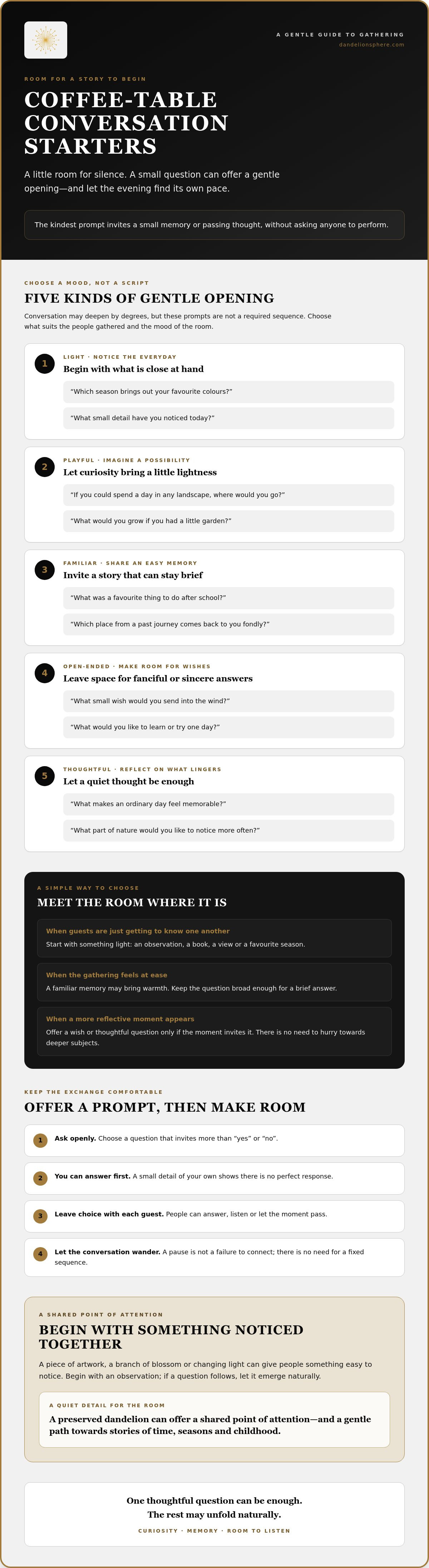
Conversation can deepen by degrees. Begin with what’s close at hand, then move towards memories or meaning only if the moment invites it. This selection of coffee table conversation starters isn’t a ranking of universally perfect questions. It offers different levels of depth, so you can choose what feels comfortable for the people gathered and the mood of the room.
Varied prompts let guests choose how much to share: a light answer can be enough, while a more thoughtful one may open a longer exchange. There’s no need to hurry towards deeper subjects. Research reported by the American Psychological Association suggests people may enjoy deep conversations more than they expect, but that doesn’t mean every gathering needs one.
1. Notice the everyday
Start with details that are easy to observe or recall. These questions invite curiosity without asking for private stories.
- Which season brings out your favourite colours?
- What small detail have you noticed today?
2. Choose a playful possibility
A little imagination adds lightness. Guests can answer seriously or playfully, without having to explain themselves.
- If you could spend a day in any landscape, where would you go?
- What would you grow if you had a little garden?
3. Share an easy memory
Once people seem at ease, a familiar memory can bring warmth. Keep the question broad enough for a brief answer.
- What was a favourite thing to do after school?
- Which place from a past journey comes back to you fondly?
4. Make room for wishes
Questions about hopes can feel tender, so leave them open to fanciful answers as well as sincere ones. Guests can pass, answer briefly or take the conversation elsewhere.
- What small wish would you send into the wind?
- What would you like to learn or try one day?
5. Reflect on what lingers
For a quieter moment, invite reflection without expecting a grand revelation. A simple thought can be shared in a sentence.
- What makes an ordinary day feel memorable?
- What part of nature would you like to notice more often?
There’s no need to move through every category. Choose one question that suits the gathering and let the replies guide what comes next. If a natural focal point feels right for the room, you might explore the Dandelion Spheres. Each features a real dandelion, offering a quiet detail for guests to notice together.
How to choose conversation starters without making guests feel put on the spot
A question that feels easy among old friends may feel too personal to new acquaintances. Let familiarity, group size and the room’s mood guide your choice. The broader science of social connection speaks to the value of feeling connected, but a host can’t prescribe closeness. The invitation matters more than the answer.
Start with a subject everyone can enter, such as a shared view or an imaginative possibility. If people respond warmly, a question about memory or change may follow. Use the guide below as a starting point, not a rulebook. No single prompt suits every room.
| Prompt style | Familiarity and depth | Group fit | Example |
|---|---|---|---|
| Shared observation | Very light; guests needn’t know one another | Easy for a larger or mixed-age group to join | “What detail in this room catches your eye?” |
| Gentle hypothetical | Light and imaginative | Works across ages; brief answers are welcome | “If you could follow one path for an afternoon, where would it lead?” |
| Personal preference | Light, with a little room for character | Useful among new acquaintances or a small group | “What kind of day makes you feel most at ease?” |
| Shared memory | More personal; best offered without expectation | Often easier among people who already know each other | “What simple tradition would you like to keep?” |
| Reflective question | Thoughtful; invites a considered answer | Better for a quieter gathering where people can take their time | “What has changed in a way you’re grateful for?” |
Match the question to the people in the room
For new acquaintances, favour familiar subjects and gentle hypotheticals that don’t require specialist knowledge. Close friends or family may welcome optional reflections on shared memories or the passing seasons. At a mixed-age gathering, choose a question that lets a child, a parent and a grandparent answer from different points of view. Keep the invitation broad enough for different experiences.
Keep deeper questions gentle and optional
Leave grief, conflict, health and private relationships untouched unless a guest brings them up. If you ask something reflective, model a short answer yourself rather than asking one person to carry the conversation. You might say, “I’ll start, but anyone can pass.” Then notice the room: if replies shorten or attention drifts, change direction. A pause or a new subject is a comfortable choice, not a refusal.
How to bring coffee table conversation starters into a gathering naturally
A good question needn’t announce itself as an activity. It can arrive as naturally as a cup being passed or a window opened to the evening air. The host’s part is simple: welcome everyone, notice something shared, offer one open question, then listen.
A simple, unhurried way to begin
Let the room offer the first subject. It might be the changing light, a book left within reach or the scent of flowers. You could say, “The sky has turned such a soft colour. What kind of weather makes you want to linger indoors?” Ask once, then give people time. Don’t rush to fill the space or move to another prompt. If someone answers, follow their thought with genuine curiosity: “What do you like about it?” A prepared list can be useful to keep nearby, but it needn’t become a script.
Keep a few coffee table conversation starters in mind, perhaps one light question and one more reflective one. Choose only what suits the people and the moment. If guests are still arriving or settling in, stay with an easy observation. If a story begins to unfold, let it take its own course rather than reaching for the next question.
Let the gathering find its own rhythm
Not every pause needs tending. Guests may be listening, watching the fire or simply enjoying a quiet moment together. Let silence breathe. If energy feels low, return to something shared and simple rather than asking a more personal question. A warm gathering doesn’t depend on continuous conversation; people can feel welcome without speaking at every turn.
A botanical focal point may offer an easy detail to notice, without asking anyone to disclose more than they wish. For a related reflection on the presence of nature at home, explore ideas around botanical focal points and interior space. A Dandelion Sphere, with a real dandelion preserved in resin, can invite quiet observation without becoming the evening’s centrepiece or a cue for everyone to speak.
If you’d like to see how a Dandelion Sphere might offer a shared point of attention, browse the botanical art objects. Let the room decide whether a question follows. The most natural exchanges often begin with a small observation, then linger only as long as they’re welcome.
A Dandelion Sphere as a quiet beginning for coffee table conversation
A dandelion seed head carries its own small invitation to pause. Its delicate form may bring to mind open fields, childhood wishes and the brief moment before a breeze lifts the seeds away. A Dandelion Sphere featuring a real dandelion can offer a shared point of attention in a room. It isn’t a guaranteed icebreaker, simply a nature-inspired art object that guests can notice, discuss or leave in companionable silence.
Questions inspired by a fleeting moment in nature
Let the questions grow from what people see. Keep them open and gentle, so a guest can answer in a phrase, share a story or take the conversation elsewhere.
- What do you notice first in a dandelion seed head?
- Do you remember making a wish and watching the seeds travel on the wind?
- Which season brings a particular memory to mind?
- If you could hold one fleeting moment in memory, what would it be?
There’s no need to ask them all. One question, offered softly, is enough. A guest may recall a summer afternoon; another may simply admire the fine pattern of the seeds. Both responses belong.
When a nature-inspired art object belongs in the conversation
A botanical focal point can give the eye somewhere to rest while conversation finds its way. A Dandelion Sphere is one possible beginning: a real dandelion preserved in clear resin, and a quiet reminder of nature’s delicate detail. It needn’t be introduced or explained. Someone may notice it and ask a question; someone else may prefer simply to look.
For a further reflection, explore the journal’s botanical art collector piece, “The Botanical Art Collector Piece: Curating Eternal Stillness”. Collecting can be less about possession than attention: choosing to live with a small fragment of nature’s artistry and allowing its meaning to change with the seasons.
If a Dandelion Sphere feels at home in your gathering, take a quiet look through the botanical art objects. Let the moment remain unhurried, like a wish carried by the wind.
Let the next gathering unfold at its own pace
A welcoming evening doesn’t depend on constant conversation. One thoughtful question, a shared observation or a comfortable pause can give guests room to settle in. Choose coffee table conversation starters to suit the people and mood, beginning lightly and letting stories deepen only when they wish to.
A natural focal point can offer another gentle beginning. Each Dandelion Sphere features a real dandelion flower preserved in resin, bringing a fleeting detail from nature into view. Dandelion Sphere is a boutique botanical art studio operating under Taraxacum Orbis, creating decorative pieces that invite quiet attention.
If this feeling of stillness speaks to you, explore the botanical art objects. Choose a Dandelion Sphere as a nature-inspired accent for your home or a thoughtful gift, and let your next gathering leave space for curiosity, easy laughter and stories that linger.
Frequently Asked Questions
What are good coffee table conversation starters?
Good coffee table conversation starters are open, welcoming questions with room for different kinds of answers. Begin with a favourite season, a small everyday pleasure or something guests have noticed in nature. For example, “What detail made you smile today?” is easy to answer briefly or expand into a story. Move towards memories or wishes only if the group seems comfortable. A prompt should invite, never demand, participation.
How do you start a conversation with guests without making it awkward?
Begin with a shared observation or a light question that doesn’t require a personal confession. You might ask, “What small thing has brought you joy recently?” and offer your own answer first. Then give the room time. A pause isn’t a failure; guests may be thinking, listening or simply settling in. Let people follow the conversation or allow it to drift towards another subject.
What are some deep conversation starters for friends?
Choose reflective questions that let friends decide how much they wish to share. You could ask, “Which place do you remember most fondly?” or “What childhood wish still makes you smile?” A question about an ordinary moment that changed how someone sees the world may also open a thoughtful exchange. Offer your own answer first, and make brief replies or passing equally comfortable. Trust, not intensity, gives a conversation depth.
Are conversation starters suitable for a mixed group?
Yes, broad and optional prompts can welcome people of different ages and experiences. Ask about changing seasons, favourite places, childhood games or small everyday wonders, leaving space for each person’s perspective. Avoid assuming everyone shares the same interests or memories. Notice how guests respond; if a question doesn’t find its moment, gently shift to a lighter subject or a detail everyone can see.
Can an object on a coffee table start a conversation?
An object can offer a shared detail to notice, though it can’t guarantee conversation will follow. A botanical art object featuring a preserved dandelion may bring wishes, childhood memories or the passing seasons to mind. The host might make a simple observation, then leave the next step to guests. They can share a story, ask a question or simply enjoy the quiet presence of nature’s detail.
How many conversation starters should a host prepare?
A handful of questions is usually enough to offer gentle direction without making the gathering feel planned. Keep a few light observations, imaginative prompts and invitations to share a memory in mind. There’s no need to ask them all, or to move through them in order. Let the people and mood guide your choice, and allow a good story to linger rather than reaching for the next question.
What conversation starters work best for people who have just met?
For people who have just met, choose questions that are easy to answer and don’t depend on shared history. Try asking about a favourite season, a place someone would like to visit or a small pleasure they’ve discovered. Avoid private subjects and questions that call for a long explanation. Answer first if it feels natural, then listen with interest. A simple exchange can grow at its own pace.
Disclaimer
The content on this website is provided for inspiration and informational purposes only. Articles reflect the philosophy and storytelling of Dandelion Sphere and are not intended as professional advice. While every effort is made to ensure accuracy, no guarantees are given regarding completeness or current applicability.


