

What if inviting nature into a man’s sanctuary did not demand an unspoken pact of daily upkeep? Too often, searching for distinctive botanical gifts for him ends in an uneasy compromise. A fragile potted fern wilts quietly in low study light, leaving behind guilt and disappointment; an uninspired desk novelty gathers dust, entirely devoid of poetry. You already recognise that living greenery often demands time and care he cannot spare, whilst ordinary office objects fail to reflect the calm, architectural poise of his personal environment.
True botanical giving honours organic form without demanding maintenance. Stillness, after all, outlasts labour. In this guide, you will discover how to select distinctive botanical gifts that bring nature’s quiet elegance into his everyday surroundings without requiring sunlight, water, or horticultural expertise. From minimalist natural forms to the serene geometry of a preserved dandelion orb, we explore how timeless collector’s pieces offer a welcome reminder to pause, elevating his desk or library with enduring wonder.
Key Takeaways
- Explore why distinctive botanical gifts for him favour quiet organic symmetry over the demanding maintenance of conventional houseplants.
- Understand the vital differences between transient greenery and permanent botanical art objects that remain pristine in low-light environments.
- Learn how to select natural forms that harmonise effortlessly with his personal space, whether set upon warm timber desks or minimalist shelving.
- Discover how natural daylight and considered placement transform a botanical orb into a meditative focal point throughout the day.
- See how the fragile architecture of Taraxacum Orbis preserves a fleeting summer moment as an enduring collector’s piece.
The Modern Philosophy of Botanical Gifts for Him
Modern work environments are often defined by rigid angles, humming technology, and relentless demands. Within these spaces, the instinct to bring the outdoors inside is entirely natural. Yet conventional botanical gifts for him have historically relied on tired tropes: an unyielding desktop cactus or a temporary potting kit. These gifts assume a man wants another obligation on his daily calendar. A true gift ought to offer an oasis, not an assignment.
The contemporary philosophy of botanical giving looks past the mundane routine of maintenance. It values presence over process. It prizes nature’s quiet artistry: structural balance, organic stillness, and the sheer elegance of natural forms. Men tend to appreciate the inherent architecture of nature, where mathematical patterns and delicate geometric repetition provide a soothing anchor. Positioned quietly on a solid timber desk or a curated shelf, a captured botanical object shifts the entire atmosphere of a room. It becomes a tactile reminder to pause, breathe, and reflect.
Moving Beyond the Conventional Potted Houseplant
Living greenery carries an unspoken demand. Soil requires testing, leaves collect domestic dust, and low-light studies slowly starve common foliage. When a potted plant browns, the sentiment behind it quietly fades into mild guilt. Selecting enduring botanical art objects avoids this entirely. They provide an authentic connection to the natural world without asking for fertiliser or pest management. The sentiment endures; the beauty remains untroubled.
The Aesthetic Power of Natural Symmetry
Nature is an exquisite mathematician. Consider the breathtaking geometry of wild flora:
- Fibonacci spirals found within the seed head of a wild thistle or sunflower.
- Radial symmetry where every delicate filament extends in effortless equilibrium.
- Architectural stems that present natural strength through minimalist poise.
These intricate forms create a striking dialogue with clean, modern architectural interiors. Grounded in the evolutionary understanding of the biophilia hypothesis, which suggests that human well-being deepens through deliberate connection with natural life, permanent sculptural botanicals soothe cognitive fatigue. They don't demand our labour. Instead, these curated nature objects simply reflect the light, offering an invitation to quiet wonder amidst the momentum of daily life.
Living Greenery Versus Preserved Botanical Art: A Considered Comparison
The impulse to offer a piece of the living earth is deeply generous. Yet discerning which form best honours his daily rhythm requires an honest appraisal of space, time, and environment. Botanical gifts for him typically diverge into two distinct expressions: the living specimen that changes and demands, and the preserved botanical sculpture that endures in uninterrupted stillness.
Every living plant exists within a precarious cycle. It asks for measured water, consistent ambient humidity, seasonal food, and dedicated sunlight. In contrast, an enduring botanical art object captures the poetry of nature at its absolute zenith, suspending that fragile balance through time without an ounce of maintenance.
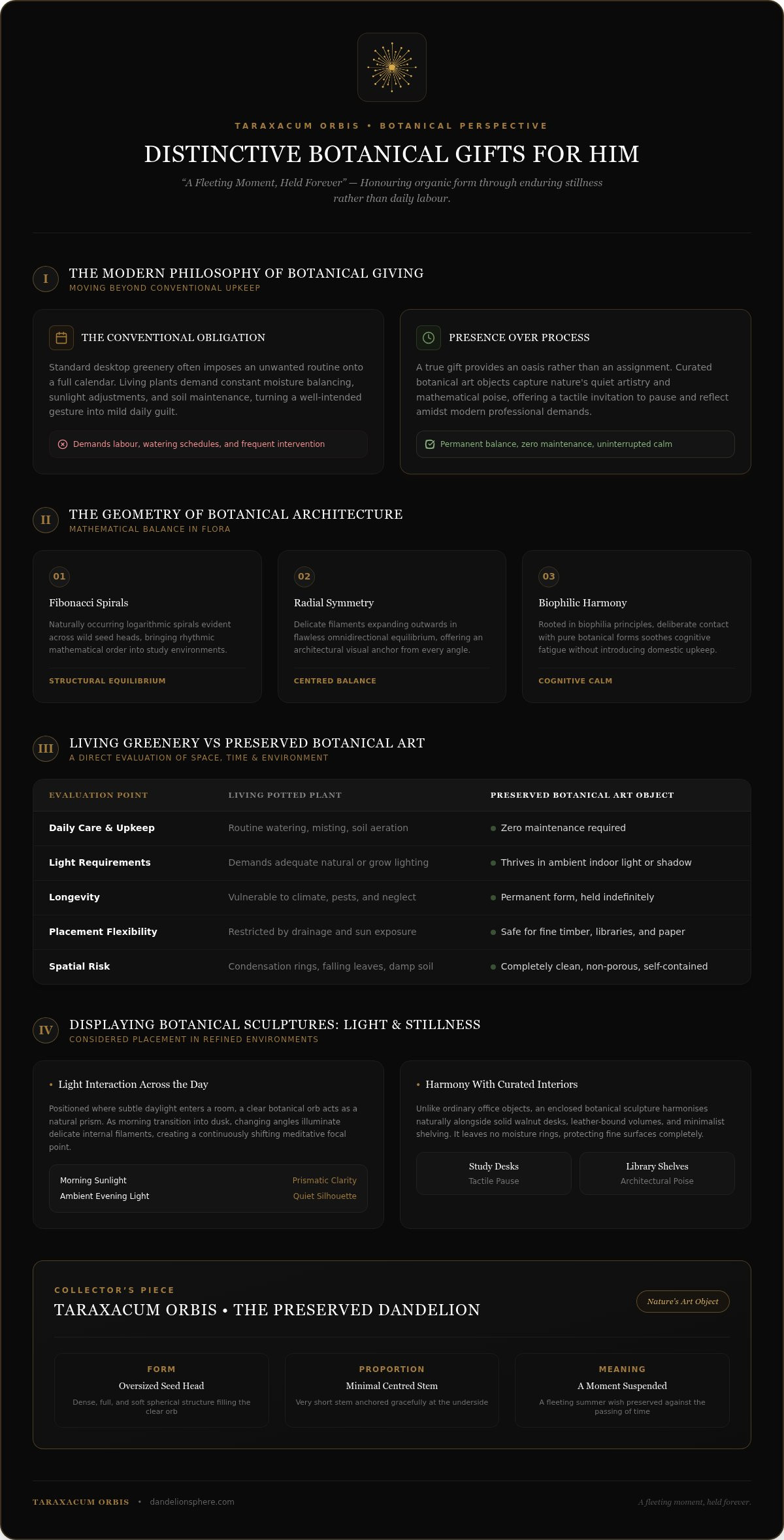
| Consideration | Living Potted Plant | Preserved Botanical Art |
|---|---|---|
| Daily Care | Routine watering, misting, soil aeration | Zero maintenance required |
| Light Requirements | Demands adequate natural or grow lighting | Thrives in ambient indoor light or shadow |
| Longevity | Vulnerable to climate, pests, and neglect | Permanent form, held indefinitely |
| Placement Flexibility | Restricted by drainage and sun exposure | Safe for fine timber, libraries, and paper |
The Realities of Living Houseplants
Living greenery responds constantly to shifting seasons. Winter radiators sap ambient moisture, turning lush fronds brittle; autumn light levels drop, prompting sudden leaf shed. Frequent travel complicates these fragile balances. Potted soil also introduces dampness, creating condensation rings on walnut desks and threatening nearby archival documents. When vitality slips away, the recipient feels disappointment rather than gratitude.
The Timeless Permanence of Preserved Botanical Sculptures
Preserved botanicals offer a sanctuary of absolute calm. Drawing upon refined techniques for preserving plant materials, these works freeze a fleeting moment at its peak of structural poise. No soil, no pests, no fallen leaves. The delicate seed head or sculpted bloom rests untouched by drought or seasonal decay. Discover more about choosing these lasting forms in The Poetry of Giving, or explore our collection of botanical art objects to find a piece that honours his space with quiet, timeless presence.
Curating the Right Botanical Gift for His Personal Space
A room speaks before anyone enters. A personal study, a private library, or an executive desk communicates values, discipline, and aesthetic rhythm. When choosing botanical gifts for him, the objective is never mere ornamentation. Instead, the piece must harmonize with his interior landscape and quiet inclinations. Rather than categorising presents by room type or gardening difficulty, consider the mind of the man who inhabits the space.
Each botanical form carries its own emotional weight. A linear timber branch conveys rustic earthiness; an architectural crystal globe captures absolute stillness. Identifying his visual language ensures the gift feels intentional, intimate, and profoundly enduring.
The Architectural Minimalist
He favours stark lines, open planes, and negative space. Clutter drains his focus. For him, a single botanical orb provides an organic counterpoint to industrial steel, stone, and monochrome palettes. Its curved form breaks rigid geometric boundaries without adding visual clutter. One solitary, museum-quality nature object resting on bare marble or brushed concrete offers an anchor of pure contemplation.
The Contemplative Scholar and Reader
Surrounded by cloth-bound literature, warm oak shelves, and tactile instruments, the scholar seeks meaning behind every object. A preserved dandelion seed head speaks directly to this sensibility:
- Resilience: The quiet strength of a wildflower thriving in unexpected places.
- Wishes and memory: A tactile reminder of childhood fields and fleeting summer afternoons.
- The passage of time: A delicate instant caught before the breeze carries it away.
Positioned quietly beside leather volumes or fountain pens, the dandelion treasure transforms a bookshelf into a personal sanctuary of memory.
The Modern Executive Office
Executive life demands relentless decision-making and continuous screen exposure. An executive gift should communicate quiet distinction rather than flashiness. Preserved contemporary nature art provides a restorative visual pause between meetings. For deeper insight into styling these serene elements beside warm architectural materials, read our thoughts on The Botanical Interior Accent. A curated collector’s piece offers him a moment of quiet grace, right where his most demanding work unfolds.
Displaying Botanical Sculptures: Light, Proportion, and Stillness
Light changes an object. When presenting botanical gifts for him, placement shapes the entire encounter. A botanical sculpture is not meant to sit forgotten on a cluttered surface. It is a curated point of stillness, designed to engage with the natural rhythms of his room. Where a potted plant requires direct light simply to survive, a preserved botanical orb uses light as a medium of art, transforming soft rays into a visual meditation.
Creating this gallery-like presence in an office or home library requires simple curatorial mindfulness:
- Sightline clarity: Position the piece at eye level from his favourite reading chair or primary desk angle.
- Negative space: Maintain generous breathing room around the object, preventing functional desk tools from intruding on its presence.
- Reflective dialogue: Allow ambient morning or evening light to pass freely through the crystalline geometry.
Balancing Daylight and Shadow
Positioning determines depth. Set a dandelion orb near a side-lit window where low morning sun or gentle afternoon raking light passes through the sphere. This angles illumination straight through the central botanical, casting delicate, feather-light shadows across the tabletop. The clear perimeter catches the beam, illuminating the fragile geometric architecture of each individual seed parachute. Avoid deep, unlit recesses or closed book cabinets, where intricate organic patterns stay veiled in shadow.
Material Harmony: Wood, Stone, and Botanical Clarity
The visual strength of a transparent botanical globe comes from textural contrast. Rest the piece against the deep, organic grain of aged oak, dark walnut, or Honed black slate. Warm timber grounds the ethereal clarity of the globe; cold stone sharpens its precision. Keep adjoining desk items minimal: perhaps a weighty brass pen or a single linen notebook. This stark, intentional restraint ensures the sculpture remains an inviting visual sanctuary during moments of thought. To find a centrepiece that captures this refined balance, explore our range of limited edition botanical spheres.
The Dandelion Sphere: A Fleeting Moment Held Forever
In the quiet grass of early summer, a dandelion seed head exists for only a heartbeat. A sudden gust of wind, a child’s breath, or a passing tread disperses its fragile architecture into the sky. Known botanically as Taraxacum Orbis, the Dandelion Sphere captures this final, delicate threshold and holds it in absolute stillness. Hundreds of silken parachutes remain suspended in complete geometric harmony, as though the world paused mid-breath on a warm June afternoon.
When selecting botanical gifts for him, choosing an enduring natural form alters the character of the gesture. It moves past temporary sentiment. The sphere becomes an heirloom of quiet wonder, a memory made tangible that never fades, wilts, or demands tending. It rests upon a desk or bookshelf as a lasting testament to the quiet poetry of the natural world.
The Poetry of Taraxacum Orbis
Few botanical forms carry such widespread emotional resonance. The dandelion represents fierce natural resilience, blooming in forgotten spaces and carrying the unspoken wishes of childhood into the summer sky. Preserving the spherical seed head captures that ephemeral optimism in permanent form. The delicate seed filaments never break away; their mathematical balance remains complete across the years. You can read deeper curatorial reflections on timeless design in The Botanical Art Collector Piece, exploring how still nature grounds our daily thoughts.
An Unspoken Invitation to Pause
In a world of constant motion and urgent demands, a captured dandelion sphere offers a quiet counterweight. It functions as a focal point for the eye and an unspoken invitation to take a measured breath. During intense working hours or reflective evening reading, its delicate internal geometry draws the gaze inward. Discerning visitors invariably stop, lean closer, and marvel at nature’s fragile precision held effortlessly in time.
Whether marking a notable personal milestone, celebrating a career transition, or simply offering a gesture of profound appreciation, this collector’s piece speaks with understated grace. Explore the complete curated gathering at the Dandelion Sphere shop to discover an enduring natural treasure for his space.
Honouring His Space with Nature’s Quiet Permanence
Selecting botanical gifts for him needn't involve the delicate anxieties of wilted leaves, parched soil, or strict lighting demands. True natural elegance doesn't impose daily domestic chores. By choosing preserved botanical art over fragile potted flora, you offer an enduring sanctuary of calm that enriches his study or executive desk indefinitely.
The Dandelion Sphere embodies this philosophy in absolute harmony. Real dandelion seed heads rest suspended in complete, unblemished geometric symmetry, entirely unaffected by shifting seasons or low indoor light. It requires zero watering, pruning, or care, leaving only pure stillness and wonder. Treasured by collectors and lovers of fine botanical art, each piece turns an ephemeral summer memory into an enduring anchor of peace.
Invite quiet poetry and timeless natural poise into his personal environment today. Discover the Dandelion Sphere Collection to select a meaningful botanical art object that remains held forever.
Frequently Asked Questions
Why choose a preserved botanical sculpture over a living houseplant for him?
A preserved botanical sculpture removes the quiet burden of watering schedules, pest monitoring, and leaf drop. When selecting botanical gifts for him, an enduring piece offers the calming presence of nature without demanding horticultural skill or natural daylight. It never wilts in a dim library or dries out during travel. The recipient enjoys complete peace of mind, contemplating pure organic form that remains pristine across the changing seasons.
How does a Dandelion Sphere maintain its shape without seeds detaching?
Each real dandelion seed head is gathered at peak maturity and stabilised through an exacting preservation method. Suspended entirely within crystal-clear geometric clarity, every individual filament remains frozen in place. The delicate parachutes cannot detach, drift, or collapse. This delicate balance holds the bloom in complete structural perfection, offering an uninterrupted three-hundred-and-sixty-degree view of nature’s intricate geometry forever shielded from the touch of wind or time.
Where is the ideal place in a study or office to display botanical art?
The ideal setting is an uncluttered surface that catches ambient, indirect daylight, such as a solid timber desk, an open credenza, or a bookshelf alcove. Positioning the piece at seated eye level creates a quiet focal point during contemplative pauses. Allowing morning or afternoon sun to glance across the sphere highlights its internal seed patterns, whilst contrasting the clear globe against dark oak or slate brings out its architectural poise.
Does a preserved botanical gift require any cleaning or ongoing maintenance?
Preserved botanical art requires no water, pruning, or feeding. Because the fragile seed head is completely sealed within its crystalline sphere, it remains entirely immune to humidity, dry indoor air, and dust. The only care required is an occasional gentle wipe across the outer surface using a soft, dry microfibre cloth to remove stray fingerprints. It offers an enduring natural presence that remains effortless year after year.
What is the symbolic meaning of giving a dandelion as a gift?
A dandelion seed head carries timeless symbolism, representing resilience, perseverance, and quiet optimism. Across cultures and childhood memories, it evokes the simple act of making a wish before the wind scatters the seeds into the sky. Presenting a preserved dandelion captures that fleeting optimism and holds it indefinitely. It serves as a gentle reminder of cherished memories, quiet ambition, and the enduring beauty found in the most fragile moments of life.
Can botanical art objects sit in direct sunlight without fading or discolouring?
While botanical art objects interact beautifully with ambient room light and gentle morning rays, prolonged exposure to intense, unshaded direct sunlight is best avoided. Gentle, diffused light reveals the intricate filaments and preserves crystal clarity over decades without heat buildup. Placing the piece slightly offset from south-facing window sills ensures the organic specimen and its clear housing retain their pristine, gallery-worthy appearance indefinitely.
What makes botanical sculptures appropriate for an executive office or workspace?
Executive workspaces require objects of distinction that project calm authority without introducing visual clutter. Botanical sculptures offer clean geometric lines, organic symmetry, and zero moisture risks near important paperwork or fine timber desks. As botanical gifts for him, they introduce a restorative biophilic presence into high-focus spaces, prompting a momentary pause to reset cognitive clarity. They serve as quiet conversation pieces that celebrate intellect, nature, and understated taste.
Disclaimer
The content on this website is provided for inspiration and informational purposes only. Articles reflect the philosophy and storytelling of Dandelion Sphere and are not intended as professional advice. While every effort is made to ensure accuracy, no guarantees are given regarding completeness or current applicability.


