

A wish can travel farther than the breath that releases it. The dandelion wish meaning comes from a gentle tradition: floating seeds carry dreams on the wind, and a drifting seed may bring luck or a message to someone dear. In folklore, people silently make a wish before blowing the seeds from a dry, open head.
There’s a reason this small ritual lingers in the memory. A familiar field becomes a place of possibility, and a fleeting seed becomes a thought set free. The dandelion’s brief change from golden flower to pale sphere gives the wish its quiet poetry.
Here, we explore what dandelions symbolise, why people make wishes on them, and how their seeds became linked with luck and messages. We trace the meaning through folklore and childhood ritual, then consider why such a delicate moment can stay with us long after the seeds have disappeared.
Key Takeaways
- Explore how the dandelion’s changing forms have gathered meanings of hope, happiness and persistence.
- Discover the folklore behind dandelion clocks and the small games once played with their seed heads.
- Learn why making a wish before blowing a seed head became a lasting childhood ritual.
- See how drifting seeds came to represent luck, affection and messages carried on the wind.
- Consider how a preserved dandelion can hold the memory of a fleeting moment close.
What does a dandelion symbolize?
A dandelion can carry several meanings at once: hope in its seeds, persistence in its return, and healing in traditional plant lore. Its familiar change from yellow flower to white seed head has shaped folklore, games and wishes across generations.
Traditional Dandelion Folklore and Games
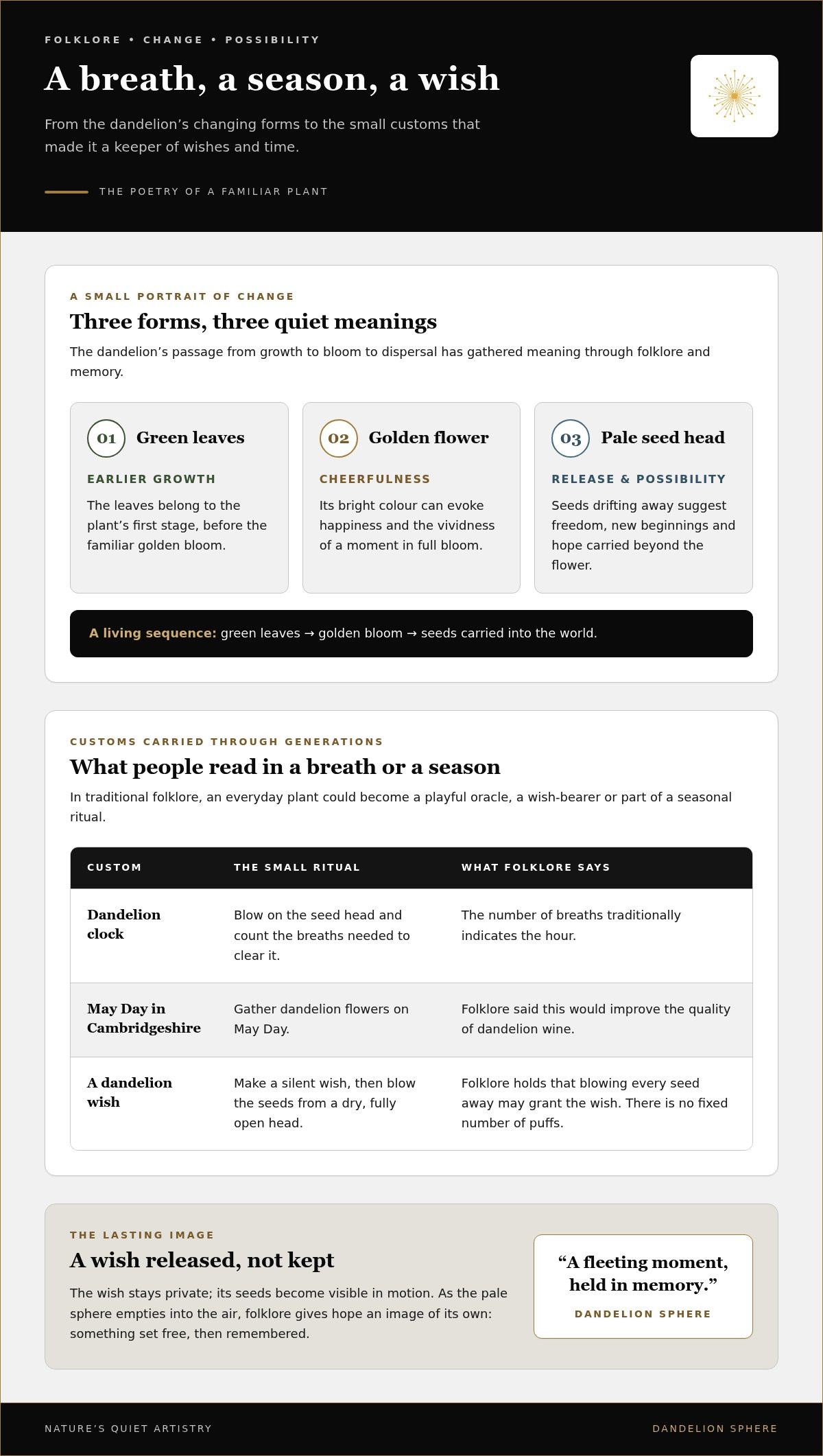
Traditional dandelion folklore turns the flower into a small oracle, with playful ways to read time and fortune. In the dandelion clock game, someone blows on the seed head and counts the breaths needed to clear it. That number traditionally indicates the hour.
Other customs attach meaning to particular days. In Cambridgeshire folklore, gathering dandelion flowers on May Day was said to improve the quality of dandelion wine. Such games bring an everyday plant into remembered rituals, where a breath or a season becomes part of a story.
The dandelion’s symbolism also touches on healing. European and Native American cultures have used dandelions in traditional medicine, and the leaves, roots and flowers are edible. These histories show how people have regarded the plant not only as a fleeting image, but as something woven into daily life.
Traditional uses are cultural history, not medical advice. Herbal traditions have associated dandelions with liver support, diuretic effects and soothing skin ailments; modern herbalism also uses dandelion tea for vitality. The contrast is striking: the same plant can represent a playful wish and care in household tradition.
Origins of the Dandelion Wish Tradition
There is no single named origin for the dandelion wish tradition. Its familiar form begins with a simple encounter: a dry, open seed head, a quiet wish and a breath that sends the seeds into the air. Folklore holds that blowing every seed away may grant the wish.
This simple sequence gives the ritual its lasting shape. The wish stays private, while its seeds become visible in motion. Unlike a written promise, it leaves no words behind; instead, the image of a wish carried on the wind becomes the memory. That sensory simplicity helps explain why many people remember the custom from childhood.
Dandelion Wishes and Other Wishing Traditions
A dandelion wish differs from traditions centred on a spoken request or a fixed object because it joins intention to a living seed head and a breath. The custom asks for a silent wish before the seeds are blown from a dry, fully open flower.
That distinction matters: letting go becomes part of the wish itself. A candle holds a flame, and a written wish preserves words, but dandelion seeds scatter out of sight. In folklore, their movement offers an image of hope released rather than kept close. The dandelion’s changing forms make that meaning especially vivid.
Dandelions as symbols of persistence and happiness
A dandelion moves through distinct forms: green leaves, a golden flower, then a pale seed head. This change has made it an image of renewal, persistence and the lightness of happiness.
The common dandelion, Taraxacum officinale, is a pioneer species. It is among the first plants to return after disturbance, including wildfires. Its appearance in a changed landscape can suggest renewal: life finding a way to begin again. The symbolism comes from its growth, not from a promise that every difficulty will pass quickly.
Each stage offers a different interpretation. The flower’s bright colour can evoke cheerfulness; the seed head suggests release and possibility. The leaves belong to the plant’s earlier growth, before the familiar golden bloom appears. Together, these forms make the dandelion a small portrait of change: a beginning, a moment in full colour, and a dispersal into the world.
In the United States, April is the Month of the Military Child. Dandelions can symbolise persistence and happiness in reflections on military children, whose lives may include change and separation. Their return after disturbance gives the flower a resonant image of resilience. This is symbolism, not a claim that a plant can describe every child’s experience.
Cultural Meaning of Dandelion Seeds
Dandelion seeds often suggest possibility because each can drift away from its parent plant. In cultural imagination, that movement can stand for freedom, change and new beginnings. A child watching seeds scatter across a lawn sees one flower become many distant possibilities. This symbolism gives a familiar plant a language for life beyond the place where it began.
The seed head also shapes how people remember the dandelion. A golden flower becomes a delicate sphere, then empties into the air. That visible passage invites people to connect the plant with happiness and impermanence. Its seeds do not stay gathered around the flower; their scattering is the image through which hope takes flight.
Dandelions as Symbols of Hope
Dandelions symbolise hope through their return and transformation. A pioneer species appearing after a wildfire offers a concrete image of growth after disruption. The plant does not erase what happened; it marks the possibility of life continuing in an altered landscape.
Its changing forms deepen that meaning. Green leaves lead to a yellow bloom, then to seeds carried beyond the parent plant. For a reader, this sequence can be a quiet reminder that change may hold beginnings as well as endings. Those drawn to keep this natural symbol close can explore preserved dandelion pieces, where a fleeting form becomes a lasting point of reflection.
Why is a dandelion called the wish flower?
The name comes from folklore linking the drifting seeds with private hopes. There’s no fixed number of puffs; the custom isn’t a measured formula.
Wishes on Dandelion Seed Heads
The seed head gives a wish a visible companion: a delicate form that changes as its seeds depart. This helps explain the custom’s hold on the imagination. A thought is private, yet the scattering can be watched. The dandelion wish meaning lies partly in this contrast between what remains inward and what is released into the open air.
In Kate Greenaway’s 1884 Language of Flowers, the dandelion is listed as “Rustic oracle”. The phrase places it within a tradition of reading signs in familiar plants. It offers a literary glimpse of how the flower could invite interpretation, beyond the childhood pleasure of watching its seed head change.
Puffs, Seeds and Dandelion Wishes
No standard puff count defines the custom. The number of breaths can vary with the seed head, the person blowing and the air around them. The ritual is remembered as a personal encounter, not a precise test. Its small uncertainty leaves room for each person’s own sense of meaning.
The dandelion wish meaning can also be understood through the flower’s place in oral tradition. Stories pass between generations, and details may shift as they are retold. One child may remember the pause before blowing; another may remember pale seeds against the sky. Both memories can keep the custom alive without requiring identical words or actions.
Calling the dandelion a wish flower names a moment rather than guarantees an outcome. The phrase brings the flower, the seed head and the act of imagining together in one familiar idea. It can make a passing encounter feel deliberate: a pause in a garden, a quiet thought, then the sight of seeds moving away.
Greenaway’s “Rustic oracle” offers a different lens. An oracle suggests interpretation, while “rustic” places that meaning in ordinary nature. Together, the words hint at why a dandelion can feel significant without ceremony. The field becomes a place for attention, and a small plant becomes a prompt for thought.
That is the wish flower’s enduring appeal. Its name doesn’t require one story or belief. It leaves space for childhood memories, private hope and the simple pleasure of noticing a familiar plant. A dandelion can be ordinary and meaningful at once, its quiet symbolism carried in a name that continues to invite imagination.
Dandelion beliefs about luck and sending messages
In dandelion folklore, a seed can carry more than the plant it came from. It may be read as a sign of good fortune or as a quiet way to express a thought.
Dandelions and Beliefs About Luck
Luck enters these beliefs through chance: a seed drifts into view, and someone chooses to treat the encounter as meaningful. Folklore doesn’t make the seed a reliable predictor. Instead, it gives an ordinary moment a hopeful interpretation, leaving the observer to decide what the sight means to them.
This distinction matters. A dandelion seed’s arrival can feel personal without proving that fortune has changed. The belief offers a way to notice possibility in a small event, much as someone might welcome an unexpected sign on a difficult day. Its value lies in the meaning a person finds, not in a promised outcome.
The seed’s movement also makes luck feel fleeting. A gust may carry it past before it can be caught; a pause may be all the encounter allows. That brevity suits a symbol of chance, imagined as something that appears without warning and cannot be held to a schedule.
Folklore leaves room for interpretation. One person may see a fortunate moment, while another simply watches the seed move through the air. Neither response changes the plant. The story lives in the attention brought to it, and in the human wish to find meaning in unexpected encounters.
Dandelions as Messengers
In one folk belief, the dandelion is a way to send an imagined message. The seed’s movement gives a thought direction, making the plant a poetic messenger rather than a practical way to communicate.
This idea gives motion to feelings that might otherwise remain unspoken. The wind carries the visible seeds, while the meaning belongs to the person who sends them. The recipient need not see or understand the gesture for it to matter to the sender.
Unlike a written note, a drifting seed leaves no words to preserve or interpret. Its passage is brief, and its destination uncertain. This contrast makes the custom an image of affection held lightly: an intention offered without asking for an answer.
Together, beliefs about luck and messages turn a passing seed into a prompt for reflection. One interpretation looks towards what might happen; the other gives shape to a thought directed beyond oneself. Both begin with the same small sight, then take on meaning through attention and imagination.
Dandelion seeds as signs of luck
A dandelion seed’s slow, delicate flight gives its associations with luck a visible form. Each seed carries a fine tuft of bristles, like a tiny parachute. The airy shape catches moving currents, allowing the seed to drift rather than fall straight to the ground. In folklore, that gentle passage can seem like a sign arriving by chance, though its meaning belongs to the person who notices it.
A seed’s small tuft has about 100 to 110 bristles. Together, they form a light canopy that helps keep the seed aloft. Researchers have found this structure can keep a seed floating about four times as efficiently as a parachute-shaped structure of similar mass. The effect is easy to picture: a seed turns in the air, pauses, then glides onward.
That movement can carry a seed beyond the place where it grew. Dandelion seeds often travel a kilometre or more, carried by air currents over lawns, paths and garden walls. Their destination is hard to follow once they rise above the ground. For an observer, the unseen journey offers a natural image of possibility: a small beginning moving towards a place yet to be known.
The longest known passive flight of a dandelion seed is up to about 100 km (62 miles). This is an exceptional recorded distance, not a typical journey. Still, it shows how far an unhurried current can take something so light. A seed may vanish from sight within moments, whilst continuing its passage well beyond the field where it began.
The air shapes the departure. In damp conditions, the seed’s bristled tuft draws closer together, so fewer seeds lift away. In drier air, the tuft opens and catches moving air more readily. The plant’s quiet response to weather makes each release feel particular: wind, moisture and timing all influence what the eye sees.
This natural movement adds quiet nuance to the seed’s symbolism of luck. The seed doesn’t choose its route, and the breeze doesn’t promise where it will land. Yet its flight can invite a hopeful reading: a small event crossing one’s path, carried by forces beyond view. The symbolism comes from human attention meeting a real journey through open air.
Seen closely, the floating seed is not a message from fate but a remarkable traveller. It rises, turns and moves on, sometimes beyond the observer’s sight. The brief encounter can still feel fortunate, not because it predicts what comes next, but because it brings a moment of wonder to an ordinary day.
For a lasting reminder of that fleeting form, explore preserved dandelion pieces, where the seed head remains a point of reflection.
Taraxacum Orbis - Dandelion Sphere: Dandelion Spheres
Taraxacum Orbis - Dandelion Sphere offers a way to keep the dandelion’s fleeting form close. A Dandelion Sphere holds a real dandelion in a still moment, a quiet reminder of the wishes, memories and meanings gathered around its seeds.
For those drawn to nature’s delicate symbolism, Botanical Art Objects and Dandelion Cubes offer other ways to preserve this botanical moment. A Dandelion Sphere can also be a Luxury Gift Object, chosen to mark a memory or share a feeling without many words.
These pieces don’t grant wishes; they give a passing image a lasting place in daily life. Explore the collection or get in touch at dandelionsphere.com.
Let the wish linger
A wish need not be measured by what follows. Sometimes its meaning lives in the pause before a breath, or in a childhood memory that returns with the changing seasons. The dandelion wish meaning may be found in that quiet space: a thought released, then carried gently beyond sight.
Some moments are too delicate to hold in the hand, yet they can stay with us. A preserved botanical form offers one way to keep the feeling close, not as an answer to a wish, but as a reminder of what inspired it.
If you’d like to find a nature-inspired piece that speaks to your own memories, explore the Dandelion Sphere collection. Let the small wonder of a floating wish accompany you into whatever comes next.
Frequently Asked Questions
What does it mean when a dandelion seed lands on you?
In Scottish folklore, a drifting dandelion seed landing within reach could be seen as a sign of luck and a chance to make a wish. Aberdeen folklore calls a caught seed a “hairy witch”, with a similar association. These are local folk interpretations, not a universal code. If a seed settles on your sleeve, treat it as a small prompt to pause and notice the moment.
What does making a wish on a dandelion mean?
Making a wish on a dandelion means giving a private hope a quiet moment of attention. The custom invites you to hold a thought inwardly, then let the seeds go. For example, someone marking a new beginning might wish for courage or patience. The ritual’s meaning comes from the intention you bring to it, not from a fixed promise about what will happen.
Why do people blow dandelion seeds to make a wish?
People blow dandelion seeds because the breath turns a hidden wish into a visible, fleeting act. The seeds lift away from the flower and travel wherever the air takes them, making release part of the ritual. A child in a garden, for instance, can watch the wish become a cloud of moving seeds. That simple image gives the custom its sense of wonder and possibility.
What is the folklore behind dandelion wishes?
Dandelion wish folklore includes the belief that blowing away every seed from an open head grants a wish. Another tradition treated the remaining seeds as a prediction of a person’s lifespan. In Kate Greenaway’s 1884 Language of Flowers, the dandelion appears as “Rustic oracle”. These different interpretations show how the plant became a source of playful fortune-telling as well as a wishing ritual.
What do dandelions symbolize in different cultures?
Dandelion meanings vary across local traditions rather than forming one shared cultural rule. Scottish folklore links catching a drifting seed with luck; Aberdeen stories call one a “hairy witch”. Cambridgeshire folklore connects May Day flowers with dandelion wine. These examples show the plant becoming part of different aspects of daily life, from seasonal customs to playful beliefs. A dandelion’s meaning depends on the story told around it.
Are dandelion wishes associated with love or luck?
Yes, folklore connects dandelions with both affection and luck, though in different ways. One belief imagines blowing a seed head towards a loved one as a pictured message. Scottish and Aberdeen traditions associate catching a drifting seed with good fortune and wishes. Someone thinking of a friend might read the same drifting seed as a tender gesture, while another person sees a lucky encounter.
How do you make a wish on a dandelion step by step?
Folklore describes a simple sequence centred on a dry, fully open seed head. Make the wish silently before blowing, so the gesture remains personal.
- Choose a dry seed head with its seeds open.
- Hold one wish quietly in mind.
- Blow gently and watch the seeds drift away.
Some tellings focus on whether every seed leaves the head; the ritual is a custom, not a fixed test.
Are dandelion wishes connected to children’s rhymes or sayings?
Dandelion wishes are often passed on through spoken customs and childhood play, rather than through one definitive rhyme. Adults might tell a child to make a silent wish before blowing a seed head. Other sayings attach beliefs to particular moments, such as the British May Day story about sniffing a dandelion. The words vary between families and places, but the flower makes the lesson easy to remember.
Disclaimer
The content on this website is provided for inspiration and informational purposes only. Articles reflect the philosophy and storytelling of Dandelion Sphere and are not intended as professional advice. While every effort is made to ensure accuracy, no guarantees are given regarding completeness or current applicability.


