The Poetry of the Passing Season
Think of a golden afternoon in June. The air, thick with the scent of sun-warmed earth and distant, cut grass. A low sun casting long shadows across a meadow. This is the quiet ache of summer at its peak. A moment so perfect, so fleeting, that the heart wishes to hold it. To keep it from fading into memory.
Nature is the first sculptor. It shapes the intricate fan of a fern, the perfect spiral of a shell, the delicate architecture of a single seed head. We are drawn to these forms, not as souvenirs, but as fragments of a story. An object that holds the echo of a place. The memory of a feeling. It is in this search for connection that we move beyond mere objects and seek pieces that resonate with the soul. A tangible piece of a golden afternoon.
- The gentle melancholy of summer’s end and the deep desire to hold a perfect moment.
- Nature as the original artist, revealed in the complex geometry of a dandelion clock.
- Moving beyond the temporary keepsake to discover an object that holds personal meaning.
- The profound link between memory, nostalgia, and the art we choose to live with.
A Moment Suspended in Time
We are drawn to the ephemeral. The brief life of a blossom. The singular flight of a seed on the wind. There is a quiet poetry in things that are not meant to last. A handmade nature sculpture does not seek to replicate this wildness, but to honour it. It takes a single, unrepeatable second and gives it permanence.
This is the journey of a botanical specimen. From a sunlit meadow, alive with the hum of insects and the sway of tall grass, to a quiet interior. A space of contemplation. The botanical orb becomes a vessel for that transition, capturing a breath that would otherwise be lost to the breeze. It holds not just a flower, but the stillness of the afternoon in which it was found.
The Beauty of Impermanence
To find permanence in the fragile is a quiet revelation. The dandelion, a sphere of near-weightless filaments, is a study in impermanence. It exists in a state of perfect readiness to disperse, to end. To preserve this form is an act of hushed reverence. It requires an artist to see the enduring structure within the fleeting beauty.
This is nature’s quiet artistry. An invitation to slow down. To observe. To reflect on the cycles of the world outside our windows. Growth, stillness, and preservation. A handmade nature sculpture is a meditation on this cycle, a testament to the profound beauty found in the most delicate of forms. It is a piece of a season, held forever.
Nature’s Quiet Artistry: The Architecture of a Seed
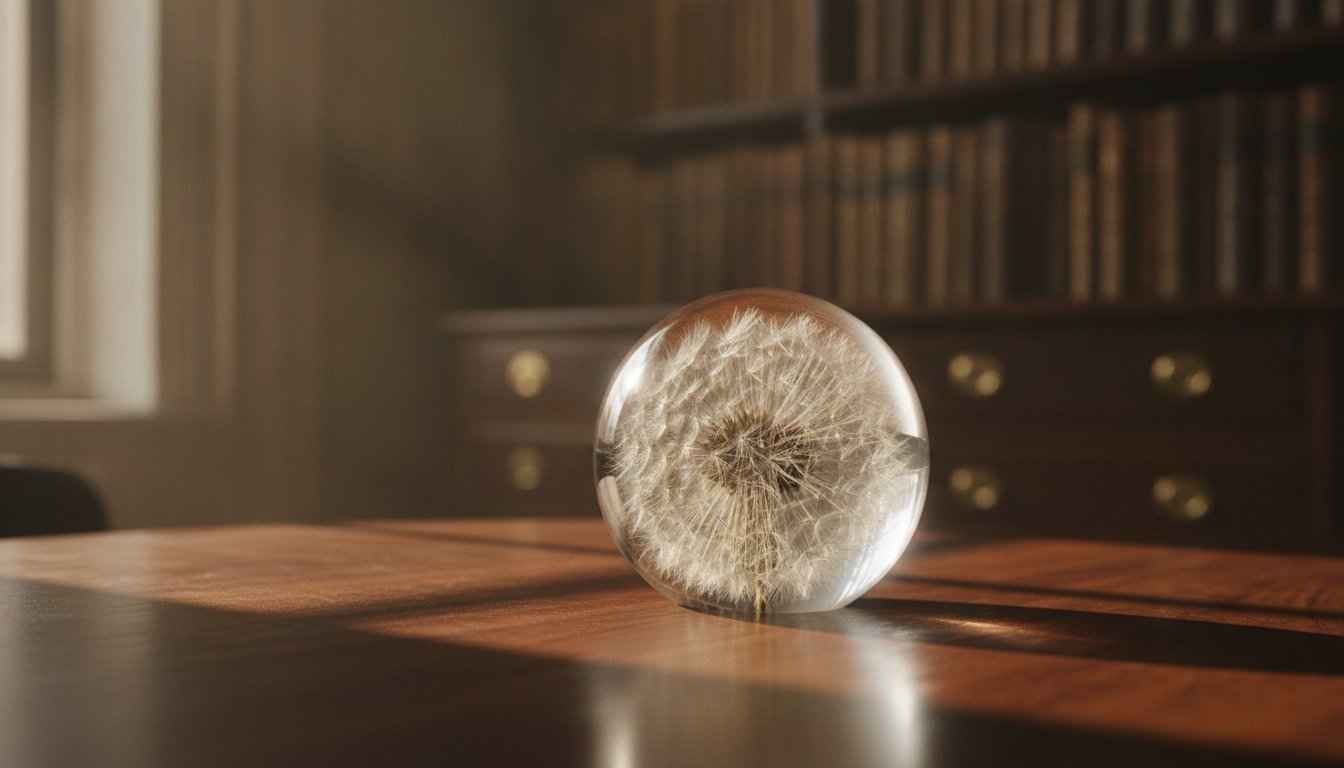
Nature’s quiet artistry is the inherent perfection found in the wild. It is the flawless symmetry in a snowflake. The gentle curve of a river-worn stone. It is the complex, geometric sphere of the dandelion clock, a form so light that a single breath could return it to the earth. We call this a Taraxacum Orbis—a small world of interconnected seeds, each a tiny promise of renewal.
To observe it closely is to witness a marvel of natural design. A constellation of filaments, each poised for flight. The challenge is not to create this beauty, but to preserve it. To capture a form so delicate it seems almost an illusion. This is the work: to take a common wildflower, a familiar face of the fields, and present it as a museum-quality nature object, worthy of deep contemplation.
- Defining nature’s quiet artistry: the innate geometric perfection in botanical forms.
- Observing the Taraxacum Orbis as a study in natural symmetry and lightness.
- The immense challenge of preserving a structure that a single breath could shatter.
- The transformation of a common wildflower into a timeless, fine botanical art object.
The Alchemy of Stillness
The process is one of stillness. Of patience. It involves waiting for the perfect moment, when the seed head is at its most complete, its most radiant. It is a silent collaboration between the artisan and the season. Each dandelion is selected not just for its form, but for its character. A unique expression of a summer’s day.
The goal is absolute clarity. A flawless sphere that allows light to pour through, illuminating every tiny filament and delicate parachute. It is through this clarity that the viewer can truly see the specimen, unadorned and perfect. This is the alchemy: the transition from a living, breathing plant, subject to the whims of the wind, to a timeless botanical sculpture held in a state of peace. It's a journey explored in the poetry of preservation.
Honouring the Natural Form
Our philosophy is simple: we do not decorate nature. We reveal it. The dandelion seed head is already a masterpiece of design. The artisan’s role is not to add, but to protect. To create a silent space in which the natural form can be appreciated without distraction. The crystal-clear orb is a window, not a frame. It disappears, leaving only the delicate architecture of the seed head.
This approach requires immense patience. It is a slow, deliberate curation of natural wonders. Each finished piece is a testament to this quiet work, a reflection of the belief that nature, in its purest state, is the most profound art we can ever hope to witness. It is an honouring of the wild, a commitment to presenting its delicate poetry with honesty and reverence.

Choosing a Collector’s Piece for the Modern Home
In a world of mass-produced objects, there is a growing desire for things with soul. A collector’s piece is more than an item of interest; it is a story, a fragment of time, an object with emotional weight. A handmade nature sculpture distinguishes itself by its uniqueness. It is not a replica. It is a singular moment from a meadow, an unrepeatable piece of natural history curated for your personal gallery.
To be a collector is to be a storyteller. You curate a life surrounded by objects that speak to you, that hold meaning beyond their form. A botanical orb is a conversation piece that transcends trends. It speaks of seasons, of wishes, of the quiet beauty of the wild. To give one as a gift is to offer something truly profound: a wish held forever, a memory of a golden afternoon made tangible.
- The distinction between a mass-produced item and a true statement object with a story.
- The role of the collector as a curator of a personal gallery of natural history.
- Why a botanical orb serves as a timeless conversation piece, immune to fleeting trends.
- The emotional significance of gifting a "wish held forever."
The Statement Object in Minimalist Design
Minimalist design is not about emptiness; it is about intentionality. It is about creating space for what truly matters. In such a space, a single, perfect sphere can anchor a room’s energy. It draws the eye, invites closer inspection, and holds a quiet power. A handmade nature sculpture becomes a focal point for contemplation.
There is a dialogue between the object, the light, and the space it inhabits. As the sun moves through the room, light travels through the orb, casting shadows and illuminating the delicate seed head within. It brings a dynamic, living quality to the quietest corner. It is more than an object; it is a botanical interior accent that connects the sanctuary of the home with the wildness of the meadow.
A Memorable Gift for the Nature Lover
The most memorable gifts are those that reflect a deep understanding of the recipient. For someone who finds solace and wonder in the natural world, a botanical sculpture is a profound gesture. It is an acknowledgement of their love for the wild, a piece of the outdoors brought inside, permanently.
The dandelion itself is a powerful symbol. It speaks of resilience, of hope, of childhood wishes cast to the wind on a summer breeze. To give a Taraxacum Orbis is to give more than a beautiful object. It is to give a legacy. A fragment of a summer day, a story of a fleeting moment captured by an artisan, a wish held in perfect, eternal stillness.
Creating a Sanctuary with Botanical Art
The placement of art is itself an art form. A botanical orb is an object of serenity, and its position in a room should enhance this quality. Placed on a windowsill, it can catch the morning sun, scattering light and revealing the intricate details of the seed head. It transforms a simple beam of light into a moment of quiet spectacle.
To create a true sanctuary, pair these nature’s art objects with other natural materials. The smooth, cool sphere rests beautifully against the warm grain of wood, the textured surface of stone, or the soft weave of linen. On a desk, a bookshelf, or a bedside table, it can become a Zen focal point—a small, silent invitation to pause, to breathe, and to reconnect with the quiet rhythms of the natural world.
- The art of placement: positioning your botanical orb to catch the light and create serenity.
- Using natural light to illuminate the fine, intricate details of the preserved seed head.
- Pairing nature’s art with materials like wood, stone, and linen to enhance a tranquil atmosphere.
- Creating a "Zen focal point" on a desk or bedside table for moments of mindfulness.
The Desk’s Quiet Companion
In the digital landscape of a modern workspace, the mind craves moments of analogue peace. A nature sculpture on a desk can provide this. It is a quiet companion during a busy day, a small portal to a calmer, wilder world. Its smooth, spherical form is pleasing to the touch, a tactile anchor in a world of screens and notifications.
To allow this botanical sculpture to truly have an impact, give it space. Organise your desk to create a small island of calm around it. Let it be a point of visual rest, a reminder of the beauty that exists beyond the demands of work. It is a sphere of stillness in a world of constant motion.
Curating a Living Room Gallery
A single botanical orb is a poem. A collection is an epic. Grouping several botanical sculptures together allows you to tell a larger story—of the changing seasons, of different meadows, of a series of moments captured in time. Place them at varying heights on a mantlepiece or within a display cabinet to create a gentle, flowing narrative.
As with any gallery, "white space" is essential. The space around your collector’s pieces is as important as the objects themselves. It gives them room to breathe, to be seen, to be appreciated as individual works of art. By curating your collection with care, you transform a simple display into a personal museum of natural history, a quiet gallery of stillness. For those looking to begin, exploring the philosophy of the botanical art collector piece is a wonderful place to start.
Taraxacum Orbis: A Fleeting Moment Held Forever
The Taraxacum Orbis is the ultimate expression of this philosophy. It is the dandelion sphere, a perfect seed head held in a moment of eternal stillness. It is the culmination of a quiet, watchful process, where the artisan acts not as a creator, but as a silent curator of the meadow. A guardian of a fleeting moment.
Each piece is, by its very nature, entirely unique. No two dandelions are the same. No two moments are identical. Each botanical sculpture is therefore an unrepeatable fragment of time, a singular story of a flower, a field, and a season. It is a piece of the wild, tamed not by force, but by quiet observation and a deep reverence for its natural perfection.
- Introducing the Dandelion Sphere as the ultimate expression of nature’s own artistry.
- A reflection on the artisan’s role as a silent partner and curator of the meadow.
- Why each piece is a unique, unrepeatable fragment of a specific moment in time.
- An invitation to explore our Journal for more reflections on nature and art.
The Artisan’s Hushed Process
To create a museum-quality nature object requires a quiet dedication. It is a process that cannot be rushed, a partnership with the natural world that unfolds at its own pace. We prioritise the emotional resonance of each piece, the story it tells, over the speed of production. It is a philosophy rooted in patience and respect.
This commitment is evident in the finished work. In the flawless clarity that reveals every detail. In the perfect preservation of a form so impossibly delicate. It is a testament to a hushed process, one that honours the fragility of the subject and seeks only to give it a lasting sanctuary.
Begin Your Collection
Bringing a piece of the outside world into our homes is a fundamental human desire. A handmade nature sculpture offers a way to do this not just for a season, but for a lifetime. It is a final, beautiful thought on the profound poetry of bringing the wild in, permanently.
We invite you to explore the full collection of botanical orbs. Should you wish to discuss a particular vision, please contact us to explore the possibility of bespoke botanical sculptures.
Disclaimer
The content on this website is provided for inspiration and informational purposes only. Articles reflect the philosophy and storytelling of Dandelion Sphere and are not intended as professional advice. While every effort is made to ensure accuracy, no guarantees are given regarding completeness or current applicability.


