

What if an expensive-looking room has less to do with what it contains than with what it leaves unsaid? The most considered luxury home accents don’t demand attention. They bring warmth, texture and meaning, then allow a little space around them. Thoughtful luxury home decor accents can make a room feel more personal without adding more to it.
It’s easy to wonder which details will feel refined rather than showy or out of place. A room’s quiet character often emerges through balance: the softness of natural fabrics, the depth of a thoughtful colour, the contrast of a sculptural form against an uncluttered surface. Each choice matters, but none needs to compete.
Here, we’ll explore how different accents shape a room’s atmosphere, from tactile materials and considered colour to art that becomes a gentle focal point. You’ll find practical ways to bring these elements together with restraint, and to choose a piece that holds a deeper meaning. A Dandelion Sphere, with a real dandelion preserved in a clear sphere, offers one such possibility: a fragment of nature and a quiet reminder of beauty’s fleeting nature.
Key Takeaways
- Luxury home accents feel refined through proportion, cohesion and restraint, not through price or excess.
- Use colour, texture and negative space to bring depth to a room while letting meaningful details breathe.
- Compare art, lighting, sculptural objects and botanical art by the atmosphere and presence each brings.
- Before adding an accent, observe the room and let its existing furnishings guide your choices.
- A Dandelion Sphere can offer a quiet focal point, holding a fleeting moment of nature within your home.
What Makes Luxury Home Accents Feel Expensive Rather Than Showy?
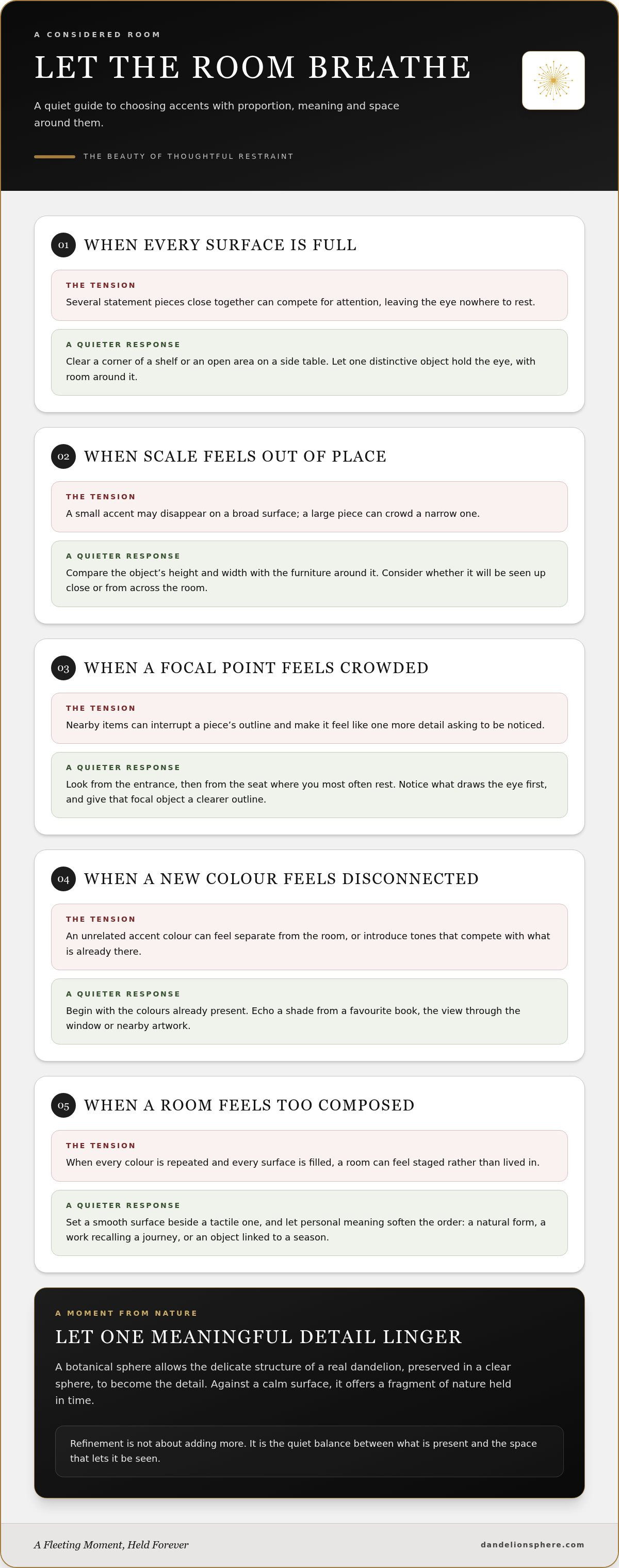
Refinement often begins with noticing what a room doesn’t need: another bright colour, one more object on the mantel. The pause left by an uncluttered surface can make the things that remain feel more present.
An expensive-looking interior isn’t defined by price. It comes from proportion, considered materials, coherence between the room’s elements and the restraint to let them breathe. A chair, a lamp and a small artwork needn’t match, but they should feel as though they belong to the same quiet conversation. These are the qualities that let luxury home accents shape a room without overwhelming it.
Visual refinement comes from harmony between an object and its surroundings. A distinctive piece can become a focal point when it has space around it. By contrast, several statement pieces placed together may compete for attention, leaving the eye nowhere to rest. The principles of interior design offer a broader context for considering how objects, space and the character of a room relate.
Which visual details suggest quiet luxury?
Consider scale first. A small accent may disappear on a broad surface, while a large piece can crowd a narrow one. Before choosing, compare the object’s height and width with the furniture around it, then consider whether it will be seen up close or from across the room. Tactile contrast adds another layer: a smooth surface beside a softly textured one, or a clear form against a quieter background. A limited palette helps these details settle together. Rather than scattering unrelated accents throughout the room, choose one distinctive object and give it room to hold the eye.
Imagine a sitting room in the late afternoon. A familiar chair catches the light; a book rests nearby; the mantel is not crowded. Nothing is arranged with perfect symmetry, yet the room feels composed. That ease matters. Refinement can welcome everyday life rather than asking it to stay outside.
How can a room feel elevated without feeling formal?
Let personal meaning soften the order. A natural form, an artwork that recalls a journey, or an object linked to a particular season can bring warmth to a carefully considered space. Its presence feels lived with, not simply placed for effect. A preserved dandelion, for instance, carries the delicate suggestion of a childhood wish and a fleeting moment held in time.
By contrast, a room can feel staged when every surface is filled, every colour precisely repeated and each object seems chosen only to complete a scheme. Welcoming restraint leaves room for change: the folded throw, the cup beside a book, the light moving across the wall. Luxury, then, is not a performance. It is the feeling that each detail belongs, and that nothing has to announce itself.
How Colour, Texture and Negative Space Shape an Elevated Interior
Light falls differently on a surface left clear. The eye settles. In a considered room, what is absent can be as eloquent as what is present.
Negative space is the unoccupied area that gives a focal object room to breathe. It creates a visual pause, allowing the form, colour and detail of a meaningful piece to come quietly into view. Clear surfaces needn’t feel bare. They can offer calm, like a patch of open sky between branches.
What role does negative space play around a statement object?
Notice the room from its entrance, then from the seat where you most often rest. What draws the eye first? Does the focal object have a clear outline, or do nearby items crowd it? A cleared corner of a shelf or an open area on a side table may be enough to give a piece its own quiet emphasis.
Resist the instinct to fill every pause. Breathing room can matter more than another accent. It lets a distinctive form feel intentional, rather than one more detail asking to be noticed.
How can colour and texture feel intentional?
Begin with the colours already in the room. A new accent might echo a shade in a favourite book, a view through the window or a small detail in nearby artwork. That relationship can make a fresh choice feel at home without changing the whole room or introducing several competing tones.
Texture brings another kind of depth. A smooth surface beside a tactile one creates gentle contrast, even when the colours remain restrained. The elements of good design, including scale, proportion, materials and colour, can be considered together rather than as separate rules. Ask how each quality contributes to the room’s overall feeling.
A botanical sphere offers one example. Its clear form lets the delicate structure of a real dandelion become the detail, while a quieter setting keeps that natural intricacy in focus. Against a calm surface, it can suggest a fragment of nature held in time, without asking the surrounding room to change around it.
Thoughtful luxury home decor accents needn’t arrive as a complete new palette or a collection of additions. Often, the more considered act is to make space for one object that feels meaningful. For those drawn to this quiet meeting of nature and form, botanical art objects offer a way to explore Dandelion Spheres and other nature-inspired pieces.
Luxury Home Accent Ideas Compared: Art, Lighting and Botanical Objects
Each accent changes a room in a different way. A framed work draws the eye upwards. A lamp shapes the light of an evening. A sculptural form gives a surface a sense of presence, whilst botanical art brings a small piece of the living world indoors. The best choice depends on what the room already holds and the atmosphere you hope to create.
| Accent | Visual role and presence | Possible placement | Atmosphere |
|---|---|---|---|
| Framed art | Wall-based; can establish a strong point of focus. | Above a sofa, mantel or console. | Expressive, reflective or quietly composed. |
| Lighting | Both practical and sculptural; its presence shifts with the light. | Beside a chair, on a table or overhead. | Intimate, softened or dramatic. |
| Sculptural object | Freestanding; shape and silhouette bring definition. | On a shelf, side table or console. | Artful and grounded. |
| Botanical art | Natural detail held in a considered form; often modest in footprint. | On a shelf or side table with room around it. | Thoughtful, delicate and connected to nature. |
These roles aren’t a ranking. A room with expressive furnishings may need no further large gesture. The right choice may be one of the quieter luxury home decor accents, placed where its detail can be discovered rather than where it competes for attention.
Which accent suits a room that already has strong furnishings?
Look at the visual footprint of what’s already there. Framed art occupies a wall; lighting adds both function and form; a freestanding sculpture claims space on a surface. If the furnishings already command the room, a botanical object on a shelf or side table can offer a finer note without adding another dominant shape. Its presence can be felt without taking over.
When does a botanical orb become the focal point?
A real dandelion held within a clear sphere draws the gaze to its intricate natural form. It can become a focal point when the surrounding area is simple enough to let that detail emerge. More than a conventional accent, it is nature’s art object: a collector’s piece carrying a fleeting moment into the everyday.
Readers drawn to collectible nature art can explore the botanical art collector’s guide. For further room inspiration, consider how botanical interior accents might sit within your own home. The most fitting object is not necessarily the boldest. It is the one whose presence feels quietly at home.
How to Curate Expensive-Looking Accents Without Overfilling a Room
A room can change through subtraction. Before bringing anything new inside, pause and look at what is already there: the familiar chair, the open stretch of a shelf, the light falling across a table. A thoughtful edit often reveals more than another purchase could.
Try this quiet process:
- Observe the room. Notice where your gaze settles, which surfaces feel crowded and what already gives the space character.
- Choose a focal point. Decide which existing feature or meaningful object deserves to lead. It might be a work of art, a treasured book or a botanical sculpture.
- Clear some space. Remove nearby pieces that compete for attention. Let the focal point have room around it.
- Assess the balance. Step back, then view the room from where you usually sit. If the arrangement feels settled, it may need nothing more.
This order matters. Working with existing furnishings first helps a room feel collected rather than assembled all at once. If you do consider a new accent, look for a quality that already belongs: a colour echoed elsewhere, a form that softens a strong line, or a natural detail that brings a different kind of stillness. That is how luxury home decor accents can feel personal, not imposed.
How do you choose a focal point for a shelf or table?
Consider how close you’ll be when you see it, what stands nearby and how much clear space the surface can offer. A small, intricate object may invite a closer look; a more pronounced form may read clearly from the doorway. Group pieces through a shared quality, such as shape, tone or a sense of age, rather than making everything match. A botanical sculpture might become the focus, but a favourite book or simple vessel could feel more at home.
How can one meaningful object make a room feel more personal?
Some objects hold more than their visible form. A preserved dandelion can call to mind childhood wishes, warm days outdoors or the first turning leaves of autumn. Its natural detail carries a story of time and impermanence, yet it needn’t dominate a room. It can simply offer a moment of recognition as you pass.
For further thoughts on placement, explore this botanical interior accent guide. When the room feels balanced, let that be enough. If a preserved dandelion feels like a fitting focal point, you can explore Dandelion Spheres as nature’s art objects, each holding a fleeting moment in view.
A Dandelion Sphere as a Quiet Luxury Home Accent
There is a small wonder in a dandelion seed head: a delicate constellation that once waited for the wind. In a Dandelion Sphere, a real dandelion is held within a clear sphere, its fleeting form resting in stillness. A moment from nature, held forever.
Among considered luxury home decor accents, its presence is quiet rather than commanding. Fine natural detail draws the eye closer, whilst the clear form allows the room around it to remain part of the composition. For collectors and nature lovers, it can be a thoughtful focal point, carrying a story of seasons, wishes and the passage of time without asking to define the whole room.
What makes a preserved dandelion feel at home in a refined interior?
There is a gentle contrast between the seed head’s intricate lightness and the stillness of the botanical orb around it. Set it where natural light can meet its detail, perhaps on an uncluttered shelf or side table. It may suggest a fragment of summer, or a childhood wish released into the air. A little space around it lets that memory made tangible feel at ease.
Its character needn’t be matched to every surrounding object. A calm surface and a few familiar forms can be enough. The sphere brings nature’s quiet artistry into the room, whilst the room gives it a place to belong.
How can a nature’s art object become part of a personal collection?
A collection grows through connection, not simply accumulation. One object may recall a garden, a changing season or the brief moment when a wish seemed possible. A Dandelion Sphere can hold these thoughts gently, offering a small pause in the day and a reminder of the beauty of impermanence. Taraxacum Orbis is the Latin name associated with Dandelion Sphere, a fitting note for a nature-inspired collector’s piece.
Some objects are chosen for their form; others stay with us for the memories they awaken. If this preserved botanical moment speaks to you, you’re warmly invited to explore the botanical sphere collection. A room needn’t hold many such pieces. Sometimes, one is enough. Some moments deserve to remain with us.
Let Meaningful Details Find Their Place
A quietly elevated room is shaped by proportion, coherence and restraint. Colour and texture bring depth; open space lets a chosen object come into its own. Before adding something new, pause to notice what the room already holds.
The most enduring accents often carry a story as well as a presence. A Dandelion Sphere holds a real dandelion flower within a clear sphere, offering a delicate connection to nature and the passage of time. For collectors and nature enthusiasts, it can be a thoughtful focal point, not because it asks for attention, but because it invites a closer look.
That is the quiet promise of luxury home decor accents: a considered detail can make a space feel more personal when it belongs to the room and to the person who lives there. Choose with care. Leave room for stillness. Let beauty be something you encounter in the everyday.
If a preserved moment of nature feels at home in your space, explore the Dandelion Sphere collection. Your home can gather meaning one thoughtful choice at a time.
Frequently Asked Questions
How can I make my home look expensive without buying all-new furniture?
Begin by editing what you already own. Clear a crowded surface, adjust the placement of a favourite chair or lamp, and allow one meaningful piece to stand out. A considered relationship between colour, texture and open space can bring a room together without replacing its furnishings. Often, the most refined change is not an addition but a pause, giving familiar things room to be seen anew.
What home accents make a room feel more luxurious?
Choose accents for the atmosphere they bring, rather than for their number or prominence. Framed art can give a wall a centre of interest; lighting can soften an evening; a sculptural or botanical piece can add a note of natural detail. Let the room guide the choice. A single object that relates to its colours or forms may feel more at home than several unrelated additions.
How do I choose a statement object for my living room?
Choose a piece that suits the room’s scale and feels meaningful to you. Consider where you’ll see it from, what already draws the eye and whether it will have breathing space. A distinctive object on a side table might suit a room with strong furnishings, whilst a quieter piece could bring interest to a calmer corner. The best choice feels connected to the room, not imposed upon it.
Can a botanical sphere suit a minimalist interior?
Yes. A botanical sphere can sit naturally within a minimalist interior, where open space allows its delicate detail to be noticed. The clear sphere holds a real dandelion flower, bringing a small trace of nature into a pared-back setting without requiring a change to the room’s palette. Placed on a quiet shelf or table, it can offer a gentle point of interest and a moment of reflection.
How should I display a botanical art object at home?
Choose a stable, uncluttered surface where the object can be seen comfortably, such as a shelf or side table. Consider the view from the room entrance and from nearby seating. A little clear space around it helps its form come forward. Natural light can reveal delicate detail, whilst a quieter setting keeps the display from feeling crowded. Let the placement feel natural to the way you live.
What is the difference between a statement accent and clutter?
A statement accent has space and purpose; clutter is what happens when objects compete without a clear relationship. Notice whether each piece adds something to the room, such as a pleasing shape, a personal memory or a connection to the palette. If several details draw the eye at once, try removing a few. The remaining objects may feel more considered, and the room more restful.
Is a preserved dandelion a thoughtful housewarming gift?
A preserved dandelion can make a thoughtful housewarming gift for someone drawn to nature and meaningful objects. Each Dandelion Sphere features a real dandelion flower held within a clear sphere, recalling the beauty of a fleeting moment. It can bring a quiet note of natural wonder to a new home, whilst carrying associations with childhood wishes, changing seasons and memories that stay with us.
Disclaimer
The content on this website is provided for inspiration and informational purposes only. Articles reflect the philosophy and storytelling of Dandelion Sphere and are not intended as professional advice. While every effort is made to ensure accuracy, no guarantees are given regarding completeness or current applicability.


