

A single breath of wind. A thousand wishes scatter into the golden light. We often try to catch these moments. We press flowers in heavy books. We take photographs that never quite capture the depth of the air. Yet, the frustration remains. The petals inevitably brown. The life fades. Finding collectible botanical art that feels alive, rather than soulless, is a rare pursuit. It requires a different perspective. One that values stillness over noise. One that seeks the eternal amongst the temporary.
You seek a sanctuary within your home. A space where time does not rush. You understand that true beauty is found in the delicate and the ephemeral. In this reflection, you will discover how to curate a nature collection that transcends simple representation. We explore the path to transforming fleeting wonders into timeless art objects. You will learn to find pieces that fit a minimalist interior whilst telling a profound story of stillness. We invite you to look closer. To see the poetry in the pause. To hold a memory made tangible.
Key Takeaways
- Understand the deep emotional connection between memory and nature, and why we are drawn to capture the ephemeral beauty of a summer meadow.
- Explore the sensory advantages of three-dimensional botanical sculptures over flat representations, adding depth and tactile wonder to your sanctuary.
- Learn how to identify high-quality collectible botanical art by prioritising the clarity of the medium and the perfect composition of the specimen.
- Discover how to select a nature’s art object that reflects your personal history, turning a physical piece into a vessel for your own stories.
- Master the art of the minimalist interior by using a single, silent statement piece to cultivate a serene, gallery-like atmosphere in any room.
The Soul of the Collector: Why We Seek Nature Collection Art Pieces
A summer meadow. Golden light. The air smells of sun-warmed grass and the cooling earth of evening. You remember the weight of a dandelion in your small hand. You made a wish. You blew into the wind. The seeds scattered, and the moment vanished. This is the origin of the collector's spirit. We seek to hold what cannot be held. We look for a way to pause the clock. The pursuit of collectible botanical art begins here. In the heart. In the memory. It's a quiet rebellion against the rush of time.
The human urge to capture the fleeting is ancient. It's a dialogue with the seasons. Whilst history often celebrates the grand, the collector of nature finds meaning in the minute. Traditionally, Botanical illustration served as a scientific record. It documented the world for the sake of knowledge. Today, we seek something deeper. We seek emotional resonance. We choose art that speaks in whispers rather than shouts. We want to feel the stillness of a morning mist. We want to touch the hem of eternity through a single, preserved breath of nature.
The Poetry of the Ephemeral
Nature is a silent teacher. It speaks in the language of cycles. Birth. Bloom. Decay. We're drawn to things that naturally fade because they remind us of our own journey. The dandelion is the ultimate symbol of this transition. It represents childhood dreams and forgotten wishes. To see one perfectly intact is a miracle of timing. It's a second of perfection. Usually, these wonders are lost to the breeze. By preserving them, we capture a story that would otherwise remain unwritten. We give a physical form to the poetry of nature. We ensure the wish remains, even when the summer ends.
Curating a Sanctuary of Stillness
Our homes are often loud. They're filled with the noise of the digital age. A nature’s art object offers a necessary antidote. It's a statement of presence. By placing a single, perfect specimen in a room, you change the frequency of the space. You create a gallery of thought. A sanctuary of stillness.
- A single botanical orb grounds the eye.
- It invites a moment of deep, mindful breath.
- It honours the past whilst remaining rooted in the now.
This is the art of the mindful curator. You don't need a hundred objects. You need one that resonates. One that tells a story of stillness. A collector’s piece from the Taraxacum Orbis collection serves as this anchor. It transforms a living space into a place of reflection. It's a physical reminder that some moments deserve to stay. They deserve to be held forever. They deserve to be part of your story.
Taraxacum Orbis: A Fleeting Moment Suspended in Time
A sphere of glass-like clarity. Within it, a miracle of geometry. The Taraxacum Orbis is not merely a depiction of nature. It is a botanical sculpture. A fusion of organic fragility and museum-quality permanence. When you hold this orb, you hold a wish in your palm. The tactile reality is striking. It is heavy. Substantial. Yet the specimen inside appears weightless. It is a moment suspended in time. A second of stillness, caught forever.
The alchemy of preservation is silent. It requires a gentle touch. The specimen is never disturbed. Never crushed. It remains exactly as it was in the field. This is the pinnacle of collectible botanical art. It offers a level of detail that a two-dimensional print can never achieve. You aren't looking at a picture. You're looking at the biological truth of the plant. Every seed. Every fine filament of the pappus. Held in a crystal-clear medium that defies the passage of years.
The Anatomy of a Botanical Orb
Look closer. Observe the delicate structure of the seed head. It is a masterpiece of natural engineering. The crystal-clear medium protects every individual seed without causing it to flutter or fail, maintaining the perfect radial symmetry of the flower. For the observer, this provides 360-degree visibility. You can rotate the piece. You can see the light pass through the seeds. It is an invitation to mindfulness. A guide for the mindful collector would suggest that the value of any specimen lies in its integrity. Here, that integrity is absolute.
From Wild Meadow to Collector’s Piece
The journey begins in the earth. A single flower. Picked at the precise moment of its maturity. From the wild meadow, it travels to the studio. There, the process of suspension begins. It is a meticulous sequence. It requires patience. The goal is permanent grace. We seek to achieve a state of stillness that transcends the changing seasons. Whilst the world outside turns from green to gold to grey, the orb remains unchanged. It is a memory made tangible. A piece of the sun, kept for the winter.
To own such a piece is to own a story of preservation. It is a commitment to beauty. You might find your own anchor amongst our limited edition botanical orbs, each one a unique testament to a single, fleeting second.
Beyond the Frame: Comparing Prints to Three-Dimensional Nature Art
A print is a memory of a memory. It lives on a wall. It is flat. It is safe. But it lacks the breath of the original. When we consider collectible botanical art, we often think of paper and ink. These have their place. They are historical. They are classic. Yet, a two-dimensional plane can only hint at the truth. It cannot hold the volume of a summer afternoon. It cannot capture the way light dances through a seed. It is a representation. Not a presence.
To observe a botanical sculpture is a dialogue of the senses. You see the form. You feel the weight. You understand the space it occupies. Major institutions have long understood the importance of preserving the fleeting moment through vast biological archives. For the private collector, the transition from paper to volume is a pursuit of authenticity. It is the difference between reading a poem and hearing the poet breathe. It is an immersive encounter with the wild.
The Depth of a Botanical Sculpture
A sphere is a lens. It catches the sun. It refracts the room. From every angle, the specimen reveals a new facet. You don't just look at it. You experience it. This interaction of light and volume creates a focal point that demands a slower pace. You cannot skim a sculpture. You must pause. You must wait for the light to hit the silk of the seed. It is a lesson in patience. A focal point that breathes amongst the chaos of a modern home.
A Comparison of Art Forms
The choice between a print and an orb is one of intent. Prints offer a visual record. Orbs offer an intimate connection to the biological reality of the plant. The longevity of a preserved specimen provides a sense of permanence that ink on paper often lacks. It is the "museum-quality" factor that defines a true nature art object.
| Feature | 2D Prints | Botanical Orbs |
|---|---|---|
| Perspective | Fixed, single plane | Immersive, 360-degree |
| Interaction | Visual only | Tactile and visual |
| Light | Surface reflection | Internal refraction |
| Nature | Representation | Biological reality |
It feels real because it is real. The dandelion inside hasn't been drawn. It hasn't been photographed. It has been suspended. This is why collectors are turning to three-dimensional nature collection art pieces. They want the truth of the field. They want a collector’s piece that transcends the seasons. A memory made tangible in three dimensions.
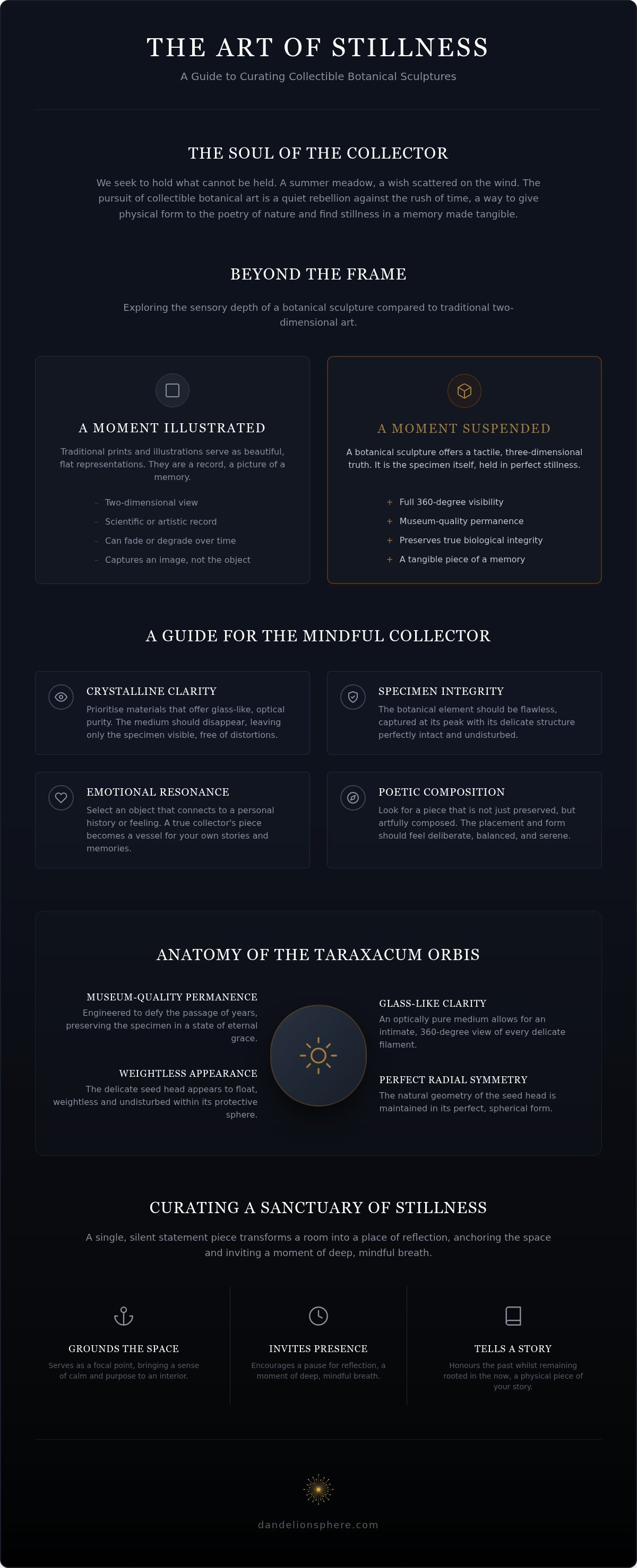
Selecting Nature’s Art: A Guide for the Mindful Collector
Selection is an intimate process. It requires a quiet mind. When you search for collectible botanical art, you aren't merely looking for an object. You're looking for a mirror. You seek a piece that resonates with your personal history. A memory of a childhood meadow. A wish made in a forgotten garden. The right piece will feel like a secret shared between you and the natural world. It's a recognition of a moment you once lived.
Clarity is paramount. In a museum-quality nature object, the medium should vanish. It should offer no distraction from the specimen itself. The composition must be natural. Unforced. If the seeds look crushed, the poetry is lost. Look for a botanical sculpture that preserves the airy lightness of the original flower. This level of artisanal quality ensures the piece remains a conversation piece for generations. It creates a dialogue between the observer and the object of stillness.
The Art of Minimalist Curation
Minimalism is the heart of curation. Less is more. A singular, perfect object holds more power than a crowded display. You might organise your collection around the passage of light. Or perhaps the changing of seasons. Integrating a botanical orb amongst other nature collection art pieces requires a gentle hand. Let the space around the object be as important as the object itself. This creates a gallery-like atmosphere in your home.
- Prioritise quality over quantity to maintain a sense of serenity.
- Group objects by their emotional weight rather than their size.
- Allow each piece of collectible botanical art enough white space to breathe.
Placing Your Piece for Maximum Serenity
Consider the path of the sun. Natural light brings the Taraxacum Orbis to life. It illuminates the fine filaments. It creates shadows that move with the day. Find a quiet corner. A place where you can sit and breathe. This is where the dialogue of stillness begins. For deeper insight into styling these moments, reflect on the botanical interior accent. It explores the delicate balance between nature and your living space.
A home should be a sanctuary. A place where time slows down. By choosing your objects with intention, you create a space that honours the ephemeral. You can begin your own journey of curation by selecting a collector’s piece that speaks to your own story of stillness.
The Dandelion Sphere: The Heart of Your Nature Collection
The collection finds its pulse here. In the centre. The Dandelion Sphere is more than a nature’s art object. It is a statement of permanence. A commitment to the quiet poetry of existence. In a world that demands speed, the sphere offers stillness. It doesn't change. It doesn't wither. It stands as a testament to a single, perfect second of summer. A moment that refused to fade. This is the cornerstone of any thoughtful collectible botanical art assembly.
Years pass. Seasons turn. The garden outside cycles through its inevitable endings. Yet, within the crystal-clear medium, the dandelion remains. It transcends the calendar. It ignores the frost. To own such a piece is to hold a gift of eternal wishes. It is a gesture of kindness to oneself. Or perhaps to a kindred spirit. Someone who understands that beauty is not found in the loud or the extravagant. It is found in the delicate. In the fragile. In the things we almost lost to the wind.
A Legacy of Stillness
Why do we choose the Dandelion Sphere? Because it represents a legacy. It is a timeless nature collection art piece that outlasts the temporary. The emotional takeaway is profound. Nature’s beauty is no longer a fleeting phantom. It is held forever. It is a physical anchor for your memories. You can explore the current collection to find the specimen that speaks to your own sense of wonder. Each orb is a unique biological signature. A silent witness to the passage of time.
The Collector’s Journey
Every journey begins with a single step. Every collection begins with a single, perfect orb. The Dandelion Sphere is the ideal starting point. It serves as a conversation piece in any space. It invites questions. It encourages a slower breath. Guests will pause. They will lean in. They will see the impossible geometry of the seeds. This is the power of the object. It forces the world to stop, if only for a heartbeat. For those seeking to deepen their understanding of this practice, we invite you to read about curating eternal stillness. It is a guide for the soul as much as the home.
The ultimate collector’s piece is not just about acquisition. It is about alignment. It is about surrounding yourself with objects that reflect your values. Stillness. Clarity. Reverence. By placing the Taraxacum Orbis at the heart of your home, you choose to honour the quiet moments. You choose to keep the wish alive.
Holding the Eternal Wish
The journey of a collector is one of recognition. It is a search for stillness. You've explored the transition from flat representation to the immersive depth of a botanical sculpture. You understand the heart of collectible botanical art. It lies in the ability to suspend time. It is the clarity of the medium. The perfect radial symmetry of the specimen. The way light dances through a moment that refused to fade. These captured fleeting moments are the anchors of a mindful home.
Artisanal botanical sculptures are more than objects. They're vessels for memory. They keep the sun of a summer meadow within your home. Regardless of the season. A single Taraxacum Orbis grounds a room. It invites a slower breath. It honours the act of making a wish. The path to a serene sanctuary begins with intention. It's the choice to surround yourself with timeless collector’s pieces. Objects that speak in whispers. We invite you to Explore the Dandelion Sphere Collection. Find the wish that belongs to you. Let the poetry of nature remain. Let the fleeting be held forever.
Frequently Asked Questions
What makes a dandelion sphere a unique nature collection art piece?
A dandelion sphere is unique because it captures a state of transition that is usually lost in seconds. It allows the observer to see the radial symmetry of the seeds from every possible angle. Unlike traditional preservation, it maintains the airy lightness of the flower without any crushing. It's a three-dimensional poem. A way to hold a memory made tangible. It stands as a pinnacle of collectible botanical art.
Is the dandelion inside the botanical orb a real specimen?
Yes, every botanical orb contains a real, perfectly intact dandelion. We pick each specimen at the precise peak of its maturity in wild meadows. The artisanal process ensures that every fine filament and seed remains exactly as it was found in the field. There's no artificial replacement. You're observing the biological reality of the Taraxacum Orbis. It's nature itself, suspended in a moment of eternal stillness.
How should I care for my botanical sculpture to ensure it lasts?
Caring for your botanical sculpture requires very little intervention to maintain its clarity. You should keep the piece out of direct, prolonged sunlight to protect the delicate biological pigments of the stem. A soft, dry cloth is all that's needed to remove dust from the surface. Avoid using harsh chemicals or abrasive materials. By treating it with the reverence of a museum object, you ensure the wish remains held forever.
Can I include these art objects in a minimalist interior?
These art objects are designed specifically for the minimalist interior where every item must hold significant meaning. The crystal-clear medium and organic form provide a hushed beauty that doesn't overwhelm a room. A single orb acts as a silent focal point, encouraging mindfulness and reflection.
- It fits perfectly on a clean surface or a quiet shelf.
- It offers a connection to the wild whilst maintaining a sense of sophisticated order.
What is the significance of the Taraxacum Orbis in contemporary art?
The Taraxacum Orbis represents a shift toward art that values the ephemeral and the delicate. In contemporary circles, it is viewed as a dialogue between the temporary nature of life and the human desire for permanence. It challenges the loud, digital noise of the modern world. Collectors value it for its biological truth and the way it turns a common meadow flower into a high-end art object. It's a symbol of stillness.
How do these pieces compare to traditional nature photography or prints?
These pieces offer a tactile and volumetric experience that traditional prints cannot replicate. Whilst a photograph is a two-dimensional record, a botanical sculpture provides 360-degree visibility of a real specimen. You can observe the internal refraction of light through the seeds. It's a more intimate and immersive way to experience collectible botanical art. It moves beyond visual representation into the realm of physical, biological presence.
Are these collector’s pieces suitable for a serene professional workspace?
A serene professional workspace is an ideal environment for these collector’s pieces. They serve as a physical reminder to slow down and breathe amongst the demands of the day. The presence of a nature’s art object can lower the frequency of a stressful room, creating a small sanctuary of focus. It's a sophisticated conversation piece that speaks of patience and attention to detail. It brings a sense of the outdoors inside.
Why is the Dandelion Sphere considered a museum-quality nature object?
The Dandelion Sphere is considered museum-quality because of the absolute clarity of the medium and the integrity of the specimen. There are no bubbles or distortions to distract the eye. Every seed is held in its natural position with scientific precision. The artisanal process prioritises the long-term preservation of the flower's fragile state. It's an object designed to be curated and passed down. It's a legacy of a single, perfect summer.
Disclaimer
The content on this website is provided for inspiration and informational purposes only. Articles reflect the philosophy and storytelling of Dandelion Sphere and are not intended as professional advice. While every effort is made to ensure accuracy, no guarantees are given regarding completeness or current applicability.


