
A child’s wish. A golden afternoon. A single breath that sends a thousand seeds dancing into the summer sky. We all remember the quiet weight of a dandelion held between trembling fingers. The magic of a moment that refused to stay. In our quest for the perfect, polished home, we often lose these fragments of soul. Modern spaces can feel sterile. Hushed. Lacking the pulse of a memory. You seek a sanctuary that breathes. A place where clean lines meet the wild, unchoreographed poetry of the earth.
It’s a common struggle to balance the starkness of contemporary design with the beautiful chaos of the outdoors. You want your space to feel like a gallery, yet you crave the warmth of the living world. By choosing the right organic modern accent pieces, you can transform a room into a meditative retreat. Discover how to curate a serene, artful interior that bridges the gap between modern minimalism and nature’s quiet artistry. We shall explore the selection of botanical sculptures that serve as conversation objects, turning your home into a timeless reflection of the seasons.
Key Takeaways
- Embrace the dialogue between architectural precision and organic imperfection to cultivate a home that feels both grounded and ethereal.
- Master the layering of natural textures and a neutral colour palette, using the cool touch of stone and the grain of timber to establish sensory elegance.
- Learn to choose organic modern accent pieces that act as soulful focal points, prioritising the quiet authority of a collector’s piece over the mass-produced.
- Identify the quiet centres within your home to organise a layout that encourages mindfulness and allows the eye to rest upon fine botanical art.
- Explore the philosophy of the Taraxacum Orbis - Dandelion Sphere, a botanical sculpture that captures a moment suspended in time to bridge the gap between nature and the modern interior.
The Essence of Organic Modern Home Decor: A Dialogue with Stillness
The sun dips. The sky is a bruise of violet and gold. The air cools. You remember the meadow at dusk. The scent of dry grass. A single dandelion stands in the long shadows. It is a masterpiece of fragility. One breath. It is gone. This is the quiet poetry we seek to invite into our rooms. A moment of pure, unhurried existence. A fragment of summer held in the palm of the hand.
We inhabit spaces defined by right angles. Sharp. Unyielding. Whilst these lines provide order, they can often feel hollow. Organic modernism offers a gentle remedy. It is the art of finding balance. It marries the structural logic of Organic architecture with the untamed grace of the field. It is a conversation between the intentional and the accidental. Between the stone and the seed.
Modern living is loud. It is fast. We crave a hushed presence. Integrating organic modern accent pieces is a deliberate act of mindfulness. It isn't about filling a void. It is about honouring the earth’s rhythm. This is nature’s quiet artistry. It’s a state of being that rewards the slow observer.
- The warmth of raw timber against polished glass.
- The weight of ancient stone beside a delicate botanical orb.
- The play of shadow across a museum-quality nature object.
The Philosophy of Impermanence
Nature is never static. It is a sequence of beginnings and endings. The curve of a petal. The drift of a cloud. We find deep meaning in these fleeting states. The philosophy of wabi-sabi teaches us to cherish the imperfect. The weathered. The brief. In a modern space, light becomes a sculptor. It falls across the intricate details of a botanical sculpture. It highlights a fleeting moment held forever. It reminds us that beauty is often found in the fragile. To hold a moment is a gift. To see it is a prayer.
Creating a Sanctuary of Focus
A minimalist home requires a soul. Without it, a room is just a void. We must shift our perspective. We don’t merely fill a space. We curate a sanctuary. A gallery of the senses. These organic modern accent pieces serve as anchors for the wandering mind. A well-placed nature’s art object acts as a quiet centre. It is a collector’s piece that captures a moment suspended in time. It invites reflection. Through these static forms, we observe the passage of time. You might find further reflection in the Taraxacum Orbis journal. We create an environment that ages with grace. A space that feels, at once, ancient and new.
Textures and Tones: The Foundation of Natural Elegance
A room begins with a breath. It starts where the hand meets the world. The cool, unyielding surface of a river stone. The deep, resonant grain of ancient timber. These are the foundations of a space that lives. In the pursuit of a serene home, we look to the earth for our language. We seek a tactile resonance that speaks of the wind and the soil. It is through the thoughtful layering of organic modern accent pieces that a house becomes a sanctuary.
Texture is the soul of this aesthetic. It is the contrast that creates depth. Imagine the warmth of a hand-turned wooden bowl resting upon a plinth of cold marble. One is a testament to growth. The other, a monument to time. This interplay invites us to touch. To feel the weight of existence. We use botanical specimens not as mere decoration, but as structural anchors. A single branch. A cluster of dried seed heads. They provide a skeletal grace that geometric furniture cannot replicate. They are nature’s quiet artistry in its most honest form.
The Organic Modern Palette
We move away from the sterile. The clinical. We embrace tones drawn from the horizon. Muted sands. Deep moss. The soft, hazy green of a lichen-covered wall. These colours ground a room. They offer a sense of permanence. Natural light is our collaborator here. It moves across the walls, shifting the perception of colour from dawn until the final light of evening. We allow for white space. It is the silence between the notes. It gives each object the room to breathe. To exist without competition.
Materials that Tell a Story
We choose materials that understand the passage of time. Objects that develop a patina. A story. There is a profound beauty in the contrast between the crystal-clear clarity of a botanical orb and the intricate, fragile detail of the seed head within. One is sharp and defined. The other is a fleeting moment held forever. You can explore this further in our reflection on The Botanical Interior Accent, where we discuss the dialogue between nature and space. When we curate with intent, we select pieces that age with grace. They become part of our history. You may find such a conversation piece amongst our collection of nature collectibles, each one a fragment of the wild brought into the stillness of the home.
Curating Stillness with Fine Botanical Art
To curate a home is to curate silence. In the modern interior, we often encounter a void. A space that asks for a soul. We answer this not with volume, but with significance. A Statement Object. It is the anchor around which a room breathes. Unlike mass-produced items that offer only a surface-level aesthetic, a true collector’s piece carries the weight of a story. It is the difference between a house that is decorated and a home that is curated. It is a commitment to the singular over the many.
Natural wonders possess an emotional resonance that factory-made items cannot replicate. A single, preserved seed head is a testament to a season. It is a reminder of the sun on our skin and the wind in the grass. These organic modern accent pieces serve as the ultimate conversation piece. They do not shout for attention. They invite a whisper. A moment of shared wonder. When we place such an object in our living space, we are not merely adding a detail. We are inviting nature’s quiet artistry to take a seat at our table.
Selecting Museum-Quality Nature Objects
Choosing a Museum-Quality Nature Object requires a discerning eye. One must seek absolute clarity. The preservation must be so perfect that the botanical form seems to breathe within its shell. This is the poetry of the find. It is the sense of discovery one feels when coming across a hidden treasure in the woods. A collector’s piece is a fragment of a memory made tangible. It is a piece of summer that will never fade. It is a fleeting moment held forever in a state of impossible grace. Look for objects that evoke a sense of permanence amidst the ever-changing cycles of life.
The Taraxacum Orbis as a Centrepiece
The Taraxacum Orbis embodies this philosophy of suspended time. The dandelion seed head is a marvel of delicate engineering. It is a constellation of wishes. Suspended in a crystal-clear sphere, it becomes a study in geometry. The perfect roundness of the orb echoes the clean lines of contemporary architecture. It is a dialogue between the organic and the mathematical. The sphere format allows the eye to explore every minute filament from every angle. It is a moment suspended in time. You can find guidance on integrating these pieces in our journal entry regarding The Botanical Art Collector Piece, where we explore the art of curating eternal stillness. By placing this nature’s art object at the centre of your world, you bridge the gap between the wild and the refined.
Organising a Serene Living Space: A Placement Guide
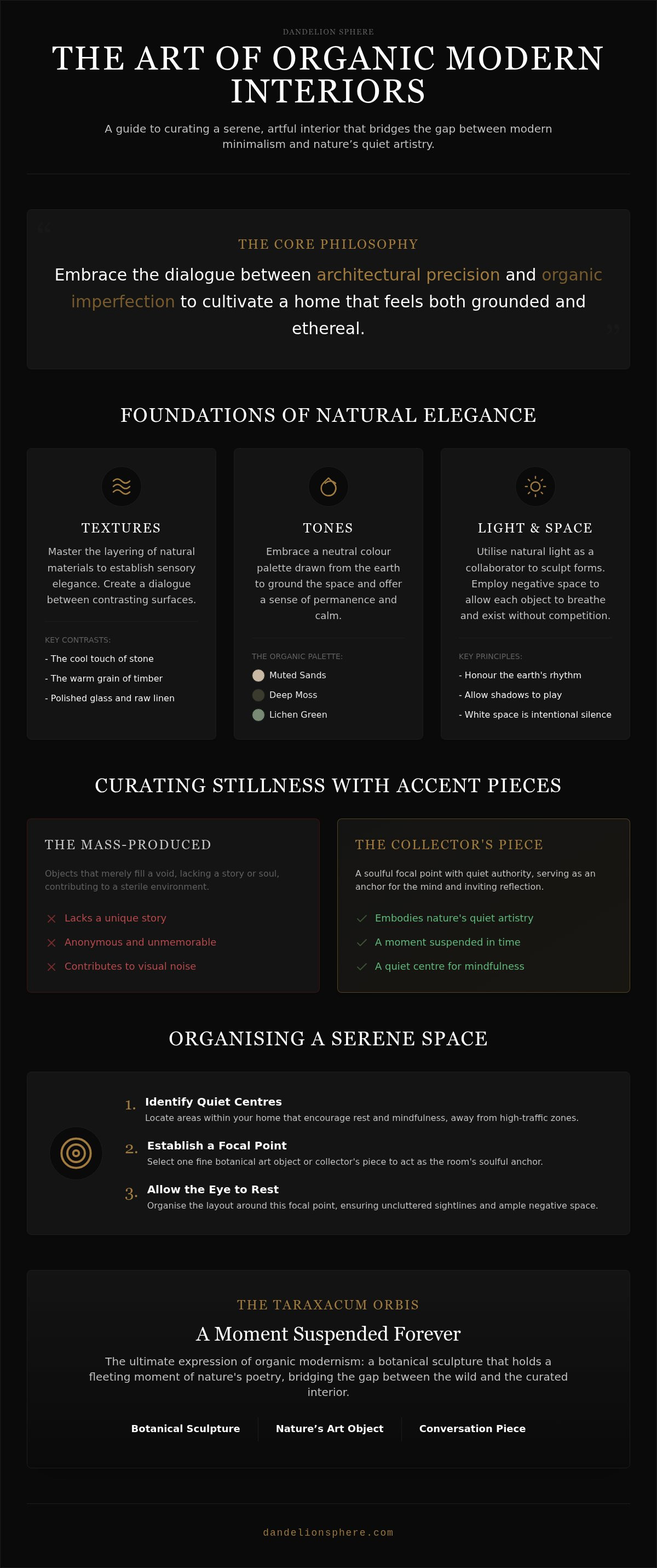
Placement is a ceremony. It is the quiet act of deciding where the light should land. To organise a room is to choreograph a dance between the solid and the ethereal. We don't merely place objects. We find their home. A serene environment is born when we allow our organic modern accent pieces to breathe. It is a process of listening to the architecture of the space. Of finding the stillness within the walls. We seek to create a home that feels like a discovery. A place where every object is an invitation to slow down.
- Identify the quiet centres. Look for the places where the eye naturally rests. A corner where the shadow is soft. A window sill that catches the first amber glow of dawn. These are the stages for nature's art. A space where the air feels stiller. These are the anchors for the wandering mind.
- Balance the heavy with the light. A substantial stone plinth or a dark timber sideboard requires a counterpoint. Introduce a delicate botanical interior accent to soften the weight. It is the whisper against the roar. It is the balance of the mountain and the mist.
- Invite the light. Position your botanical orb where the sun can pierce its heart. Watch as the light illuminates the intricate filaments of the seed head. It is a daily revelation. The light becomes a participant in the art.
- Embrace the odd. Nature rarely speaks in pairs. Group your objects in threes or fives. It maintains an unforced, organic rhythm that feels found, rather than staged. It mirrors the beautiful asymmetry of the forest floor.
The Desk as a Place of Reflection
Our workspaces are often battlefields of noise. We can transform them into sanctuaries. A single botanical sculpture placed beside a lamp creates a quiet centre. It offers a micro-nature break. A moment to pause whilst the cursor blinks. This desk companion encourages deep thought. It reminds us of the world beyond the screen. It is a fragment of a summer meadow. A moment suspended in time. It brings a sense of permanence to the fleeting nature of our daily tasks.
Living Room Altars
The coffee table or the mantelpiece should be treated as an altar to the natural world. When styling with a museum-quality nature object, breathing room is essential. Do not crowd the silence. Allow the sphere to command the space. Create a dialogue with other sensory elements. The rough texture of a wool throw. The scent of cedar. The dialogue between the crystal-clear orb and the raw timber of a table is a poem in itself. It is the meeting of the eternal and the temporal. These layers enhance the presence of your organic modern accent pieces. They ground the ethereal within the domestic.
To begin your own curation of stillness, we invite you to explore our luxury home accents, where every piece is a memory made tangible.
The Taraxacum Orbis: A Moment Suspended Forever
The wish you made as a child still lingers. It lives in the memory of a sun-drenched field. The soft, white globe of a dandelion. The intake of breath. The scattering of seeds into the unknown. In that moment, you understood the beauty of the passing. But what if the wish remained? The Taraxacum Orbis is the answer to that ancient longing. It is the culmination of our dialogue with stillness. It is the physical manifestation of a moment suspended in time.
Whilst other organic modern accent pieces might mimic the forms of the wild, this botanical sculpture holds the wild itself. It is a testament to nature's quiet artistry. Each seed head is captured at its absolute zenith. It is a slow, deliberate process. A ceremony of preservation. We don't just create an object. We preserve a state of being. We give permanence to the ephemeral. It is the bridge between the meadow and the modern home.
A Fragment of Summer
There is a profound nostalgia in the dandelion. It speaks of beginnings. Of childhood dreams. These botanical orbs bring an eternal bloom into the sanctuary of the home. They offer a startling contrast. The seeds are impossibly delicate. They are fragments of air and light. Yet, they are held within a solid, crystal-clear sphere. It is a marriage of the fragile and the permanent. A piece of summer that refuses to succumb to the frost. It is a natural wonder that invites the eye to wander amongst the filaments. To dream. To remember the warmth of the sun whilst the world outside grows cold.
The Gift of Stillness
To give a Taraxacum Orbis is to offer a memorable gift. It is a gesture of deep reflection for any nature lover. Trends fade. Seasons turn. But a museum-quality nature object remains. It is a legacy piece. It doesn't ask for attention; it simply exists with a hushed authority. It is a statement object that grows more meaningful as the years pass. We invite you to explore the journal for more stories of nature and the poetry of the seasons. It is a place for those who find beauty in the quiet corners of the world.
In the end, we don't own these moments. We simply hold them for a while. To have a fragment of the meadow in your palm is to remember that beauty is everywhere. It is in the small. The overlooked. The quiet. It is the poetry of nature, held forever. It is a wish that finally stayed.
Cultivating a Sanctuary of Eternal Stillness
The journey toward a serene home is a journey inward. We've explored the delicate balance between architectural precision and the untamed grace of the natural world. By identifying the quiet centres of your rooms and layering textures with intent, you transform a house into a living gallery. The selection of organic modern accent pieces is more than a choice of style. It's a commitment to nature’s quiet artistry. It's the act of bringing a fragment of a summer meadow into the heart of your everyday life.
Every space deserves a soul. A focal point that breathes. We invite you to explore the Taraxacum Orbis collection. Within this curated space, you'll find artisanal botanical art objects designed to capture nature’s fleeting moments. These timeless collector’s pieces offer a sense of permanence in a world that never stops moving. May your home become a place where time slows down. Where every object tells the story of a wish held forever. Find beauty in the small. The delicate. The enduring. Let your home be your sanctuary.
Frequently Asked Questions
What is organic modern home decor and how does it differ from minimalism?
Organic modernism is the marriage of architectural precision and the untamed grace of the earth. Minimalism often seeks the removal of the superfluous. Organic modernism seeks the addition of the soulful. It introduces the warmth of timber and the intricate detail of organic modern accent pieces into the stark geometry of contemporary life. It isn't just about less. It's about more meaning. A dialogue between the made and the found.
How do I choose the right statement object for a small modern space?
In a limited environment, prioritise significance over scale. A single, museum-quality nature object creates a quiet centre without overwhelming the room. Look for pieces that invite close inspection, such as a botanical orb that captures a moment suspended in time. These objects allow the eye to wander within their crystal-clear depths. They provide a sense of expansive wonder within a compact footprint. They're the anchors of the small sanctuary.
Are natural specimens considered sustainable interior accents?
Nature’s artistry is inherently sustainable when captured with reverence. By preserving a fleeting moment in a permanent form, we move away from the cycle of mass-produced, disposable items. These pieces are designed to be held forever. They encourage a deeper connection to the cycles of the earth. Choosing objects that age with grace ensures a timeless aesthetic. It reduces the need for frequent replacement. It's an investment in permanence.
Can I mix organic modern style with other design aesthetics like industrial?
The dialogue between the wild and the mechanical is profoundly beautiful. The cool, hard surfaces of industrial design provide a perfect canvas for the soft filaments of a botanical sculpture. A conversation piece like the Taraxacum Orbis softens the edge of steel and concrete. It introduces a breath of the meadow into the machine. This contrast highlights the delicate nature of the specimen. It grounds the room in the living world.
How do I maintain the clarity of a botanical sculpture over time?
Preservation requires only the gentlest touch. To maintain the crystal-clear brilliance of your nature’s art object, use a soft, lint-free cloth to remove the dust of the passing days. Keep the piece away from the direct, harsh glare of the midday sun to protect the fragile botanical form within. This simple care ensures that the poetry of nature remains vivid. It remains clear for generations to come. A legacy of stillness.
Why are dandelions used in fine botanical art objects?
The dandelion is a master of the ephemeral. It's a constellation of wishes. Its form is so delicate that it usually disappears with a single breath. By capturing this natural wonder, we celebrate the impossible. The seed head represents childhood memories and the beauty of beginnings. In the realm of fine botanical art, it serves as a powerful symbol. A moment held against the drift of time.
What makes a nature object 'museum-quality' for a modern home?
Museum-quality is defined by absolute clarity and the mastery of preservation. It implies that the organic modern accent pieces have been created with such precision that every minute detail is visible. The specimen must appear as if it were still standing in the field. There should be no distortion. No imperfections. Only the silent authority of a piece that belongs in a gallery of the senses. It's a memory made tangible.
Disclaimer
The content on this website is provided for inspiration and informational purposes only. Articles reflect the philosophy and storytelling of Dandelion Sphere and are not intended as professional advice. While every effort is made to ensure accuracy, no guarantees are given regarding completeness or current applicability.


