
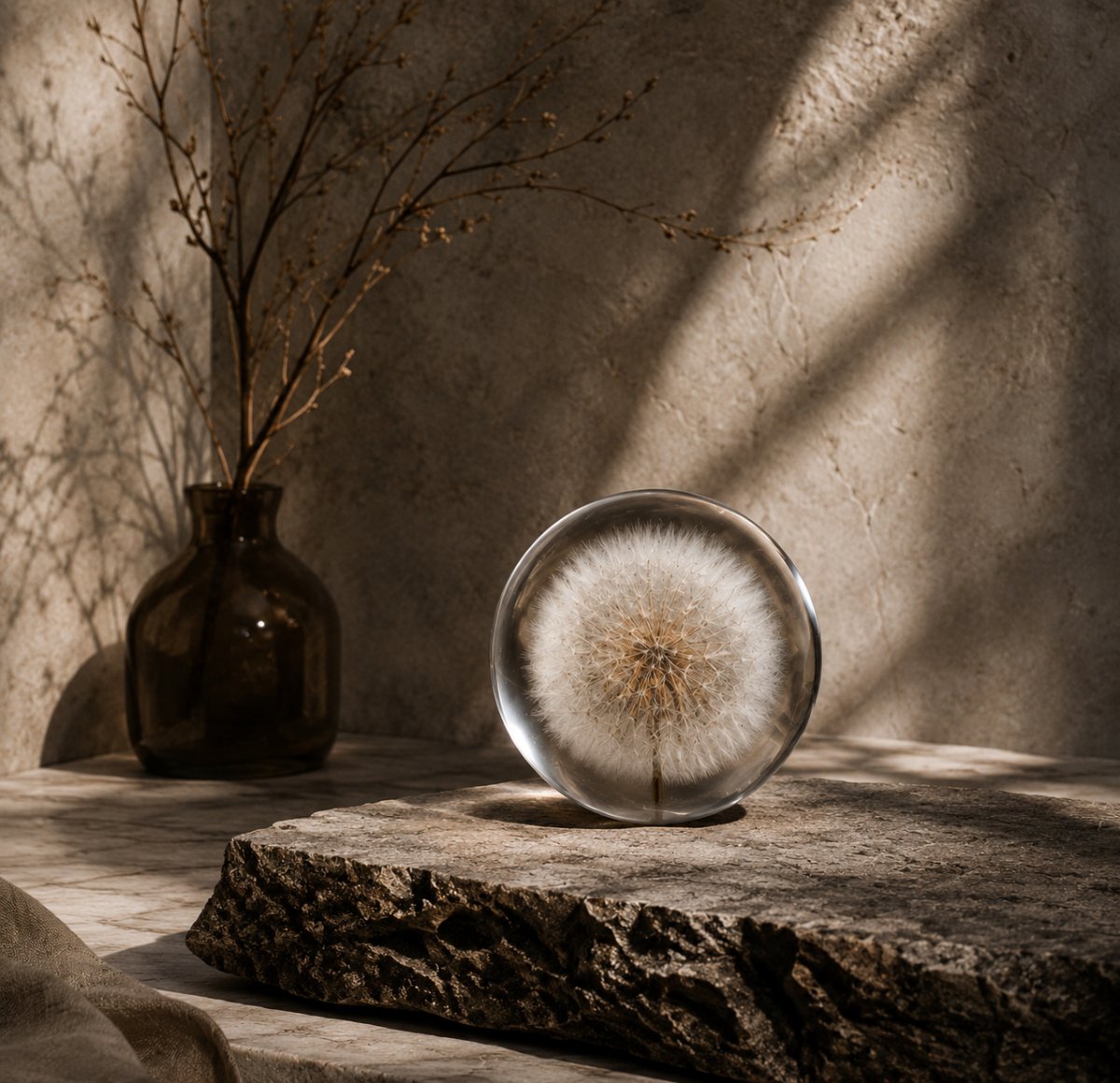
A single stem carries the weight of an entire season. A fragment of a summer afternoon. A memory of a meadow. Most floral displays demand space. They use loud, crowded gestures. They fight for attention. Yet, the most profound beauty resides in the quietest corners. In the stillness of a single flower sculpture.
It's a common sorrow to watch a favourite bloom surrender to time. To see the vibrant colours of July fade. Perhaps it's a wildflower from a childhood garden. Or a stem plucked during a quiet walk. We understand the desire to hold the fleeting nature of these moments. Often, preservation feels artificial. It yellows. It lacks the breath of life. You seek an object that mirrors the grace of the original specimen. A piece that feels like a moment held forever.
This meditation explores the poetry of nature’s quiet artistry. You'll discover how a solitary bloom becomes a sophisticated collector’s piece. We'll reflect on how a botanical orb invites a sense of serenity and stillness into your home. It's a journey into the heart of a single, perfect blossom. A way to keep the essence of summer, suspended in time.
Key Takeaways
- Understand the profound emotional resonance of the solitary bloom and how capturing nature’s quiet artistry offers a sense of eternal stillness.
- Learn how a single flower sculpture acts as a minimalist statement object, creating a sophisticated centre of calm within your interior.
- Discover why a three-dimensional botanical orb provides a more immersive connection to a specific memory than traditional flat-pressed methods.
- Gain insights on curating your personal gallery by allowing your collector’s piece sufficient breathing room to catch the shifting light of the day.
- Explore the artisanal journey of the Taraxacum Orbis - Dandelion Sphere, a fragment of a summer meadow held forever in a state of crystalline perfection.
The Philosophy of the Single Bloom: Beyond the Fleeting Meadow
A meadow in June. Golden light spills across the tall grass. The air is heavy with the scent of sun-warmed earth. Here, a single dandelion stands. It's a humble architecture of seeds. A fragile geometry. Within days, the wind will claim it. The meadow will move on. This is the brief, golden life of a wildflower. It's a whisper of a season that refuses to stay. We feel the pull to pause. The human heart aches at the exit of summer. We want to stop the clock. To hold nature’s quiet artistry before it scatters into the breeze.
This desire isn't about possession. It's about presence. It's about keeping a fragment of beauty that would otherwise vanish. When we look at a single flower sculpture, we aren't just looking at a plant. We're observing a moment suspended in time. The meadow is a sea of movement. Thousands of stems swaying. Yet, our eyes often find the one. The solitary bloom. The choice to see the individual is a choice to find meaning in the small. To value the specific over the general. It's a meditation on life itself.
The transition from a living plant to a museum-quality nature object is a profound one. It requires a shift in perspective. We no longer see the wildflower as a weed or a common sight. We see it as a masterpiece. A collector’s piece that carries the weight of a memory. It becomes a bridge between the wild world and the sanctuary of the home. A way to bring the stillness of the meadow indoors. Held forever. Safe from the wind.
The Beauty of the Brief
A dandelion’s seed head is a delicate fragment of summer, a ghost of the sun that lingers just long enough to carry a wish. We remember childhood. Kneeling amongst the clover. Closing eyes. One breath. The seeds fly. That nostalgia is a powerful weight. It's a connection to a simpler time. Preservation serves as the bridge between that fading memory and the physical world we touch today. It allows the wish to remain. Unbroken. Still.
A Higher Register of Preservation
This is not a mere token. It's a fine botanical art piece. Whilst historical flower preservation methods often focused on the functional or the scientific, we seek the poetry of the specimen. We move beyond industrial encasement. We seek clarity. We seek the truth of the bloom. This single flower sculpture demands focus. It asks for silence. By honouring the specimen as a solitary, perfect form, we recognise its inherent worth. It's a fragment of the universe. A nature’s art object that invites us to slow down. To breathe. To remember. You can explore more reflections on these quiet moments in our journal.
Methods of Suspending Time: A Reference for the Collector
To hold a moment is to defy the natural order. Most preservation is a flattening. A pressing of history into two dimensions. It loses the breath of the object. A single flower sculpture offers something different. It offers depth. It offers life held in three dimensions. The eye can travel around the bloom. Underneath. Through. It's a complete vision of a fleeting state. A preservation of volume and space.
The choice of a spherical form is deliberate. A sphere has no edges. No corners to trap the eye. It creates a continuous dialogue with the surrounding light. As the sun moves across a room, the piece breathes. It changes. It glows. It's a living interaction. A flat frame is a window. A sphere is an atmosphere. It invites the collector to view nature from every possible angle, revealing the hidden architecture of the wild.
Suspending a dandelion is a feat of patience. Each seed is a parachute of light. A single breath could scatter them. To keep them intact amongst a transparent medium requires a hushed, careful process. It's a dance of stillness. The goal is absolute crystalline clarity. To capture light without distraction. To let the flower speak for itself. We don't just preserve the plant. We preserve the silence that surrounds it.
The Crystalline Embrace
Clarity is the primary pursuit. A high-quality medium must resist the passage of years. It shouldn't yellow. It shouldn't cloud. It must act as a perfect lens. When light enters a botanical orb, it illuminates the hidden. Microscopic details. The fine hairs of a seed. The delicate curve of a petal. This transparency is essential. It protects the fragile botanical structures whilst making them more visible than ever before. You might find such clarity amongst our nature collectibles.
Preserving the Architecture of Nature
The dandelion is a masterclass in geometry. It's a mathematical symmetry born of the earth. We often overlook this perfection in the wild. We see a weed. We don't see the architecture. Capturing the blowball state is the greatest challenge. One must preserve the form without disturbing a single seed. It requires a reverence for the specimen. The intricate symmetry of a seed head held in eternal stillness is a testament to nature’s quiet artistry. It's a single flower sculpture that invites us to look closer. To see the infinite within the small.
The Aesthetic of the Solitary Specimen: Minimalist Sculpture vs. Traditional Bouquets
A bouquet is a chorus. Loud. Demanding. Many voices speaking at once. It has its place. In the rush of a wedding. In the celebration of a grand gesture. But a single flower sculpture is a solo. A whisper. It does not shout for attention. It invites it. One stem. One bloom. One moment held in silence.
Traditional arrangements are often crowded. They are beautiful. But they are busy. They fill the room with visual noise. A solitary specimen creates a centre of stillness. It allows the eye to rest. To focus. In a modern home, this minimalism is essential. We need spaces that breathe. We need objects that do not clutter the mind. A nature’s art object on a desk or a shelf acts as a natural wonder. It is a point of focus in a world of distraction. It reminds us of the quiet poetry of everyday life.
The void is as important as the object. White space. Silence. Room to think. When a collector’s piece stands alone, the space around it becomes part of the art. The emptiness gives the flower its weight. Its significance. It’s a dialogue between the seen and the unseen. Between the fragile and the infinite. This is the power of the solitary specimen. It creates a sanctuary within the home. A place where time feels irrelevant.
The Poetry of the Individual
To see one petal is to see the universe. To observe a single airborne seed is to understand the wind. A bouquet hides the detail in the mass. A single flower sculpture reveals it. The emotional impact of a solitary bloom is deeply personal. It isn't the shared noise of a ceremony. It's the quiet reflection of a walk amongst the wildflowers. A sophisticated interior demands this level of focus. It seeks the refined. The elegant. The essential.
Choosing Your Statement Object
Every room has a temperament. A mood. A colour palette. A botanical sculpture should not just sit in a space. It should belong there. The dandelion, or Taraxacum Orbis, is a favourite for many. It is a symbol of resilience. Of new beginnings. Of the quiet wish. When placing your piece, consider the conversation it holds with its surroundings. You can explore more on this relationship in our journal entry, The Botanical Interior Accent: A Dialogue Between Nature and Space. Choose a piece that mirrors your own stillness. A fragment of summer that speaks to your soul.

Curating Your Personal Gallery: Living with Botanical Art
A home is a collection of intentions. We choose what to keep. What to discard. A single flower sculpture requires a specific kind of intention. It is not a filler for an empty corner. It is a point of focus. To live with botanical art is to invite a rhythm of stillness into your daily life. It asks you to look. To really look. One seed head. One moment. One breath.
Breathing room is essential. Most objects are crowded. They jostle for space. A collector’s piece needs silence. Give it a wide berth. Let the white space of the wall or the shelf frame the delicate geometry of the bloom. This distance creates serenity. It allows the eye to travel without distraction. When we pair nature’s art objects with raw materials, the dialogue deepens. Reclaimed wood. Cold stone. These textures anchor the ethereal nature of the orb. They ground the wish.
The workspace often lacks soul. It is a place of function. A botanical orb on a desk transforms the air. It becomes a meditative focal point. A reminder of the meadow during a busy hour. It is a small window into the eternal. A way to breathe whilst the world rushes by. It is a sanctuary in a sphere.
Light as a Silent Collaborator
Light is the life of the piece. Position your single flower sculpture near a window. Watch the dance of shadows. The seeds catch the morning sun. They glow. By evening, the shadows lengthen. The internal details of the dandelion become like glowing embers during the golden hour. It is a shifting masterpiece. For more on this, explore our guide on Botanical Art for Living Room: Curating a Gallery of Stillness. It is a lesson in observation. A study of time.
The Conversation Piece
Guests will notice. They will stop. A botanical orb is a natural conversation piece. It invites storytelling. Shared memories of childhood meadows. Wishes made on summer breezes. It is a bridge between people. In a minimalist home, it serves as a quiet reminder of our connection to the earth. Treat it with reverence. It is a museum-quality nature object. A fragment of the wild, held in trust. You can begin your own collection of luxury gift objects to bring this stillness home.
The Taraxacum Orbis: A Fragment of Summer Held Forever
The meadow has long since turned to autumn. The wind is colder now. The tall grasses have bowed to the frost. But on your shelf, summer remains. The Taraxacum Orbis is more than an object. It is a fragment of a June afternoon. A piece of fine botanical art for the discerning collector. It is the culmination of a search for the eternal within the fleeting. This single flower sculpture stands as a silent witness to a season that refused to be forgotten. It is a presence that anchors a room in a state of perpetual grace.
The artisanal journey to capture this state is a slow one. It is a methodical transition from the wild earth to the sanctuary of the home. We don't rush the process. We wait for the dandelion to reach its most perfect, fleeting state. The blowball. The moment before the wind. Capturing this requires a reverence for the specimen. It is a quiet dialogue between the artisan and the plant. We seek to hold the breath of the meadow. To give the intangible a weight. A form. A place to rest.
This is nature’s quiet artistry, rendered tangible. It is a memory you can hold. A wish that has found a permanent home. For the collector, it represents a commitment to beauty. A choice to value the delicate. It is a single flower sculpture that invites a lifetime of observation. Every time the light changes, the story of the summer day is retold. It is a gift of stillness in a world that rarely stops to breathe.
The Artisan’s Touch
Precision is a form of devotion. We employ a meticulous composition that ensures every seed remains in its natural, intended place. There is no room for the chaotic. We seek a crystal-clear crystalline structure. A polished surface that acts as a lens into the microscopic world. This pursuit of perfection is what defines the Botanical Art Collector Piece: Curating Eternal Stillness. It is a standard of beauty that defies the passage of time. Each orb is a testament to the patient observation of the natural world. It is a fragment of history, held in crystalline clarity.
A Wish to Hold
The emotional takeaway is simple. It is a reminder of the beauty found in impermanence. We learn to appreciate the passing seasons because we have held a piece of one. It is a final reflection on the poetry of nature. A way to keep the childhood wonder of a meadow walk alive in the adult heart. Whether as a meaningful gift for a loved one or a personal keepsake, it is a way to hold the brief. It is a sanctuary in a sphere. We invite you to Discover the Taraxacum Orbis Collection. Find the fragment of summer that speaks to your soul. Hold the moment. Forever.
Inviting Stillness into Your Home
The meadow is silent now. The seasons have turned. Yet, on your mantle, the wish remains. We've explored the shift from a fleeting summer day to a state of eternal stillness. A single flower sculpture is more than an accent. It's a point of focus. A sanctuary. It invites you to pause. To observe the microscopic geometry of a seed head. To breathe. One moment. Held forever.
True preservation is an act of reverence. It requires artisanal, gallery-grade crystalline clarity to honour the specimen. We capture real dandelions in their most delicate, ephemeral state. These botanical orbs create a timeless dialogue between the wild world and your interior space. They are fragments of a memory made tangible. A way to hold the poetry of nature within your own sanctuary.
Invite this serenity into your daily life. Let a solitary specimen become your centre of calm. Explore the Taraxacum Orbis: Nature’s Art Objects and find the moment that speaks to you. May your home always hold a fragment of the sun.
Frequently Asked Questions
What is the best way to display a single flower sculpture in a minimalist home?
Position your single flower sculpture on a solitary surface where it can breathe. A minimalist home thrives on white space and quiet intentions. Allow the piece to act as a centre of stillness. Placing it near a window lets the shifting daylight interact with the seeds. It creates a dance of shadows throughout the day. Avoid crowding the object. Let it stand alone.
Will the colour of the preserved wildflower art fade if placed in direct sunlight?
Nature is defined by change. Whilst our preservation methods seek to hold time, prolonged exposure to harsh, direct sunlight may eventually soften the natural hues. We recommend placing your collector’s piece in a spot with bright, indirect light. This protects the delicate pigments. It ensures the fragment of summer remains vibrant for years to come. It's a gentle dialogue with the sun.
How is a single flower held perfectly in place within a crystalline sphere?
The suspension of a bloom is an act of extreme patience. It requires a hushed, artisanal process that protects the fragile architecture of the plant. We avoid industrial methods. Instead, we carefully introduce the medium to ensure every airborne seed remains in its natural, intended place. It's a moment suspended in time. The flower appears to float in a state of weightlessness.
Is a botanical orb suitable as a meaningful memorial gift for a loved one?
A botanical orb is a profound way to honour a memory. It makes the intangible tangible. For many, a specific wildflower carries the weight of a shared walk or a childhood garden. Giving such a piece is a gesture of deep reflection. It's a memorable gift that offers a sense of permanence. It's a quiet companion in a space of remembrance. A memory held forever.
How do I clean and care for my fine botanical art object to maintain its clarity?
Treat the object with the reverence of a museum-quality nature object. A soft, lint-free cloth is all that's required to remove dust. Use a gentle, circular motion. Avoid harsh chemicals or abrasive surfaces that might disturb the crystalline surface. The goal is to maintain absolute clarity. This allows the light to continue illuminating the microscopic details of the specimen held within.
Can I find a dandelion sphere that captures the wish state of the flower?
The Taraxacum Orbis is specifically designed to capture the dandelion in its most perfect, fleeting state. This is the blowball. The moment of the wish. We preserve the delicate seed head before the wind can claim it. It's a fragment of summer held forever. It allows you to keep that childhood sense of wonder on your shelf. A wish that never scatters.
What makes a museum-quality nature object different from a standard paperweight?
The distinction lies in the register of artistry and the pursuit of crystalline perfection. A standard object often lacks the clarity and depth of a true nature’s art object. Our collector’s pieces prioritise the specimen as a solitary masterpiece. We focus on the poetry of nature rather than utility. Every surface is polished to ensure a continuous dialogue with the light. It is fine botanical art.
Why is the dandelion often chosen for single flower preservation art?
The dandelion is a masterclass in natural geometry. Its symmetry is a mathematical wonder born of the earth. Beyond its form, it carries a deep emotional resonance. It's the symbol of the quiet wish and the resilience of the wild. By preserving it, we find beauty in what is often overlooked. It's the perfect subject for a single flower sculpture. It represents the infinite within the small.
Disclaimer
The content on this website is provided for inspiration and informational purposes only. Articles reflect the philosophy and storytelling of Dandelion Sphere and are not intended as professional advice. While every effort is made to ensure accuracy, no guarantees are given regarding completeness or current applicability.


