
What if the path to deep focus is not found in the restless raking of sand, but in the absolute stillness of a single, captured breath? Most office spaces are defined by a sterile weight. A heavy silence that feels empty rather than full. We seek calm in traditional tools. Yet, the raked lines of a miniature landscape often bring their own clutter. A mess of dust. A distraction of movement. If you find yourself seeking a zen garden for desk alternative, perhaps the answer lies in a different kind of quiet. A quiet that does not ask for your labour.
We understand the fatigue of the modern workspace. The visual noise that fragments the mind. You deserve an environment that feels curated and timeless. In this reflection, we explore the poetry of the botanical orb. You will discover how to transcend the mundane through the presence of a nature’s art object. We invite you to step away from the corporate and into the eternal. We will look at how one suspended moment can create a centre of gravity for your most profound work. A sanctuary. Held in light.
Key Takeaways
- Learn how to cultivate visual silence by creating a dialogue between your professional demands and the hushed poetry of the natural world.
- Discover why a botanical sculpture serves as a sophisticated zen garden for desk alternative, offering profound stillness without the distraction of sand.
- Master the use of soft, organic palettes and natural light to transform a sterile office into a curated gallery for deep, rhythmic focus.
- Identify your primary sightline to ensure your gaze rests upon a meaningful nature's art object every time you pause your work.
- Explore how preserving a fleeting moment of beauty can ground your workspace in a sense of permanence and timeless inspiration.
Defining the Quiet Centre: The Philosophy of Serene Workspace Curation
A single dandelion seed drifts. It catches the light. It is a moment of total, unhurried grace. On a desk, however, grace is often absent. Clutter. Demands. Noise. A truly serene workspace offers a different rhythm. It's a dialogue. Between the necessity of the task and the poetry of the earth. We often seek a zen garden for desk alternative because we crave stillness. Not more tasks. Not more raking. We want a presence that exists without our intervention.
Visual silence is a rare gift. In a world of digital glare, the eye becomes weary. It needs a rest. A place to pause amongst the noise. By choosing a single nature’s art object, you create a discovered space. It's a sanctuary that evolves through intention. One piece anchors the energy of an entire room. It holds the light. It remains whilst the world rushes. It is a moment suspended. A memory made tangible.
The Psychology of Stillness in Professional Spaces
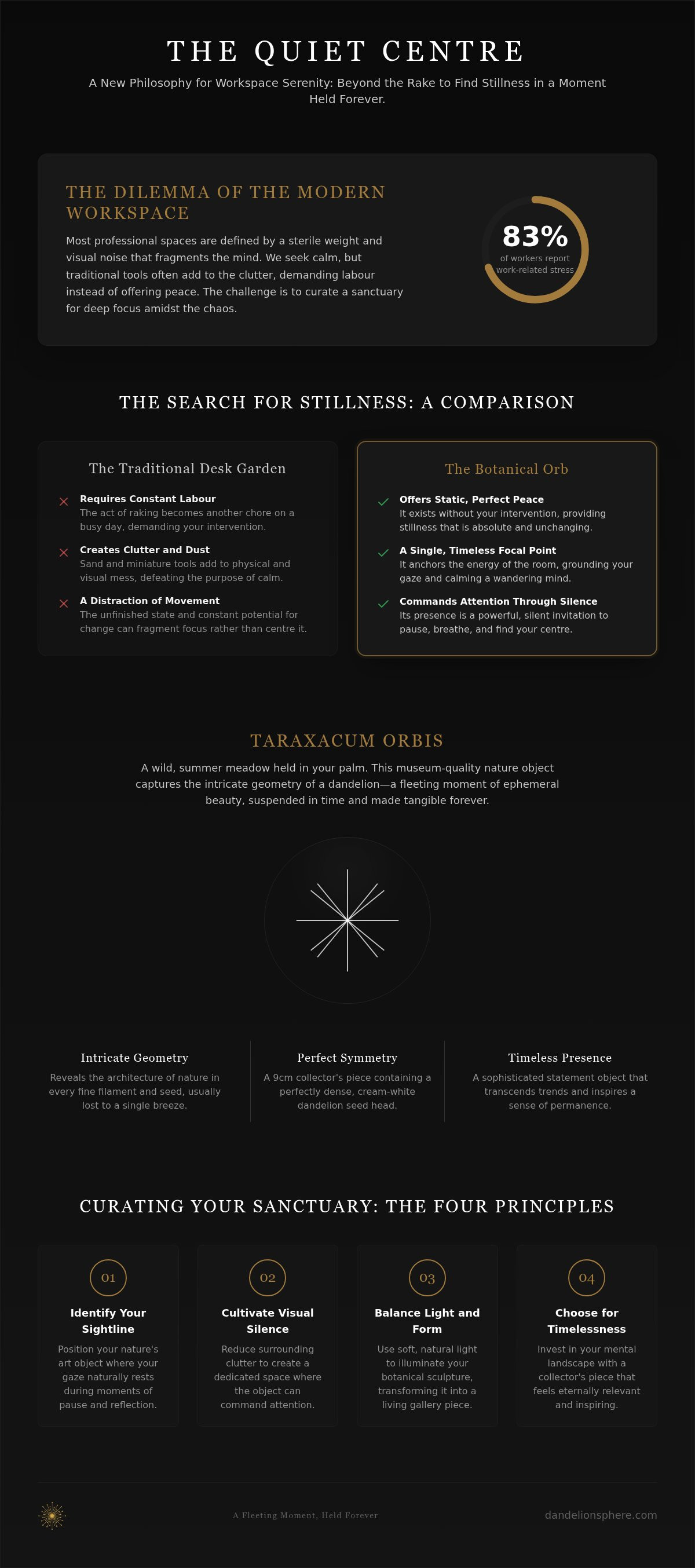
Organic forms are a balm. They reduce the cognitive load of the workday. Research indicates that 83 per cent of workers report work-related stress. We need a boundary. A line between the chaos outside and the hush of our office. This is the biophilia hypothesis. Our innate need for natural geometry. The curve of a petal. The symmetry of a seed head. Unlike the active maintenance of a Japanese rock garden, a botanical orb offers a static, perfect peace. These forms speak to us. They whisper of a world that does not hurry.
Why Minimalist Principles Require a Focal Point
Minimalism is not about absence. It's about presence. There is a coldness in empty space. It feels hollow. But a curated collector’s piece brings warmth. It provides a focal point. During high-stress hours, the mind often wanders. It seeks an exit. A botanical sculpture gives it a place to return. It grounds the gaze. It reminds us of the delicate and the enduring. Visual white space is the necessary breath between creative thoughts.
Beyond the Rake: Seeking a Zen Garden for Desk Alternative
Traditional dry gardens require action. Raking. Levelling. On a busy desk, this often becomes another chore. A source of dust. A distraction. If you seek a zen garden for desk alternative, you likely seek the result, not the labour. You seek the stillness of a finished thought. A museum-quality nature object does not ask for your attention. It commands it through silence. It offers the same restorative focus as a raked path, yet it remains perfect. Unmoved by the wind of a passing colleague or the clutter of a deadline.
We are drawn to the dandelion because it is the ultimate expression of the ephemeral. It is a childhood memory. A wish caught on a breeze. Its fragility is its strength. To see such a delicate structure remain intact is to witness a small miracle. Understanding the Health Benefits of Biophilic Design reveals why we crave these organic geometries. They lower the heart rate. They soften the hard edges of professional life. We invite you to explore our collection of captured moments.
The Power of the Botanical Orb
A botanical orb is a microcosm. It is a wild, summer meadow held in the palm. Within its crystalline clarity, a single dandelion head is suspended. It is a wish held in time and space. The architecture of nature is revealed in every fine filament. Every seed. Each piece captures the intricate geometry that usually vanishes in a single afternoon. It creates a centre of gravity for your gaze. A place where the eye can rest and the mind can breathe.
Curating for Longevity and Timelessness
True serenity transcends seasonal trends. It does not follow fast-moving interior fads. A collector’s piece should feel as relevant in a decade as it does today. Whilst mass production offers the hollow echo of repetition, the artisan-led process ensures each nature’s art object is a unique testament to a single summer day. It is an investment in your own mental landscape. You may find deeper reflection in our journal entry on The Botanical Art Collector Piece: Curating Eternal Stillness. Choose objects that invite a pause. Savour the quiet poetry of a moment made tangible.
The Natural Palette: Balancing Light and Organic Forms
Light is the silent architect of serenity. It moves across the desk. It touches the surface. It transforms. To create a gallery feel in a professional space, one must look beyond the glare of the screen. Soft, muted tones provide the necessary canvas. They allow the eye to breathe. When you introduce a nature’s art object, you are not just adding an item. You are inviting a dialogue between shadow and form. This is the true appeal of a zen garden for desk alternative. It is a visual anchor that requires no manual maintenance. It asks only for your observation. A single breath in a busy day.
Harmonising textures is a delicate art. The rough, honest grain of aged oak. The cool, unyielding weight of smooth stone. The liquid, light-refracting clarity of a botanical sculpture. These elements should not compete for your attention. They should sing in unison. Rhythmic repetition of organic shapes, the curve of a sphere or the radial symmetry of a seed head, soothes the weary mind whilst you work. It mirrors the patterns found in the deep woods or the open field. It brings the meadow to the workspace. It grounds the digital in the physical.
Choreographing Light and Shadow
Position is everything. Place your collector’s piece where it can greet the shifting morning sun. Watch as the botanical orb catches a stray beam. It refracts the light. It glows from within. A soft halo spills onto the desk surface, illuminating the intricate architecture of the seeds. It is a moment of pure, silent alchemy. In the late afternoon, allow the shadows to lengthen. Depth creates a sense of mystery and weight. It reminds us that our professional efforts are but a small part of a larger, more ancient cycle of light and dark.
Materials that Speak of the Earth
Raw materials carry a certain quiet honesty. They age with grace. They tell a story of time passing. There is a profound contrast between the fragile, delicate dandelion seeds and the solid, eternal clarity of their casing. One is a fleeting moment of summer. The other is a promise of permanence. Keep the colour story grounded. Hushed. Sophisticated. Let the palette of the earth guide your curation. Soft greys. Warm tans. The translucent, ghostly white of a captured wish. This is how a workspace becomes a sanctuary.
Arranging Your Sanctuary: Practical Steps for Visual Peace
The first act is subtraction. Clear the surface. Remove the noise of tangled cables. The stacks of paper that whisper of unfinished tasks. Keep only that which holds a profound purpose. Or that which evokes a quiet joy. Once the space is clear, look up. Find the exact place your eyes rest when you pause your work. This is the prime sightline. It is here that you should place your botanical sculpture. It serves as a zen garden for desk alternative that offers the same rhythmic focus without the mess of sand. Balance the scene. Perhaps a linen journal. A stone vessel. Let them sit in quiet conversation with the orb. This curation is not about filling space. It is about honouring it.
When we organise our environment with such intention, we create a sanctuary. The placement of a single nature’s art object acts as a visual anchor. It grounds the room. It provides a destination for the gaze to land. This deliberate arrangement allows the mind to settle into a state of deep, rhythmic focus. It is the difference between a desk that merely holds equipment and a workspace that nurtures the soul. You are not just arranging objects. You are choreographing a moment of peace.
The Rule of One: Embracing Singular Statements
A singular, high-quality nature's art object possesses a gravity that a collection of trifles can never match. It needs room to breathe. When we surround an object with space, we allow it to speak its quiet truth. This intentionality has a profound effect on productivity. A clear desk surface is a clear mind. It signals to the self that there is space for new thoughts. For deep, uninterrupted work. It is an invitation to clarity. By choosing one significant collector’s piece, you reject the clutter of the mundane. You choose the eternal over the ephemeral.
Integrating Nature into the Daily Workflow
Treat the botanical orb as a tool for micro-meditation. During brief breaks, turn your gaze away from the digital glare. Look into the crystalline depths. Reflect on the poetry of nature. It is a sophisticated counterpoint to the binary world of tasks and deadlines. This is the essence of The Botanical Interior Accent: A Dialogue Between Nature and Space. By integrating such a piece, you create a sanctuary within the storm. You can select your own collector’s piece to begin this transformation of your daily rhythm. Let the presence of a wish held forever be your companion through the hours of professional ambition.
Taraxacum Orbis: A Fleeting Moment Held Forever
The Taraxacum Orbis is more than an object. It is a philosophy. A single, perfect moment. Held forever. In the search for a zen garden for desk alternative, one often finds tools that require constant attention. Raking sand. Re-organising stones. The Dandelion Sphere offers the opposite. It is a finished state. It is the hushed poetry of a summer field. Captured at the exact peak of its fragile beauty. For the discerning collector, it is a memory made tangible. A physical echo of a childhood wish. A sanctuary for the gaze.
These botanical sculptures serve as timeless gifts. They honour the recipient's appreciation for nature’s artistry. In a professional world of rapid change, they represent the eternal. They are a statement. A quiet authority. Each nature’s art object belongs in a space where deep thought is the primary currency. Where the eye needs a place to rest amongst the digital noise. It is the ultimate expression of serene workspace curation. A wish made physical. A moment suspended in time.
The Alchemy of Stillness
There is a reverence in the suspension. A dandelion seed head. Perfectly intact. Every filament is visible. It sits in a crystal-clear medium that allows light to pass through without resistance. Each piece is a unique dialogue. Between the artisan and the wild meadow. It is not mass-produced. It is curated with a methodical, almost meditative rhythm. This ensures that the gravity and intent behind the work are felt by the collector. We invite you to explore the Taraxacum Orbis collection for your own workspace. Find the piece that speaks to your own sense of quiet.
A Wish for the Future
The dandelion is a herald. It speaks of beginnings. It carries the weight of our hopes. Our wishes. Placed on a desk, it becomes a companion for professional ambition. It is a reminder that even the most delicate ideas can be given permanence. It provides a centre. A point of gravity. When the digital world feels overwhelming, look to the orb. It remains. Unmoved. It is a sophisticated counterpoint to the rush of the everyday. We encourage you to visit our Journal for further reflections on botanical art. Some moments deserve to stay with us. Forever.
Embracing the Eternal Breath of the Meadow
The pursuit of focus is a journey to the centre. It is a choice. To replace restless motion with absolute stillness. We've seen how the botanical sculpture transcends the traditional zen garden for desk alternative. It asks for nothing. It gives everything. A dialogue between light and form. A sanctuary that breathes. By honouring the prime sightline and clearing the visual noise, you invite a deeper rhythm into your workday. A rhythm that mirrors the slow, certain cycles of the natural world.
The Taraxacum Orbis is the final note in this curation. A memory made tangible. These museum-quality nature objects are created by artisans to anchor the soul. We offer global delivery for the discerning collector. We invite you to Discover the Taraxacum Orbis collection for your workspace. Let your desk become a place of rhythmic focus. A place where wishes remain. Held forever. May you find peace in the quiet poetry of a moment suspended in time.
Frequently Asked Questions
What defines a serene home office interior style?
Serene workspace aesthetics are defined by visual silence and the intentional dialogue between light and organic forms. Avoid the noise of excess. Focus on textures like aged wood or stone. A serene space prioritises quality over quantity. It creates a sanctuary where the mind can rest. This is why many seek a zen garden for desk alternative that offers stillness without the distraction of active maintenance. Every element should serve a profound purpose or evoke a quiet joy.
How can nature-inspired objects improve focus at work?
Natural geometry acts as a visual anchor for the wandering mind. Observing the intricate symmetry of a seed head or the curve of a petal provides a moment of micro-meditation. These forms reduce cognitive load by offering a soft, restorative focal point. Unlike digital screens, organic objects invite a rhythmic pause. This stillness allows the brain to reset. It encourages deep, uninterrupted thought. The presence of nature grounds professional ambition in the eternal and the enduring.
Where is the best place to position a botanical sculpture on a desk?
The prime sightline is the most effective location for a botanical sculpture. This is the exact point where your gaze naturally lands when you look up from your screen. Positioning a collector’s piece here ensures that every pause in your workflow is met with a moment of beauty. Consider the movement of light throughout the day. Place the sculpture where the morning sun can illuminate the interior filaments. This creates a soft halo effect upon the desk.
Why should I choose a single statement piece over multiple smaller items?
A singular nature’s art object possesses a gravity that a collection of trifles cannot mimic. It requires breathing room to speak its quiet truth. Multiple small items often fragment the attention and add to visual clutter. One significant collector’s piece commands silent respect. It creates a clear, intentional centre of gravity. This choice reflects a sophisticated commitment to quality. It signals to the self that the workspace is a place of clarity and high, unhurried intent.
How do I maintain a minimalist workspace aesthetic without it feeling cold?
Warmth is found in the connection to the natural world. A minimalist space only feels cold when it lacks an emotional soul. By introducing a botanical sculpture, you bring the poetry of the meadow into the room. Use raw, honest materials like linen or timber to balance the crystalline clarity of the orb. These organic textures provide a necessary resonance. They turn a stark surface into a curated sanctuary. It is about the warmth of a captured memory.
Can botanical art objects help reduce work-related stress?
Botanical art objects serve as a threshold between the chaos of the world and the hush of the office. Research suggests that biophilic elements can lower heart rates and reduce cortisol levels. Observing a fleeting moment held forever encourages a slower, more meditative breathing rhythm. It reminds the observer of the passage of time and the beauty of the ephemeral. This perspective helps to soften the hard edges of professional pressure. It offers a wise, silent companion.
What makes a Dandelion Sphere a unique gift for a home office?
It represents a wish held in time and space. Each Taraxacum Orbis is a memory made tangible. It is a sophisticated herald of new beginnings and hopes. This makes it a meaningful choice for those who value nature’s artistry. Unlike conventional office gifts, it is a museum-quality nature object that transcends trends. It is a testament to the artisan’s patience. It offers the recipient a permanent piece of summer. A wish for their future and their peace.
How does biophilic design influence productivity in a home workspace?
Integrating natural elements into the workspace is proven to increase focus and creative output. Exposure to organic forms can boost productivity by up to 15 per cent. Biophilic design addresses our innate need to connect with the living world. By using a botanical orb as a zen garden for desk alternative, you create an environment that restores mental energy. This reduces burnout and fosters a sense of wellbeing. It makes the act of working feel deeply human.
Disclaimer
The content on this website is provided for inspiration and informational purposes only. Articles reflect the philosophy and storytelling of Dandelion Sphere and are not intended as professional advice. While every effort is made to ensure accuracy, no guarantees are given regarding completeness or current applicability.


