

What if the calmest presence on your desk asked for less attention, not more? When a work surface feels crowded or impersonal, another useful object may not be the answer. Botanical art for office desk can offer something quieter: a small point of nature and a reason for the eye to rest.
A considered desk doesn’t need to be bare. It needs room for what matters. A botanical form can make the space feel personal without competing with the work of the day. A preserved dandelion, its delicate seeds held within a clear sphere, carries the memory of a fleeting moment and a wish once sent into the wind.
Here, discover how to choose a botanical piece that feels at home on your desk, where to place it, and how to let it bring a gentle pause without overwhelming the space. A Dandelion Sphere offers a nature-centred focal point, not a conventional desk accessory, but a quiet reminder that even within the working day, there is room to notice beauty.
Key Takeaways
- Let botanical art for office desk create a quiet focal point, rather than compete with the work around it.
- Choose a piece according to the space available and the feeling you want: a subtle detail or one defining presence.
- Consider daylight and sightlines when placing art, so it can meet your gaze during a natural pause.
- Clear your desk, observe what remains, place your chosen piece, then pause to notice how the space feels.
- A Dandelion Sphere holds a real dandelion in a clear sphere, bringing a fragment of summer and the memory of a wish into the working day.
What botanical art for an office desk can bring to the working day
Think of a summer field at the hour when a dandelion has turned to seed. A breath, a wish, and its delicate parachutes travel into the air. At a desk, botanical art can recall that fleeting scene: a natural focal point within a space otherwise shaped by screens, notes and daily tasks.
It isn’t another tool to organise the day, nor an accessory with a task to perform. It asks for nothing. A small natural detail can invite a pause, without promising to change how much you accomplish. Its meaning may be as simple as a remembered walk, the warmth of summer, or the childhood ritual of making a wish.
Why a small natural presence can change the feeling of a desk
A working day gathers momentum. Messages arrive; pages fill; one task gives way to another. Against this movement, a single botanical form offers a different kind of presence. Its outline doesn’t instruct or interrupt. It simply remains, making a little space for stillness among the day’s more urgent shapes.
The response is personal. Perhaps a seed head brings back a familiar garden, or its fine structure draws your attention for a moment. That detail can make a work surface feel less anonymous, reflecting something you value rather than merely what you need to get done. It’s a quiet distinction: not more to manage, but something meaningful to notice.
Botanical art beside screens, notebooks and daily rituals
A desk holds many kinds of attention. There is concentration before a screen, correspondence on paper, and the small pause between finishing one thought and beginning another. Botanical art belongs within this rhythm when it has a considered place, where its presence is visible without taking over the surface.
Notice how daylight moves across the desk. See where your eyes rest when you look away from a screen, or where a notebook lies open beside a pen. The quiet outline of a seed head can sit within that familiar arrangement, a delicate contrast to crisp paper and glowing pixels. Let it be close enough to meet the eye during a natural pause, but not so prominent that it competes with the work.
Botanical art can take many forms, from an illustration that records a plant’s details to an object shaped around nature itself. For context, Botanical Illustration: History and Purpose traces the tradition of depicting plants with care. The same dialogue between natural form and its surroundings continues in botanical art objects, where the setting matters as much as the piece.
In this way, botanical art for office desk is less about filling a space than choosing what deserves to remain in view. A single detail can give the working day a softer edge and offer the gaze somewhere quiet to return.
How to choose botanical art for an office desk without crowding it
The right choice doesn’t ask the desk to become something else. It belongs alongside the habits already there: the notebook opened each morning, the familiar pen, the clear patch of space needed to think. Before choosing, notice what the surface can hold, what your eye is drawn to and how much presence feels welcome.
For botanical art for office desk, the decision needn’t be about finding the most striking piece. It’s about choosing a form that feels at ease with your working day. One person may want a quiet detail at the edge of their vision; another may prefer a single focal point with a more sculptural presence.
Scale the choice to the working surface
Look at the desk as it is, not as you might wish it to be. An open surface may leave room for a distinct botanical focal point. A desk already shared with books, stationery or equipment may feel better with a subtler presence. The aim isn’t to follow a universal size rule, but to leave the objects you use each day comfortable in their place.
| Choice | Visual presence | Desk space | Feeling it may bring |
|---|---|---|---|
| Botanical image | Quiet and familiar | Uses little surface space when placed nearby | A gentle suggestion of leaves, flowers or a remembered landscape |
| Living plant | Soft, changing presence | Needs a considered place amongst daily essentials | A sense of growth and the passing seasons |
| Botanical sculpture | One defining focal point | Claims a distinct place on the surface | A closer encounter with nature’s form and detail |
Choose by visual presence, available desk space and the feeling you want the piece to bring. Let those three considerations guide you before being drawn in by appearance alone.
Choose a visual presence that feels personal
A botanical image can remain a discreet companion, while a sculptural focal point gives the desk one clear centre of attention. In a Dandelion Sphere, a real dandelion held within a clear form lets delicate natural detail meet the light. Its presence can feel distinct without requiring a crowded arrangement around it.
Think, too, of what you want the piece to hold in memory. Perhaps it recalls a childhood wish, a summer walk or simply the quiet beauty of a seed head. Collecting botanical art can be a way to choose pieces for the meaning they carry, rather than to fill a surface. These reflections on curating botanical art speak to that slower, more personal way of seeing.
If a single nature-centred focal point feels right, take a moment to view the botanical art objects and imagine how one might sit alongside your everyday rituals. The best choice leaves room for both the work at hand and a small moment of stillness.
Where botanical art for an office desk belongs: light, sightlines and stillness
A desk changes with the hours. Morning light settles differently from the softer brightness of late afternoon; a screen, an open notebook and a cup may each claim their place. Notice these shifts before deciding where botanical art should sit. Placement is not only about finding an empty patch. It shapes what catches your eye as one task ends and another begins.
For botanical art for office desk, consider whether you want a focal point you can look towards during a pause, or a quieter presence at the edge of your working area. Neither is better. The right position depends on the movement of your hands, the direction of your gaze and the small rituals that make the desk yours.
Let the desk’s natural light shape the composition
Observe the surface at different moments in the day. Where does daylight fall? Which parts feel bright, and where do gentle shadows gather? A clear botanical form may appear different as the light shifts around it, revealing changing outlines and delicate detail. Treat this as part of the visual composition, not a rule about where a piece must stand.
Perhaps the light draws your attention to one corner in the morning, whilst another part of the desk feels calmer later on. Let that daily passage inform your choice. If your working area is shared, or daylight is limited, begin with the place that feels visually settled rather than trying to create a fixed arrangement.
Place the focal point within a comfortable sightline
Imagine looking up from a screen, or lifting your gaze from a line of writing. A botanical piece might sit just beyond the notebook, within that brief pause, while leaving the central work area clear. For another routine, an outer corner may feel more natural. The useful position is one you can notice without needing to move your hands or interrupt your flow.
Consider the relationships between things. Does the piece sit comfortably beside the screen, or does it draw attention away from what you’re reading? Is it close to the notebook, but outside the space where your hands turn pages and make notes? These simple questions can help the composition feel intentional without becoming rigid.
On a shared desk, the edge of your own working area may offer a gentle boundary, a personal point of stillness amongst collective activity. On a desk used for drawing or spreading out papers, the best position may change from day to day. Allow room for that. A thoughtful placement can be temporary, adjusted as your work shifts, rather than fixed once and for all.
Try sitting as you usually do, then looking away from your task as naturally as possible. Notice what meets your gaze. If the botanical form feels intrusive, let it recede. If it gives the eye somewhere quiet to rest, its place may already feel found. Stillness begins not with a perfect arrangement, but with attention to how a space is lived in.
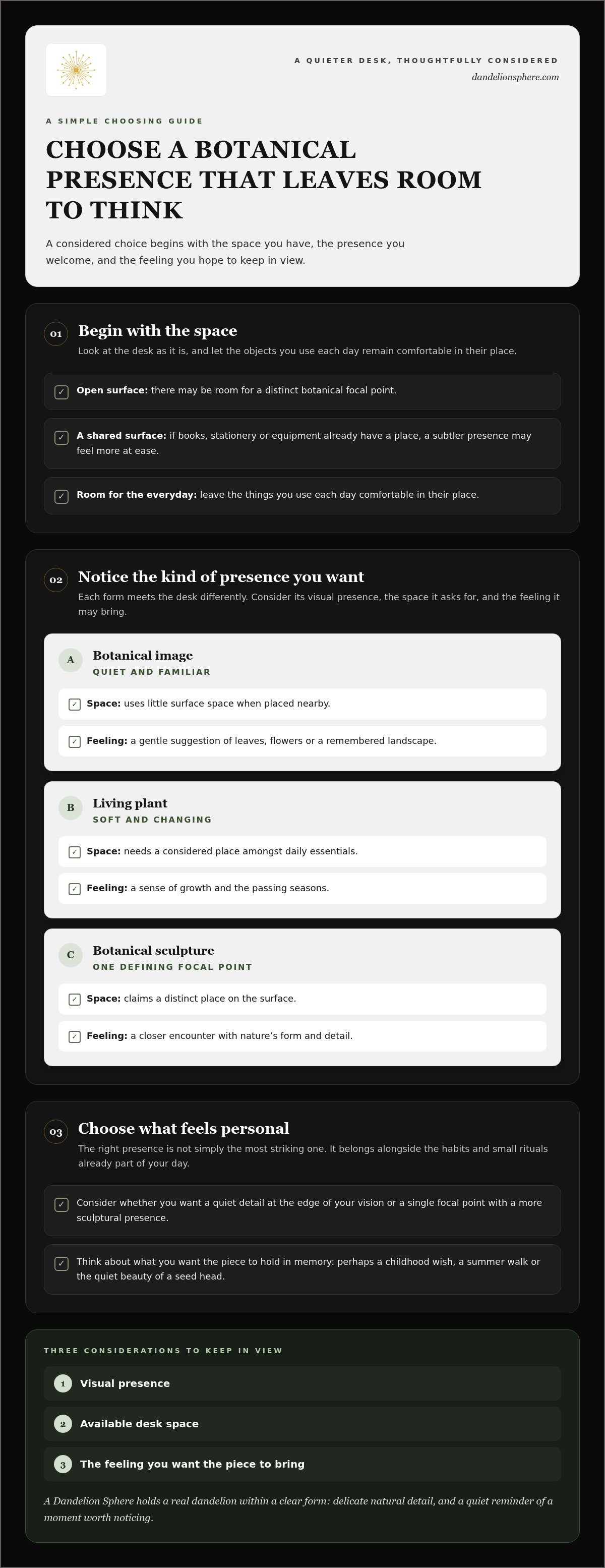
A simple way to compose botanical art on an office desk
A desk is already a composition, shaped by the work it holds and the habits that return each day. There’s no need to begin again or create a perfect scene. A few attentive moments can reveal where a natural form might belong, allowing it to sit alongside your working life rather than rearrange it.
Begin with what the desk already holds
Before moving anything, notice what you genuinely use: the notebook that stays open, the pen close to hand, the screen you return to. Make a little visual space by gathering or shifting only what feels out of place. Keep useful essentials where they serve you. The aim is to respond to your desk’s real rhythm, not to imitate a staged ideal.
- Clear. Set aside a moment to bring order to one small part of the surface. Move only what’s finished with or no longer needed there. Leave familiar tools within reach; the cleared space is simply a pause in the arrangement, not an invitation to remove what makes the desk work for you.
- Observe. Look at the lines already present: the edge of a notebook, the screen, the place your hands naturally rest. Notice where your attention tends to settle between tasks. A thoughtful composition begins with these everyday patterns, not with an imagined desk that bears little resemblance to your own.
- Place. Set one botanical focal point where it can be noticed without interrupting your work. It might sit beside a notebook or at the edge of the area you use most. Let the natural form have a little breathing room; nearby objects can remain simple, so its delicate detail has space to emerge.
- Pause. Return to your usual task. Later, look up and notice how the arrangement feels. Does the object meet your eye gently, or draw too much attention? Shift it if needed. Composition is a living response to daily use, and a small adjustment can make the difference between presence and clutter.
Create one point of stillness
One considered focal point is often enough. Let it relate quietly to the desk’s existing lines and sightlines, rather than building a cluster around it. A clear botanical form can hold attention through its silhouette and the detail within it, whilst the notebook, screen and working tools keep their familiar places.
Give the arrangement time to settle into your routine. On a shared desk, keep the piece within your own working area; on a surface that changes throughout the day, move it when your needs shift. The best composition isn’t fixed. It makes room for the work, and for a quiet moment within it.
If you’d like to consider a botanical focal point for your own desk, explore the Dandelion Sphere shop. Choose with the same unhurried attention: a nature’s art object should feel at home in the space you already inhabit.
A Dandelion Sphere as botanical art for an office desk
As children, many of us knew the small ceremony: find a dandelion gone to seed, close our eyes and send a wish into the air. The seeds travelled lightly, carrying a thought beyond the field. A Dandelion Sphere recalls that moment, holding a real dandelion within a clear sphere. The fine structure of its seed head remains visible, like a fleeting moment gathered from summer and set gently apart from the passing day.
A preserved dandelion, held within a moment
Look closely and the flower’s delicate form seems to contain its own quiet world. Each seed rests in relation to the whole, a small expression of nature’s order. The sphere doesn’t erase the memory of change; it offers a way to stay with it. For some, this may bring back a familiar field or the bright stillness of a childhood afternoon. For others, it is simply a memory made tangible.
There is a particular tenderness in the dandelion’s brief passage from flower to seed. It reminds us that beauty need not be permanent to matter. A preserved dandelion makes that thought present without turning it into a promise about time. It is nature’s art object, carrying the trace of a moment that once belonged to the open air.
A quiet reminder within the working day
On a desk, the sphere can become one considered focal point amongst the objects already there. It needn’t be part of a larger arrangement, or serve a practical task. Its clear form lets the botanical detail remain in view, while its presence offers a quiet point of attention between notes, correspondence and the ordinary movement of work.
This is the gentle possibility of botanical art for office desk: not a tool for concentration, nor a promise of a different working day, but a nature-centred presence chosen for what it means to you. It might recall a wish released into the wind, a garden visited in another season, or the simple wonder of looking closely at a seed head.
Dandelion Cubes offer another form of botanical art, carrying the same invitation to notice nature’s quiet artistry. Whether a sphere or a cube feels more at home is a matter of personal feeling and the character of the space. What matters is that the piece belongs to your own story, rather than asking the desk to become something it isn’t.
To discover the Dandelion Sphere collection is to encounter these preserved moments in their own stillness. Perhaps one will bring a fragment of summer to your desk, and remind you that even an ordinary day can hold a little wonder.
Make room for a quieter moment
Tomorrow, before the first message or page of notes, take a breath and look at the space where your working day begins. What would you like your eyes to meet there? Botanical art for office desk can be a small expression of that answer, chosen not to fill the surface, but to make it feel more your own.
Perhaps it will call to mind an open field, a childhood wish, or the turn of a season. Perhaps its meaning will change with the light and with the days. Let it belong to your routine in its own quiet way, asking nothing of you except, now and then, to pause.
If you feel drawn to bring a nature-centred presence into your workspace, take a quiet moment to discover botanical art objects for your desk. Let the choice begin with curiosity, and leave a little room for wonder.
Frequently Asked Questions
Can botanical art for an office desk work in a shared workspace?
Yes, a considered focal point can feel personal without taking over a shared surface. Before settling on a place, notice which areas colleagues use and what they see from their seats. Keep shared tools and working space easy to reach, and consider whether the piece feels at home within your own part of the desk. Each workspace has its own rhythms, so let everyday use guide the arrangement.
Is botanical art for an office desk distracting?
It depends on the person and the working environment. A simple, quiet form may offer a brief visual pause, whilst a busy arrangement or prominent position could draw your attention more often than you’d like. Notice how it feels during an ordinary day: while reading, replying to messages and moving between tasks. If your gaze keeps returning when you’d rather focus elsewhere, try a less prominent position.
Can a Dandelion Sphere sit beside a computer?
Yes. Choose a stable place near your computer where the sphere won’t obstruct your keyboard, screen or normal desk movements. Keep it clear of the area where you work with your hands, and move it carefully if you need to make room. The best position lets you notice its botanical detail without interrupting your usual setup.
How much botanical art should an office desk have?
There’s no universal number. One considered focal point may feel more composed than several pieces competing for attention, but the right balance depends on the desk and what you do there. If you often spread out papers, leave room for that; if your work surface is quieter, a botanical piece may have more space around it. Begin with what you genuinely use, then decide what feels missing.
What does a dandelion seed head symbolise in desk art?
A dandelion seed head often brings to mind childhood wishes, open fields and the passing of summer. Its meaning isn’t fixed; a familiar sight may recall a particular garden or a moment from years ago, whilst someone else may simply appreciate its delicate form. On a desk, that personal association can lend a small, private note to an otherwise everyday working space.
How should I care for botanical art displayed on an office desk?
Give the piece a stable place where it is unlikely to be knocked, and handle it gently when moving it to make room. To keep the clear surface looking its best, remove dust carefully with a soft, dry cloth. A little attention is usually enough to let the preserved botanical detail remain the focus.
Disclaimer
The content on this website is provided for inspiration and informational purposes only. Articles reflect the philosophy and storytelling of Dandelion Sphere and are not intended as professional advice. While every effort is made to ensure accuracy, no guarantees are given regarding completeness or current applicability.


