
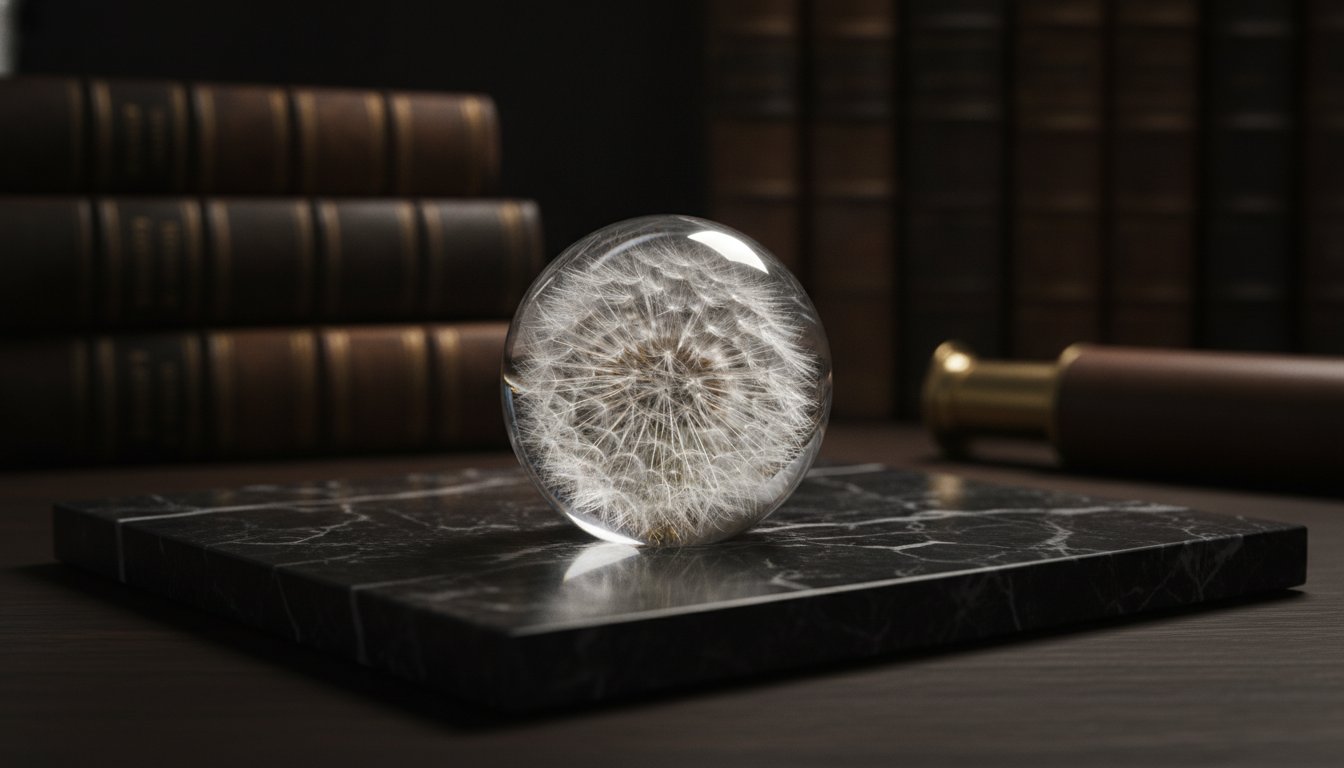
What if a single, fragile breath of summer could be caught, stilled, and held in the palm of your hand?
Most objects in our modern spaces are loud. They demand attention whilst offering very little soul. For those seeking botanical paperweights for collectors, the journey often leads to disappointment. Many find only cluttered trinkets. They feel mass-produced. They yellow. They fade. They lose the spirit they intended to preserve. You deserve more than a mere object. You seek a fragment of nature. A piece that inspires mindfulness. A conversation piece that transcends trends.
Discover how a fleeting moment in a summer meadow becomes a timeless collector’s piece through the quiet art of preservation. We'll explore the journey from a wild seed head to a museum-quality nature object. This is the story of the Taraxacum Orbis. A botanical sculpture. A silent witness to the poetry of nature. A botanical orb. A moment suspended in time. Nature’s quiet artistry. Held forever.
Key Takeaways
- Understand how the ancient desire to archive nature has evolved from flat herbariums into luminous, three-dimensional botanical sculptures.
- Identify the hallmark traits of botanical paperweights for collectors, ensuring you invest in pieces where the medium never obscures the delicate specimen.
- Discover the quiet poetry of the dandelion seed head, a symbol of childhood wishes held forever in a state of perfect stillness.
- Learn how to organise a serene interior gallery by using natural light to set your nature’s art object alight.
- Recognise why a museum-quality nature object serves as a profound legacy, transforming a fleeting summer moment into a cherished family heirloom.
The Evolution of Botanical Collecting: From Herbariums to Sculptural Orbs
The human impulse to archive beauty is ancient. We've always tried to stop the clock. For centuries, we pressed petals into heavy, leather-bound books. We called them herbariums. They were flat. They were silent. They were merely shadows of the living meadow. They lacked the volume of the field. They lacked the light. Today, the collector seeks more. They seek depth. They seek the third dimension. They seek a connection that feels alive.
The move from 2D archives to the three-dimensional botanical sculpture is a quiet revolution. It's a dialogue. Between the organic. And the permanent. It's a way to touch the untouchable. Whilst the history of glass paperweights traces back to 19th-century utility, the modern vision is entirely different. These botanical paperweights for collectors are not functional tools. They are museum-quality nature objects. They are silent observers of the passing year. They don't just hold paper on a desk. They hold a state of grace. They anchor a room with the stillness of the wild.
Modern botanical paperweights for collectors represent a shift in perspective. We no longer wish to just categorise nature. We wish to experience its presence. We seek objects that possess a soul. Objects that tell a story of a single, golden afternoon.
The Philosophy of the Specimen
There's a profound power in natural geometry. A single seed head is a masterpiece of architecture. It's a natural wonder. The collector's eye finds the extraordinary amongst the ordinary. We don't see a common field flower. We see a miracle of symmetry. A botanical orb serves as a quiet centrepiece. It's a point of focus in a cluttered world. It invites us to slow down. To breathe. To observe the intricate lace of the seeds. It's a conversation piece that speaks in whispers. It asks us to look closer. To find meaning in the small things.
Preserving the Ephemeral
A dandelion clock is the most fragile state in nature. It exists for a heartbeat. One breath. Then the wind takes it. Capturing this second is a form of preservation that feels like a wish. It's about keeping the delicate intact whilst time moves on. This isn't about mass production. It's about the unique fragment. This is a fine botanical art object. We transform a brief season into a timeless sculpture. It's a moment suspended in time. It's the poetry of nature. A held breath. Made tangible. A fragment of summer. Held forever. It's a memory of childhood. A wish that never flies away.
Suspended in Time: The Intricate Beauty of the Dandelion Seed Head
A summer meadow is a place of transit. The wind moves. The grass bows. Amongst the green, a white sphere stands perfectly still. It is the dandelion clock. A biological masterpiece at the edge of dispersal. For many, it is a childhood memory. A wish held in the lungs. One breath. One scattering. The passage of summer is written in these fragile seeds. To see one intact is to witness nature’s quiet artistry. It is a moment of profound fragility.
Capturing this state requires more than skill. It requires reverence. The botanical paperweights for collectors found today aim to preserve this exact second. Before the wind. Before the change. There is a paradox here. A museum-quality nature object offers strength. It protects the ultimate vulnerability. This tradition of capturing botanical truth has long inspired the curious. One might look to the Ware Collection of Blaschka Glass Models to see how art has always sought to mirror the organic with absolute clarity. We do not just look at the object. We look through it. Into the heart of a season.
The Anatomy of a Wish
Every seed is a vessel. It carries a hope for a new beginning. The visual rhythm of the pappus is a masterclass in natural symmetry. Each fine filament radiates from the centre. It creates a perfect sphere of geometry. This is why the dandelion remains the favourite amongst those who seek fine botanical art. It is a natural wonder. A seed head art piece that resonates with our own history. We see our wishes. We see our past. We see the poetry of nature made tangible.
The Artisan’s Observation
Selection is the first act of art. We seek the perfect specimen. One that embodies the essence of the fleeting moment. It must be whole. It must be luminous. The Taraxacum Orbis is a botanical sculpture that freezes a biological event in time, granting permanence to a state that nature intended to be ephemeral. There is a hushed silence in the studio. A stillness. The work demands a slow pace. Each nature collectible is treated as a silent witness. If you wish to bring this stillness into your own space, you may explore our current collection of botanical orbs. Each piece is a fragment of summer. Held forever.
Assessing Value in Fine Botanical Art: Beyond the Functional Object
Value is not a number. It's a feeling. A weight in the hand. A stillness in the eye. When seeking botanical paperweights for collectors, one must look beyond the surface. A true statement object breathes. It possesses a soul. It's the difference between a fragment of summer and a mere imitation. It's about finding a piece that captures the essence of life without the noise of production.
Clarity is the first requirement. The medium must vanish. It shouldn't distract. It should illuminate. We seek the preservation of colour. The retention of form. A collector’s piece should look the same in ten years as it does today. It's a legacy of a fleeting moment. Held forever. It's nature’s quiet artistry. Protected from the rush of time. It's a commitment to the permanent in a world that is always moving.
A museum-quality nature object is never loud. It doesn't shout for attention. Instead, it invites a quiet appreciation of the ephemeral. Finding the right botanical paperweights for collectors involves a search for this specific serenity. It's about finding a Taraxacum Orbis that feels like a biological event frozen in grace. Not a product of a factory. Not a soulless copy. It's a fragment of the wild. Brought indoors.
The Gallery Standard
Observe the seeds. Are they poised? Are they perfectly still? In fine botanical art, the poise is everything. If the seeds are disturbed, the poetry is lost. Weight also matters. It creates a sense of ceremony. A gravity. Collectors prioritise the "fine botanical art" label because it denotes intent. It's not a generic description. It's a promise of quality. It's a commitment to the extraordinary. It's the difference between a simple object and a masterpiece of nature.
A Dialogue of Materials
The sphere and the specimen must speak to each other. They shouldn't compete. Light is the final artisan. It travels through the orb. It sets the seed head alight. It reveals the intricate lace of the pappus. The absence of bubbles is the hallmark of a museum-quality nature object. Without these imperfections, the eye can wander freely. It can get lost in the geometry. It can find peace in the natural wonder. It's a dialogue of light and life. A moment suspended in time. It's the poetry of nature. Held in a state of grace.

Curating an Interior Gallery: The Placement of Nature’s Wonders
A home is more than a shelter. It is a collection of silences. A sanctuary where the soul finds rest amongst the noise of the world. Integrating a botanical sculpture into a minimalist space requires a quiet intention. It isn't about filling a void. It's about creating a centre. Amongst the clean lines of a serene interior, a natural wonder provides a soft counterpoint. It is a fragment of the wild. Perfectly stilled. A museum-quality nature object does not compete with your space. It enhances it. It brings the rhythm of the seasons indoors.
Placement is an act of curation. When searching for botanical paperweights for collectors, consider the dialogue between the object and its surroundings. A quiet mantelpiece. A solitary shelf. These spaces allow the botanical orb to breathe. It becomes a statement object. A silent observer of your daily life. It anchors the room in a state of grace. By grouping different specimens, such as a Dandelion Cube alongside a Dandelion Sphere, you can tell a story of different moments. A gallery of the ephemeral. Held forever.
The Serene Workspace
A desk is often a place of noise. Digital clutter. Racing thoughts. A unique nature’s art object can change the tempo of a working day. It serves as a conversation piece. It invites a slower pace of thought. Looking at the intricate geometry of a seed head encourages a moment of mindfulness. It's a visual breath. It reminds us that even the most complex structures in nature began as a wish. To explore how these pieces transform a room, you might enjoy reading The Botanical Interior Accent. It offers a deeper look at the dialogue between the organic and the built environment.
Lighting the Eternal Bloom
Light is the final artisan of fine botanical art. Positioning your collector’s piece to capture the morning sun is essential for revealing its soul. As the rays travel through the sphere, they set the seed head alight. The seeds cast delicate patterns on your surfaces. It's a dance of shadows. A shifting poetry that changes with the hour. To maintain the pristine clarity of your botanical orb, keep it away from direct heat. A simple, soft cloth is all that's required to preserve its brilliance. If you're ready to begin your own collection, explore our current selection of botanical orbs. Each piece is a fragment of summer. A moment suspended in time.
The Taraxacum Orbis: A Masterpiece for the Discerning Collector
The Taraxacum Orbis is more than a study of geometry. It's a testament to the fleeting. A Dandelion Sphere represents the ultimate expression of botanical art. It's where the wild meets the eternal. For those seeking botanical paperweights for collectors, the search often ends in this presence. In the stillness of a masterpiece. It's a legacy of summer. Held in a state of grace. It's a silent witness to the poetry of nature. A fragment of a meadow. Captured at the exact second of its perfection.
This is not a product of utility. It's a vessel for the soul. The collector doesn't just see a plant. They see a moment suspended in time. They see the intricate lace of the pappus. The delicate architecture of a wish. Each nature’s art object carries an emotional weight. It's a connection to the earth. To childhood. To the quiet moments we often overlook. Owning a collector’s piece is an invitation. To slow down. To breathe. To find wonder in the small things.
A Meaningful Gift for the Nature Lover
A preserved botanical sculpture is a shared memory. It's a bridge between two people. Giving a museum-quality nature object is a profound gesture. It's a memorable gift for life’s most significant milestones. A wedding. An anniversary. A quiet new beginning. You aren't just giving a piece of fine botanical art. You're giving a wish that never fades. It's a statement of permanence in a changing world. To choose the right specimen for your specific narrative, you may consult The Poetry of Giving. It's a guide for those who speak through objects. For those who find meaning in the delicate and the rare.
The Collector’s Legacy
Building a collection is an act of devotion. It's about honouring nature’s quiet artistry. One piece at a time. Each botanical orb is a fragment of the wild. Brought into the sanctuary of your home. As you look upon your gallery, you see the passage of seasons. You see the beauty of impermanence made permanent. This is the journey of the mindful observer. You can begin your own legacy at the Dandelion Sphere Shop. Find the moment that speaks to your soul. The wish that belongs to you. The summer that stays.
We don't truly own these objects. We care for them. They remind us that beauty is often fragile. That time is a river. But for a second, we can stop the flow. We can hold the summer. We can keep the light. Held forever. In a state of perfect peace.
The Eternal Summer: Finding Your Fragment of Nature
Nature is a series of disappearances. The meadow changes. The wind arrives. Through museum-quality preservation and poetic storytelling, we find a way to stay the hand of time. We've explored how the 19th-century herbarium has transformed into the three-dimensional botanical orb. We've seen how the value of botanical paperweights for collectors lies in the absolute clarity of the medium and the hushed reverence of the artisan. Each hand-selected botanical specimen is a silent witness to a season that refused to end. It's a dialogue between the organic and the permanent. A piece of fine botanical art that transcends trends.
Now, it's your turn to choose. Whether placed on a quiet mantelpiece or a serene desk, these statement objects serve as a centre for reflection. They're a wish made tangible. A memory held in a state of grace. You're invited to explore the Taraxacum Orbis collection and hold a fleeting moment forever. Let the light of a summer morning catch the seeds. Let the stillness anchor your space. The poetry of nature is waiting. It's time to bring the wild indoors. Find the natural wonder that speaks to your soul. Hold the summer. Held forever.
Frequently Asked Questions
Is the dandelion inside the botanical orb a real flower?
Every specimen held within the botanical orb is a genuine dandelion seed head. It's a natural wonder. We select each one at the peak of its fragility to ensure the geometry is perfect. This is nature’s quiet artistry. Held forever. The seeds aren't imitations. They're fragments of a summer meadow. A biological event frozen in time. A moment suspended in time. Made tangible for your collection.
Can the seeds inside the sphere move or fall off over time?
The seeds within the botanical sculpture are held perfectly still and cannot move. The preservation process secures each delicate filament in its natural position. It's a state of permanent grace. Even the passing years won't disturb the intricate symmetry. You can hold the orb and observe the lace-like patterns without fear. The seed head art remains intact. It's a wish that never flies away.
How should I clean and maintain my botanical sculpture to ensure clarity?
Maintenance of your nature’s art object requires only a gentle touch. Use a soft, dry cloth to remove dust from the surface. This preserves the crystal-clear clarity that allows the specimen to breathe. Avoid using liquids or abrasive materials. They might cloud the luminous finish. Treat the object with hushed reverence. It's a fine botanical art piece. A simple wipe keeps the specimen radiant for a lifetime.
What happens if the collector’s piece is exposed to direct sunlight for years?
Whilst light sets the seeds alight, it's best to avoid direct, prolonged sunlight. Constant UV exposure can affect the clarity of any museum-quality nature object over many decades. Place your collector’s piece in a spot with filtered or indirect light. This ensures the poetry of nature stays bright. Proper placement protects the delicate specimen. It keeps your fragment of summer vivid. It preserves the stillness of the wild.
Is each Taraxacum Orbis unique, or are they all identical?
Every Taraxacum Orbis is entirely unique because nature never repeats itself. Each seed head has its own rhythm. Its own individual symmetry. When you own one, you own a unique fragment of the wild that can't be replicated. These botanical paperweights for collectors are as varied as the meadows they come from. No two wishes are ever the same. It's a piece of fine botanical art that belongs only to you.
How does a botanical orb differ from a standard glass paperweight?
A botanical orb differs from standard glass objects through its living core. It holds a real biological specimen. Not a glass imitation. It's a piece of nature’s quiet artistry where the focus is on the fragile seed head. Not the medium. It's a statement object that tells a story of life and the passage of time. Most glass objects are purely decorative. This is a fragment of a season. Held in a state of grace.
Can these botanical art objects be used as memorial gifts?
These nature collectibles are often chosen as a meaningful gift for remembrance. They represent a wish that stays. A memory made tangible. It's a poetic way to honour a life’s milestone or a quiet departure. The dandelion is a symbol of hope and childhood nostalgia. Gifting a botanical sculpture is a way to share a moment that lasts. It's a legacy held forever. A silent witness to a cherished story.
What is the best way to display a botanical orb for maximum visual impact?
Display your botanical paperweights for collectors where the light can reach them. A morning sunbeam through a window is ideal. It illuminates the seeds from within. Place the orb on a dark, minimalist surface to highlight the white geometry. It should be a centrepiece for reflection. A conversation piece in a quiet room. Let the shadows cast delicate patterns on your walls. Let the object anchor your space in serenity.
Disclaimer
The content on this website is provided for inspiration and informational purposes only. Articles reflect the philosophy and storytelling of Dandelion Sphere and are not intended as professional advice. While every effort is made to ensure accuracy, no guarantees are given regarding completeness or current applicability.


