
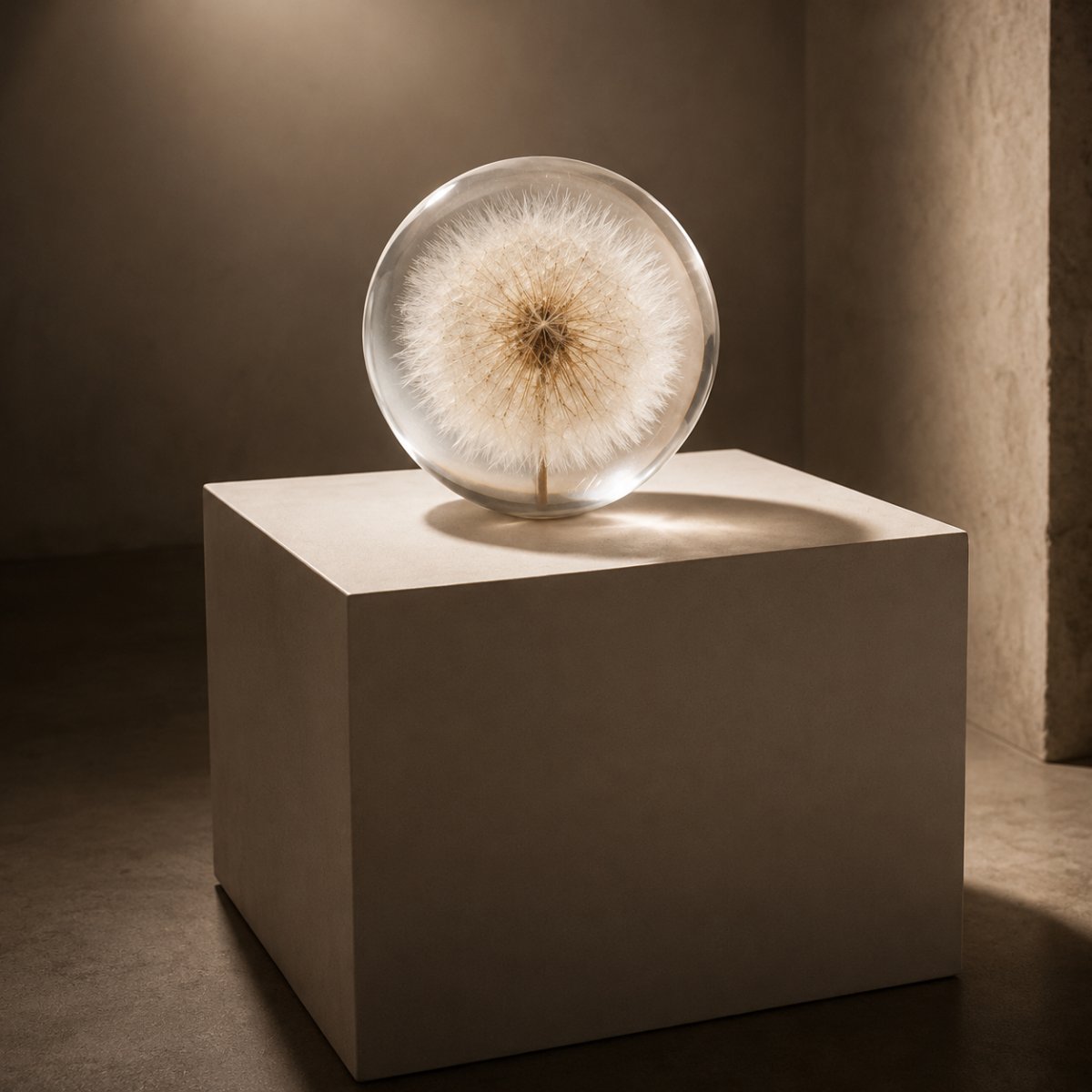
The most enduring beauty is often the most fragile. A petal. A seed. A breath of wind. We seek a timeless decorative object to anchor our quietest spaces. Yet we often find ourselves surrounded by the noise of the passing season. Objects that spoke to us yesterday feel silent today. They clutter our homes. They lack a soul. They lose their whisper after a single winter.
It's a familiar ache. The desire for a living space that feels like a sanctuary. You want to invest in beauty that remains. Beauty that honours the passage of time. In this reflection, we'll discover why true permanence belongs to the natural world. We'll learn to identify pieces that transcend the fleeting nature of trends. We'll explore how a botanical orb can hold a moment suspended in time. Together, we'll embrace the philosophy of slow living through the quiet poetry of nature's artistry.
Key Takeaways
- Understand why true timelessness is found in the rhythms of the natural world rather than the shifting shadows of design trends.
- Learn to identify a truly timeless decorative object by its ability to hold a fleeting moment of beauty in perfect, silent clarity.
- Discover how to prioritise nature’s quiet artistry over mass-produced duplicates to ensure your home accents retain their soul.
- Master the philosophy of slow living by organising your sanctuary around a quiet centre where the eyes can rest and the heart finds peace.
- Explore how a botanical orb serves as a fragment of summer, allowing you to keep a piece of the meadow’s magic held forever.
The Myth of the Trend: Why Timelessness Is Not a Style
Style is a shadow. It shifts as the light moves. Trends are loud. They demand your attention. They shout. They insist. Then. They fade. Most objects in our homes are echoes of a fleeting mood. They belong to a season that has already passed. We buy them to fill a void. Yet. The void remains. The space feels cluttered. Not with things. But with the noise of yesterday's ideas.
True timelessness is different. It's a quiet state. An absence of noise. It doesn't ask to be seen. It simply exists. A moment suspended in time. This is the only permanence we can truly hold. When we search for a timeless decorative object, we aren't looking for a fashion. We're looking for a truth. A stillness that remains when the world outside is rushing.
The Illusion of the "Classic" Accessory
We often mistake the familiar for the eternal. Stone. Ceramic. We label them as designer essentials. Yet. They eventually feel dated. A specific curve of a vase. A particular grain of stone. These are markers of a human moment. They are historical mimicry. They try to capture a feeling. But they are bound by the tools of their time. They are heavy with the weight of intention.
The human eye is restless. It tires of man-made patterns. They are predictable. They lack the chaotic grace of the wild. When we seek a timeless decorative object, we're often sold a trend disguised as a classic. It's an echo. Not the voice itself. In The Timeless Way of Building, the philosophy suggests that beauty comes from a quality without a name. It's a wholeness that transcends the ego of the maker. It's a living structure. Not a static ornament.
Nature as the Only Constant
Nature's artistry is the only constant. The geometry of a seed head. It's a miracle of mathematics. It was perfect a thousand years ago. It's perfect today. It will be perfect for a thousand years to come. Botanical forms never fall out of favour. They are the foundation of our visual world. They are the first patterns we ever saw. The ones we'll always recognise.
The poetry of nature is a language that requires no translation. It speaks to a deep, ancestral memory. A botanical orb isn't a mere addition to a room. It's a fragment of summer. It's a nature's art object that resists the decay of fashion. It doesn't belong to a decade. It belongs to the earth. It belongs to the sun. It belongs to the quiet stillness of your sanctuary. Choosing such a piece means finding a centre. A place for the eyes to rest. A moment held forever.
Beyond the Surface: The Architecture of a Suspended Second
The dandelion is a ghost of the meadow. A fragment of summer. Its architecture is impossibly fine. It's a structure built of air and light. A single breath would scatter it. It would vanish into the wind. Yet. Here. It remains. This is the art of stillness. It's the act of capturing the ephemeral before it's lost to the passage of time. These museum-quality nature objects preserve the delicate for a future we cannot yet see.
We often look to history for stability. We admire the timeless appeal of Art Deco or the gravity of ancient stone. But a timeless decorative object can also be weightless. It can be a seed. A whisper. By holding a moment suspended in time, we create a bridge between the seasons. We find a sanctuary in the small. We learn to see the strength in what's fragile. It's a quiet revolution against the loud and the heavy.
The Science of Stillness
Clarity is the silent language of this preservation. It's a window into a summer meadow. A fleeting moment becomes a permanent botanical sculpture through a ritual of absolute transparency. Every seed is visible. Every tiny filament is sharp against the light. Nature's quiet artistry is captured when the most fragile state of a living thing is held in a state of eternal, crystalline grace.
The Weight of Memory
Think of a wish made in childhood. A field of gold turning to silver. You blew. The world changed. That memory is now suspended in a botanical orb. These pieces act as anchors. They hold our history amongst the chaos of a rushing world. There's a deep connection between the observer and the observed. You aren't just looking at a collector's piece. You're looking at a fragment of your own story. A piece of a day you thought was gone.
Objects should do more than fill a shelf. They should hold a space in the heart. They should remind us of the poetry of nature. If you wish to find your own anchor, you might explore the garden of held moments. It's a way to bring the stillness of the meadow into the centre of your home. A way to remember that even the most fleeting beauty can be held forever.
Nature’s Artistry vs. Mass Production: A Comparison of Permanence
The factory produces duplicates. Thousands. Identical. Without a heartbeat. They are born of precision but lack a soul. Nature creates only originals. Each seed head is a singular event. A timeless decorative object should not be a copy. It should be a discovery. A collector’s piece should be as unique as a fingerprint. When we choose the manufactured, we choose the temporary. A trend is a flicker. A natural wonder is an eon. The soul seeks the organic over the manufactured because it recognizes its own complexity in the wild patterns of the earth.
We see this enduring connection throughout the history of our living spaces. Nature-inspired design has long been the anchor of the thoughtful home. It's a language that requires no translation. It doesn't age because it doesn't follow the clock. Whilst mass-produced items begin to fade the moment they leave the shelf, a fragment of nature grows more profound with every passing year. It becomes a witness to your life. A quiet observer of your most private moments.
The Artisan’s Touch
There is a vast distance between a common souvenir and a fine botanical art piece. One is a loud reminder of a place. The other is a silent invitation to a feeling. In the creation of a timeless decorative object, the hand of the maker must remain invisible. If we see the effort, the magic vanishes. We must only see the dandelion. Suspended. Perfect. This is The Poetry of Preservation. It's the act of letting nature speak its own hushed language without the interruption of human ego. It requires a reverence for the fragile. A patience that the machine can never possess.
Choosing Your Statement Object
Identifying a conversation piece that will endure requires a shift in perspective. It's about more than shape. It's about light. It's about shadow. A botanical orb provides a more profound focus than a traditional vase. A vase is a vessel for something else. It waits to be filled. The orb is the thing itself. It's a world held in clarity. It changes as the day moves. The morning sun reveals the intricate architecture of the seeds. The evening glow softens the edges into a silver mist. It provides a centre of stillness. A place for the eyes to rest when the world feels too loud. It's an investment in a sanctuary. A way to ensure that the beauty of your home remains as constant as the seasons themselves.

The Quiet Centre: Organising Your Space for Reflection
Minimalism is not emptiness. It is intention. It is the deliberate choice to let one thing speak. A single voice in a quiet room. We often feel the heavy need to fill. To layer. To group. We are told that a home must be a collection of many things to feel complete. But the soul needs space to breathe. It needs a place where the air feels thin and the light feels thick. Create a centre of stillness. A place for the eyes to rest. When you choose a timeless decorative object, you are not merely filling a void. You are defining a boundary. Between the chaos of the world and the peace of your sanctuary.
Think of the botanical interior accent as a dialogue. It is a conversation between the space and the soul. It does not demand attention with loud colours or sharp angles. It invites it. Place your nature art object where the light can find it. Watch the morning sun pass through the delicate architecture of the seeds. See the shadows lengthen across the floor. The object changes as the day moves. Yet. Its essence remains. It is a fixed point. A small miracle held in clarity. It reminds us that whilst the world is rushing, there is a beauty that stays.
Curating with Intention
Less. But better. This is the philosophy of the botanical art collector. We avoid the trap of the seasonal. The impulse to change our surroundings as the fashion shifts. A true botanical art collector piece does not belong to a month. It belongs to the cycle of years. It is a constant. A summer that never ends. Whilst the market insists on newness, the collector finds depth in the enduring. We choose objects that hold a memory tangible. We choose pieces that we will still love when the seasons have turned a hundred times.
A Sanctuary in the Home
Use a botanical orb to anchor a workspace. Or a bedside table. Natural forms have a profound influence on human behaviour. They bring a hushed calm. They slow the heart. They remind us of the slow, patient growth of the meadow. In a world of digital noise, a fragment of nature’s quiet artistry provides a meditative focus. It is a window into a simpler state of being. A room anchored by a single natural wonder becomes a cathedral of the everyday, where the passage of time is observed but never feared. It is a place of deep, restorative silence.
Find your own centre of stillness amongst our botanical art objects. Let nature be the anchor of your home.
The Taraxacum Orbis: A Fragment of Summer Held Forever
The search for a timeless decorative object often leads us back to the earth. It leads us to the Taraxacum Orbis. This is the ultimate expression of a moment suspended in time. It is a seed head held in perfect clarity. A miracle of preservation that defies the seasons. Every tiny filament is sharp. Every seed is poised for a flight that will never come. This is not a transient accessory. It is a fragment of summer. It is a piece of the meadow brought into the quiet of your home. It is a witness to the poetry of nature. Held forever.
We often forget the small wonders. We overlook the delicate. But the Taraxacum Orbis demands a different kind of attention. It requires a hushed breath. A slow gaze. It is a nature’s art object that speaks of beginnings. And of endings. It reminds us that beauty does not need to be loud to be eternal. It only needs to be true. For the one who seeks a meaningful gift, this botanical orb offers something rare. It offers the gift of a paused second. A sanctuary in a sphere.
The Poetry of the Dandelion
There is a deep nostalgia in the dandelion. We remember the gold of the grass. The silver of the seed head. We remember the act of making a wish. A single breath would scatter the seeds across the wind. Now. That wild flower is transformed into a preserved botanical sculpture. It is the geometry of a wish made tangible. We have captured the architecture of the ephemeral. It is a dialogue between the wild and the refined. A collector’s piece that honours the fragile state of a summer’s afternoon. It is the poetry of nature, written in light and stillness.
A Legacy of Stillness
The world outside is a storm of change. Trends arrive with a shout and leave with a whisper. Yet. This botanical orb remains constant. It does not age. It does not tire. It is a legacy of stillness. It reflects the enduring appeal of nature’s quiet artistry. By bringing this natural wonder into your space, you are choosing to celebrate the beauty of impermanence. You are acknowledging that the most fleeting moments are often the ones worth holding. It is a final reflection on what it means to live with intention. To find a timeless decorative object that doesn't just fill a space. But fills a heart. It is a memory held in crystalline grace. A piece of the sun. A fragment of the wind. A sanctuary for the soul.
Embracing the Eternal Stillness
The search for a timeless decorative object ends where the meadow begins. We've discovered that permanence isn't found in man-made patterns. It's found in the quiet poetry of nature's artistry. A home becomes a sanctuary when we choose intention over volume. When we let a single, fragile moment speak. True beauty resists the noise of trends. It lives in the geometry of a seed. It lives in the memory of a childhood wish. It stays when everything else fades.
Each Taraxacum Orbis is handcrafted in our boutique art studio. We feature only real, perfectly preserved botanical specimens. These pieces are not mere accents. They are timeless centrepieces for the mindful home. They hold a fragment of summer tangible. They allow the light to find a suspended second. The seasons will turn. The world will rush. Yet. Your centre of stillness remains. It is a promise of peace held in crystalline clarity.
We invite you to explore the Taraxacum Orbis and find the piece that speaks to your soul. May your home always be a place of deep reflection and enduring beauty.
Frequently Asked Questions
What makes a decorative object truly timeless?
A truly timeless decorative object is one that transcends the shifting shadows of design trends by anchoring itself in the eternal rhythms of the natural world. It doesn't follow a passing fashion; it holds a truth that remains constant whilst the world changes. It is a quiet state of being. It is a moment suspended in time that requires no translation across generations or cultures.
How can I distinguish between a trend and a lasting art piece?
A trend is a loud demand for attention that begins to fade as soon as the light moves, whilst a lasting art piece possesses a quiet, internal stillness. Look for the unique. Factories produce thousands of identical duplicates, but nature creates only originals. If an object feels like a fragment of a specific decade, it is a trend. If it feels like a fragment of the earth, it is art.
Why is nature considered the most timeless form of art?
Nature's artistry follows a geometry that has been perfect for thousands of years. The intricate architecture of a seed head or the delicate curve of a petal doesn't fall out of favour because it is the foundation of our visual world. It speaks to an ancestral memory. It is a language of beauty that was valid a century ago and will remain valid a century from now.
Are botanical orbs suitable for a minimalist home?
They are the perfect anchor for a minimalist sanctuary because they embody deep intention rather than empty clutter. Minimalism is not about emptiness; it is about choosing one thing that speaks with absolute clarity. A single botanical orb provides a quiet centre of stillness. It allows the eyes to rest and the mind to breathe without the distraction of unnecessary, mass-produced ornamentation.
How do I care for a fine botanical art object?
Preservation is a ritual of stillness that requires very little intervention from the hands. Keep your nature's art object away from the direct, harsh heat of a fire and out of the constant, punishing glare of the midday sun. Use a soft, dry cloth to gently remove the dust of the passing days. Treat it with the same reverence you would accord a fragile, beautiful memory.
Can a timeless decorative object also be a meaningful gift?
It is perhaps the most profound way to offer a piece of your heart to another. When you give a timeless decorative object like the Taraxacum Orbis, you are giving a moment held forever. It is a memorable gift for a wedding, a housewarming, or a significant birthday. It represents a wish made tangible. It is a fragment of summer that will never wither or fade.
What is the significance of the dandelion in botanical art?
The dandelion is a powerful symbol of hope and the fleeting, delicate nature of life. It represents the transition from a bright wild flower to a silver ghost of the meadow. In botanical art, it is the ultimate challenge of preservation. We capture the geometry of a wish before the wind can scatter it. It is a miracle of fragile strength held forever in crystalline grace.
How does light affect the appearance of a botanical orb?
Light is the breath that brings a botanical sculpture to life. As the sun moves across your room, the seeds within the orb will catch the glow in different ways. Morning light reveals the fine, silver architecture of the filaments. Evening light softens the edges into a dreamlike mist. The object is never the same twice. It changes with the rhythm of the day.
Disclaimer
The content on this website is provided for inspiration and informational purposes only. Articles reflect the philosophy and storytelling of Dandelion Sphere and are not intended as professional advice. While every effort is made to ensure accuracy, no guarantees are given regarding completeness or current applicability.


