
What if a breath could stay? A summer field. Held. Still. We often seek to fill our homes with life, yet we find ourselves surrounded by the noise of objects that lack a soul. Cluttered spaces. Empty echoes. The fleeting grace of a cut flower that wilts whilst the sun still shines. True minimalist botanical decor is not about filling a room. It's about the presence of a single, perfectly captured moment of nature.
You likely feel the weight of the modern world pressing against your walls. You long for a sanctuary. A place where time slows. This guide explores how to transform your living space into a haven of mindfulness through the quiet poetry of a botanical sculpture. Honouring the earth. You will discover how a nature's art object becomes a conversation that never ends. A connection to the wild that does not fade. We invite you to explore the Taraxacum Orbis. A fleeting moment. Held forever. A memory made tangible.
Key Takeaways
- Discover the dialogue between the wild and the curated. A balance. A profound stillness.
- Witness the transition of a fleeting bloom into a nature's art object. A moment held forever.
- Explore the sensory depth of a botanical orb. A sculpture that invites reflection beyond the limits of a print.
- Identify Zen focal points within your sanctuary. Where minimalist botanical decor meets the quiet of a mantel or bedside.
- Embrace the Taraxacum Orbis as a legacy of light. A memory made tangible through a symbol of wishes.
The Philosophy of Minimalist Botanical Decor
Minimalism is not a void. It's an intention. It's the choice to surround oneself only with what carries weight. In the quiet practice of minimalist botanical decor, we find a dialogue. Between the wild. And the curated. It's a philosophy of "less but better" that seeks to replace the noise of mass production with the hushed breath of the meadow. A single, profound object speaks with more clarity than a gallery of prints. It holds space. It demands a pause.
A nature's art object serves as a bridge. It connects our modern, structured lives to the untamed cycles of the earth. When we choose a collector's piece like the Taraxacum Orbis, we aren't just selecting an accent. We're inviting a focal point for mindfulness into our sanctuary. It's a quiet authority. A testament to the beauty found in the smallest, most overlooked details of our world.
A Fleeting Moment Held Forever
Think of a dandelion in late spring. A sun-child turned to silver. It's the most temporary of things. One stray breeze. One exhaled wish. And it's gone. There's a deep emotional resonance in the act of capturing that wish before it scatters. We've all stood in fields as children, holding these fragile globes with reverence. By suspending this state, we create a memory made tangible. This act of preservation transforms a common field dweller into a museum-quality nature object that stands outside the reach of the seasons.
The Poetry of Natural Stillness
Modern architecture thrives on the linear. Steel. Glass. Right angles. These spaces are beautiful, yet they can feel cold without the organic complexity of a botanical orb. The contrast is vital. The sharp, architectural lines of a room meet the delicate, radial geometry of the seeds. It's a moment suspended in time. It brings a sense of ceremony to the everyday. By placing such an object on a desk or a mantel, you create a ritual of observation. You're not just looking; you're seeing. You're finding a point of stillness amongst the rush of the hours. This is the true essence of minimalist botanical decor. It's the art of noticing the quiet poetry that exists in the pause between breaths.
From Fleeting Bloom to Eternal Botanical Sculpture
To hold a dandelion is to hold a secret. It's a whisper of the field. A fragile breath. We act as curators of these briefest seconds. The transition from a living, breathing bloom to an eternal botanical sculpture is a silent ceremony. It's the suspension of a state that nature intended to be ephemeral. Within the crystal-clear clarity of a botanical orb, the dandelion finds a new weight. It's no longer vulnerable to the wind. It possesses a gravity that commands the eye. In the context of minimalist botanical decor, this presence is essential. It provides a focal point that is both light and substantial.
The artisan does not create the beauty. They merely witness it. They capture it at the precise moment of perfection. Before the decay. Before the scattering. This is the role of the curator. To select. To protect. To present the wild in a way that allows us to live alongside it without the clutter of the temporary. It's an act of honouring the lifecycle by pausing it at its most radiant peak.
Nature’s Art Object: Beyond the Surface
A print is a shadow. A memory of a memory. Three-dimensional preservation offers something more profound. It's a dialogue with depth. You can trace the path of a single seed from every angle. This 360-degree visibility reveals the architecture of the wild. It invites you to look closer. To see the world in a grain of sand. This depth is what defines a true collector's piece. It's an interaction that changes as the light moves through the room. You can explore more about this in our journal entry on The Botanical Art Collector Piece: Curating Eternal Stillness.
The Rhythmic Beauty of the Taraxacum Orbis
There is a hidden rhythm in the wild. A mathematical perfection. Within the Taraxacum Orbis, this geometry is magnified. The sphere acts as a lens. It draws the eye into the centre of the bloom. It reveals the quiet details that usually pass us by. This is nature's eternal vow. A promise of beauty that does not fade. It's a conversation piece for a home that values the poetry of the natural world. This is the height of minimalist botanical decor. A single object that tells the story of a whole summer. Perhaps it's time to invite this stillness into your own space.
Comparing Textures: Why Botanical Orbs Surpass Traditional Prints
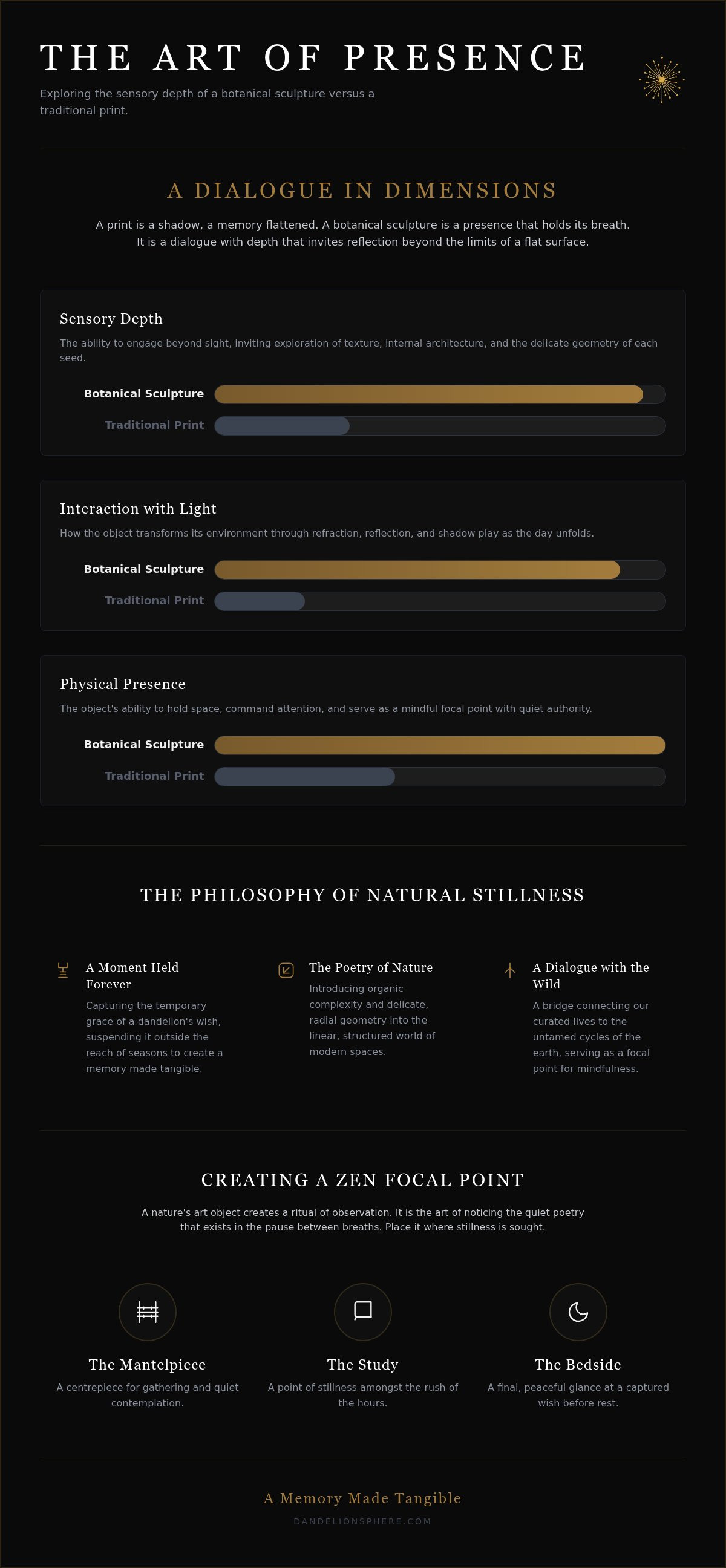
A print is a shadow. A memory flattened against paper. Whilst a photograph can capture the likeness of the wild, it cannot hold its breath. In the quiet practice of minimalist botanical decor, we often settle for the two-dimensional. A leaf pressed behind glass. A watercolour sketch. These are echoes. They lack the pulse of the original. A botanical sculpture offers something more profound. It's a dialogue with depth. It's a collector's piece that invites the eye to wander into the heart of the object. Perspective shifts as you move through the room. One moment, you see the radial symmetry of the seeds. The next, the light catches the silver down. It's a living presence that a flat image cannot sustain.
The Taraxacum Orbis represents a sophisticated evolution of the botanical print. It's not merely an image of nature. It is nature, suspended. Held. The weight of the object in the hand provides a tactile anchor. It feels permanent. Real. It demands a different kind of attention. A slower gaze. By choosing a three-dimensional form, you aren't just adding a visual accent. You're introducing a new dimension of stillness into your sanctuary.
Sculpting with Light and Clarity
Sunlight is a collaborator. When it enters a crystal-clear botanical sculpture, it doesn't just reflect. It travels. It illuminates the intricate architecture of the seeds from within. This interplay creates a secondary, ephemeral art piece. Long, delicate shadows cast upon the wall. They move as the sun moves. They change character from the sharp clarity of morning to the soft amber of dusk. Clarity is the soul of a high-quality nature object. It must be a window. It must allow the light to tell the story of the dandelion without interference. This transparency ensures that the object remains light, even as it holds significant emotional weight.
A Dialogue Between Nature and Space
A botanical orb acts as a bridge. It connects the structured interior to the untamed world outside. It brings the meadow to the mantelpiece. The heavy, polished surface of a collector's piece feels cooling to the touch. It's a sensory experience that grounds the spirit. This is more than an object; it's a Dialogue Between Nature and Space. It bridges the gap between the wild and the curated. It's a choice to surround yourself with objects that have a soul. Objects that tell a story of a moment suspended in time. This is the true essence of minimalist botanical decor. Finding the extraordinary in the quietest details of the earth.
Styling Your Sanctuary with Nature’s Art Objects
To style a sanctuary is to curate silence. It requires a gentle hand. A collector's piece does not demand attention; it waits for it. To truly appreciate the quiet poetry of minimalist botanical decor, one must embrace white space. An object needs room to breathe. If a surface is crowded, the story is lost. Place your botanical sculpture where the eye can rest upon it without distraction. A lone mantel. A bare bedside table. A single shelf. Let the emptiness around the orb act as a frame for the intricate life within.
Consider the dialogue of textures. A crystal-clear botanical orb finds its perfect companions amongst other fragments of the wild. A piece of driftwood. A river-smoothed stone. A slab of raw oak. These materials speak the same language. They are grounded. Real. By grouping different sized sculptures together, you create a narrative of growth and time. This layering is a key element of minimalist botanical decor. A smaller orb beside a larger one suggests a legacy. A wish passing from one generation to the next.
The Serene Workspace
The modern desk is often a place of digital fatigue. Flat screens. Endless noise. A botanical orb serves as a mindful companion during the working day. It's a tactile anchor. When the eyes tire of pixels, they can find refuge in the radial geometry of a dandelion. It's a reminder of a slower world. To highlight the sculpture, place it where natural light can pierce the centre. Avoid harsh overhead glare. Let a soft desk lamp or a nearby window reveal the silver down of the seeds. It's a small ritual of beauty that preserves your focus.
Curation as Storytelling
Your home is a living journal. Each nature's art object you choose represents a chapter. You might mix different specimens to reflect the changing seasons. The bright promise of spring. The heavy stillness of late summer. This is the role of the minimalist Cabinet of Curiosities. It's a collection of wonders that invites reflection rather than clutter. You can find inspiration for your own curated collection of botanical art objects by exploring our latest pieces. Every selection is a choice to hold onto a fleeting moment. To make a memory tangible. To live amongst the extraordinary.
The Taraxacum Orbis: A Legacy of Wishes and Light
A wish is a fragile thing. Usually. It's carried by the wind. Scattered. Lost to the tall grass. But within the Taraxacum Orbis, the wish remains. It's a memory made tangible. This is the heart of minimalist botanical decor. It's the decision to hold onto the light. We all remember the fields of our youth. The golden sun. The silver globes waiting for a breath. By preserving this state, we create a legacy. A physical anchor for the wonder we felt as children. It's a way to keep the magic of the meadow within reach. Even whilst the world outside moves too fast. The dandelion is not a weed here. It is a symbol of hope. Of childhood wonder. Held forever.
Trends fade. Seasons turn. Yet, a botanical sculpture stands outside of time. It's a constant. A quiet witness to the passing years. It doesn't ask for attention. It simply exists. In its stillness, it offers a sanctuary. A place for the mind to rest. This is the beauty of the brief, held forever. A collector's piece that grows more meaningful as time passes. It becomes a part of the home's soul. A silent guardian of a moment suspended in time. It's an invitation to slow down. To breathe. To appreciate the quiet poetry of everyday life.
A Meaningful Gift for the Nature Lover
Choosing a gift is an act of translation. You're turning a feeling into an object. For the nature lover, a botanical sculpture is a reflection of a shared moment. Perhaps a walk in a summer meadow. Or the start of a new chapter. The dandelion wish is a universal symbol. It's perfect for anniversaries. For new beginnings. It says that some moments deserve to stay. It's a promise. A memory made tangible for those who appreciate the quiet poetry of life. This is the true essence of minimalist botanical decor. You can explore our thoughts on this in The Poetry of Giving: A Guide to Selecting a Unique Botanical Gift.
Suspending Time in a Crystal Sphere
Every piece is a story. The artisan acts as a scribe. Recording the delicate geometry of the wild. It's a slow process. A meditative one. The work is not about production. It's about presence. We invite you to visit our Journal for more reflections on the art of stillness. If you seek something unique, you may contact our studio for bespoke inquiries. We seek to capture the poetry of nature. One breath at a time. Held in a crystal sphere. Forever. A moment. Suspended. In stillness.
Inviting the Eternal Meadow Home
A home should be a sanctuary. A place where the clock slows. We've explored how the choice of minimalist botanical decor is more than an aesthetic preference. It's a commitment to the quiet poetry of existence. By selecting a nature's art object, you bridge the gap between the structured world and the wild meadow. You've seen how depth and light transform a simple dandelion into a museum-quality botanical sculpture. It's a dialogue that never ends. A memory made tangible. Held forever within a crystal-clear sphere.
These artisanal pieces from the Taraxacum Orbis studio aren't merely objects. They are witnesses to the beauty of the brief. They remind us that whilst time moves on, some wishes deserve to stay. Whether placed on a sunlit desk or a quiet bedside, they offer a focal point for modern mindfulness. Real nature. Suspended. Still. We invite you to explore the collection of Taraxacum Orbis at the Dandelion Sphere shop and find the sculpture that speaks to your own story. May your space always be a haven of light and reflection.
Frequently Asked Questions
What is the best way to clean a botanical orb without scratching it?
To clean your botanical orb without scratching the surface, use a soft microfibre cloth. No abrasive materials are needed. A gentle, dry touch is all that is required to maintain the museum-quality clarity. Avoid any chemical cleaners or liquids. The surface is polished to perfection. Treat it with the same reverence you would a fine lens. A light dusting ensures the light continues to travel through the seeds without obstruction.
Can I place my botanical sculpture in direct sunlight?
Sunlight is a beautiful collaborator for your botanical sculpture. It pierces the crystal-clear sphere and illuminates the intricate architecture of the seeds. However, be mindful that the orb can act as a magnifying lens. Avoid placing it near flammable materials in intense, direct sun for extended periods. When positioned thoughtfully, the sun will cast long, poetic shadows that dance across your sanctuary as the day turns whilst the light shifts.
Are the dandelions inside the spheres real or artificial?
Every Taraxacum Orbis contains a real dandelion. These are not replicas. We capture each bloom at its precise moment of perfection, usually in the quiet hours of early morning. By preserving the biological specimen, we ensure that the radial symmetry and silver down are authentic. This connection to the living earth is what makes each piece a true nature's art object. It is a fleeting moment, held forever in a state of grace.
How do I style a botanical orb in a very small apartment?
In a limited space, one singular object carries more weight. Minimalist botanical decor thrives on intention. Choose one Zen focal point, such as a floating shelf or a small bedside table. Ensure there is ample white space around the orb so it can breathe. By placing it amongst your most cherished items near a window, you draw the outside world in. This creates an illusion of depth and a stronger connection to the wild.
Why is a botanical sculpture considered a collector’s piece rather than a souvenir?
A collector's piece is defined by its artisanal integrity and the story it tells. Mass-produced items often lack a soul. Each botanical sculpture is a museum-quality nature object, curated with a deep respect for the passage of time. It represents a legacy of wishes and childhood wonder. It is an investment in stillness. It is designed to be passed down through generations as a memory made tangible. It is art that honours the earth.
What is the significance of the dandelion in minimalist botanical decor?
The dandelion is the ultimate symbol of the ephemeral. It represents the temporary beauty of nature and the act of making wishes. In minimalist botanical decor, it serves as a reminder to find meaning in the overlooked. By suspending this fragile state, we create a dialogue between the wild and the curated. It forces us to slow down and appreciate the quiet poetry that exists in a single, silver seed head amongst the grass.
Do the seeds inside the botanical orb move over time?
The seeds are held in a state of absolute stillness. They do not drift or settle. This permanent suspension is what allows the Taraxacum Orbis to remain a moment suspended in time. Even if the orb is moved or handled, the delicate geometry of the dandelion remains perfectly intact. This stillness is the essence of the artistry. It provides a sense of peace that does not change whilst the seasons turn outside your door.
How is a Taraxacum Orbis different from a traditional paperweight?
A traditional tool is defined by its function. A Taraxacum Orbis is defined by its emotion. It is a nature's art object, not a desk accessory. Whilst it possesses a satisfying weight, its primary purpose is to invite reflection and mindfulness. It is a sculpture that honours the architecture of the wild. It belongs in a gallery of the home, serving as a conversation piece that transcends simple utility. It is a memory held in light.
Disclaimer
The content on this website is provided for inspiration and informational purposes only. Articles reflect the philosophy and storytelling of Dandelion Sphere and are not intended as professional advice. While every effort is made to ensure accuracy, no guarantees are given regarding completeness or current applicability.


