
What if a flower’s beauty doesn’t end when it fades, but finds another way to remain? A bloom is always passing: a fragment of summer, a garden remembered, a moment too delicate to keep as it was. Preserved botanical art gives that fleeting presence a new form, without asking us to forget its impermanence.
Perhaps you’ve wondered whether pressing, drying or presenting a flower in a sculptural form changes what made it beautiful in the first place. Each holds a different kind of memory. A pressed bloom becomes a quiet trace. A dried flower keeps its shape and shadow. A botanical orb lets delicate details remain in view from different angles. The difference is not simply how a flower is held, but how we meet it again.
In this article, we’ll explore the visual possibilities of these forms and how to choose one that feels personal. We’ll also consider the botanical orb as one way to hold a flower’s presence in view: Dandelion Sphere places a real dandelion flower within a clear sphere, a moment from nature held in time. Sometimes, a small natural wonder is enough to make memory tangible.
Key Takeaways
- Preserved botanical art can hold a flower’s presence in a lasting form while honouring the beauty of its brief life.
- Pressed, dried and spherical forms each create a different visual feeling and invite a different kind of remembrance.
- Begin with the moment you wish to remember, then consider which flower and form best echo its meaning.
- Imagine where the piece might rest, and how its presence could become a quiet reminder in everyday life.
- A botanical orb offers one way to keep a real dandelion flower in view, held within a clear sphere.
What Is Preserved Botanical Art, and What Makes a Flower Linger?
In a field at summer’s end, a dandelion seed head holds still for a breath. A child leans close, makes a wish and sends its delicate seeds into the air. The flower is gone almost as soon as it is noticed. Yet the moment may remain: a small brightness carried into memory.
Preserved botanical art is artwork that keeps a flower’s presence in view, allowing its natural form to become a lasting expression of memory. The bloom has changed its place in time, not its history. It once opened to the light, moved with the weather and belonged to a living plant. In art, that fleeting life is not recreated. Instead, one fragment of it is held for contemplation.
When does a preserved flower become botanical art?
A flower becomes botanical art through the way it is seen and presented. Attention gives significance to its curve, fine veins, soft edges or open seed head. Composition lets those details speak, whether the flower rests on a page or is presented as a form to be viewed from different angles. Artistic meaning needn’t depend on scale or intricacy. A single botanical detail can hold the feeling of a garden, a person or a particular afternoon.
There are many flower preservation methods, including pressing and drying, each offering a different way to encounter a bloom. The method shapes the view, but the meaning often comes from what the flower recalls.
Why do fleeting flowers stay with us?
Dandelion seeds seem made for wishes. Their pale, wandering forms recall childhood rituals: choosing a seed head, closing one’s eyes and breathing a hope into the wind. Then the seasons turn. The bright flower gives way to a silvery sphere, and the field changes around it. The briefness is part of its tenderness.
Preservation cannot return a flower to the living world. It doesn’t need to. A preserved bloom is a remembrance, not a replacement for nature’s scent, movement and changing light. It offers a moment suspended in time, a quiet reminder of what once passed through our hands. In that stillness, the beauty of impermanence remains.
Pressed, Dried, or Held in a Botanical Orb: How Flower Art Forms Differ
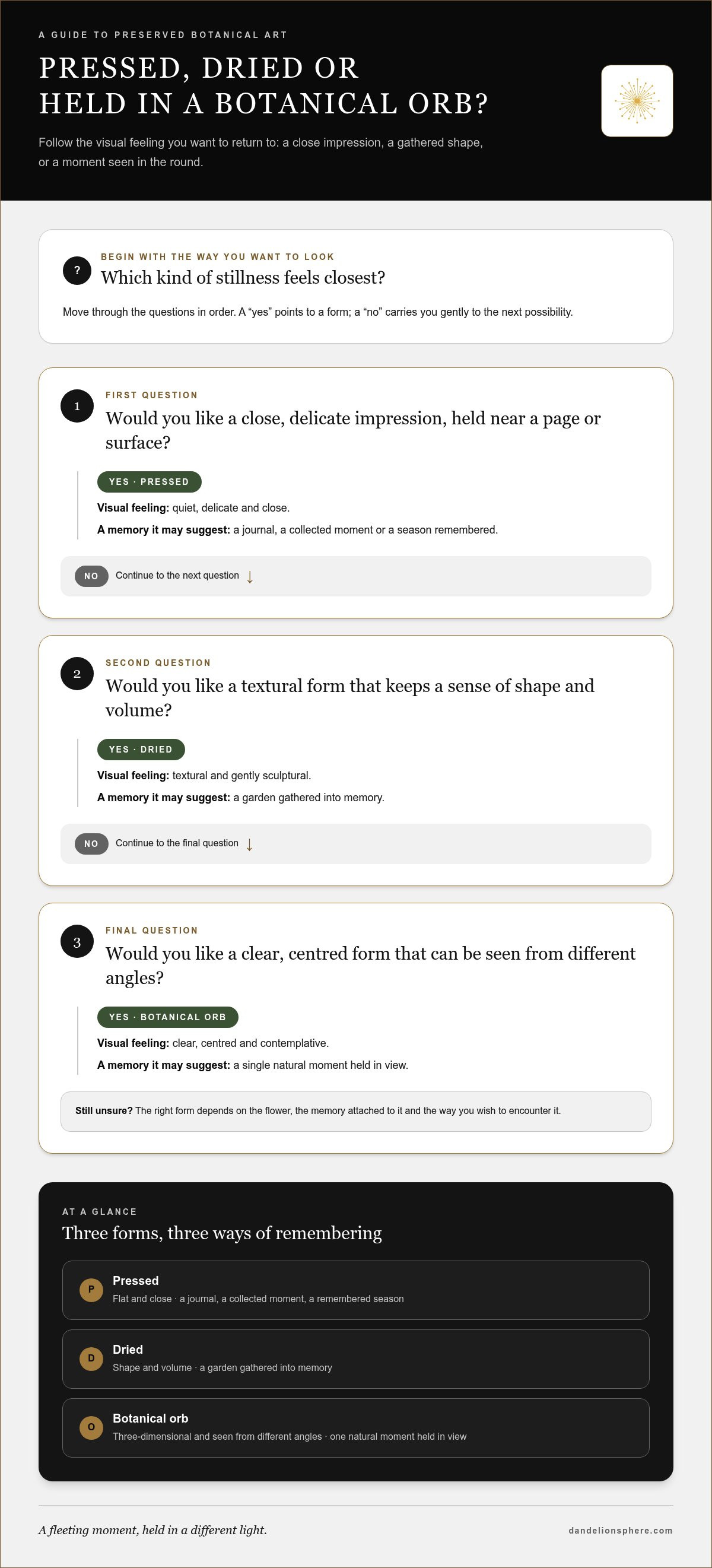
A flower can be remembered as a delicate impression, a gathered shape or a small world held in clear space. In preserved botanical art, form changes how we look: whether we meet a bloom close to a page or pause before its full silhouette. Each way of seeing carries its own kind of stillness.
| Form | Visual feeling | Relationship to space | Memory it may suggest |
|---|---|---|---|
| Pressed | Quiet, delicate, close | Flat, held near a page or surface | A journal, a collected moment, a season remembered |
| Dried | Textural, gently sculptural | Retains a sense of shape and volume | A garden gathered into memory |
| Botanical orb | Clear, centred, contemplative | Three-dimensional, inviting different viewpoints | A single natural moment held in view |
What feeling does pressed or dried flower art create?
Pressed flowers invite a close gaze. Their flattened forms can feel like a page kept between the leaves of a favourite book: intimate, ordered and touched by time. The history of flower pressing reaches from botanical study to artistic expression, giving this quiet form a long place in how people observe and remember plants.
Dried flowers retain more of their shape, bringing a different presence. A stem or bloom may recall a gathered handful from a particular season. Flowers vary, and no two arrangements hold the same feeling. One may suggest abundance; another, the tenderness of something almost gone.
What changes when a flower is presented as a sphere?
A botanical orb gives a flower room to be seen in the round. Its clear spherical form keeps the bloom at the visual centre, while its three-dimensional silhouette invites the eye to wander around it. The encounter feels less like reading a pressed page and more like returning to one small moment from changing angles.
For a deeper reflection on collecting nature’s quiet artistry, explore the botanical art journal. The right form depends on the flower, the memory attached to it and the way you wish to encounter it. You might find a quiet point of reflection among these botanical art objects.
Does Preserving a Flower Take Away Its Natural Beauty?
A living flower is never still for long. Light shifts across its petals; a breeze unsettles its shape; the day carries it towards change. To preserve a flower is not to keep all of this. Nor must it be. Its natural beauty belongs partly to its passing.
A preserved flower is a memory held in form; a living flower is nature unfolding, moment by moment. One cannot replace the other. Preserved botanical art offers a lasting view of a real botanical presence, while the living bloom remains bound to its season, scent, movement and eventual fading. The distinction is not a loss to be solved, but a way of seeing what each can hold.
What can a preserved flower hold that a photograph cannot?
A photograph can keep colour, light and a particular instant with extraordinary tenderness. A pressed flower can bring its own quiet intimacy. A preserved flower offers another kind of encounter: the presence of an actual botanical form, rather than an image of it. Its contours and delicate details become a tangible point of attention.
This physical presence doesn’t prescribe what someone should feel. A small bloom might recall a familiar garden, a walk taken with someone dear or simply a season that has passed. For another person, it may be admired for its shape alone. Botanical art can be aesthetically focused as well as attentive to the natural world, a distinction explored in Botanical art. Photographs, pressed specimens and preserved forms each offer their own language of remembrance.
Can a lasting flower still honour impermanence?
Yes, if its stillness leaves room for the life that came before it. A preserved form can recall the season in which a flower opened, the brief sunlight on a path or a wish carried by the wind from a dandelion seed head. It doesn’t claim that the moment can be returned. It gives the memory somewhere to rest.
In a room, a natural form may bring the eye back to the living world beyond its walls. Its presence can sit quietly amongst changing light and the rhythms of the day. Botanical forms can also change the way a room is seen, drawing attention to shape, space and the details of nature.
Whether preservation feels beautiful is personal. Perhaps it’s the flower’s familiar outline that matters. Perhaps it’s the memory attached to it, or the reminder that even a fleeting moment can linger. The question isn’t whether a preserved bloom is more beautiful than a living one. It’s what you see in it.
How to Choose Preserved Botanical Art That Feels Meaningful
A piece that feels personal often begins with a memory, not a room or a trend. Before considering shape or setting, pause with one question: what would you like to remember? A person. A season. A childhood moment. The quiet beginning of something new. Let that answer gently guide your choice.
- Begin with the memory. Name the moment, or simply notice the feeling you hope to return to. A dandelion seed head might bring back childhood wishes and the first warm days of spring.
- Consider the flower. Think about the quality that draws you: a fine silhouette, an open bloom or a form that speaks of a particular season. The flower’s natural character can offer a quiet thread back to the memory.
- Choose the form. A pressed flower may feel intimate, like a page from a private journal. A dried silhouette keeps a sense of shape. A botanical sculpture offers a presence to view from different angles. No form is right for everyone.
- Imagine its place. Consider the light, the view from a favourite chair and the room’s existing calm. A modest shelf, a writing table or a quiet corner might each offer a different way to meet the piece.
Which flower or memory should guide the choice?
Begin with what you want the artwork to call back, rather than searching for the most elaborate form. Perhaps it’s the dandelion’s airy seed head and the old ritual of making a wish before sending it into the breeze. Perhaps another flower holds the colour of a garden you knew, or recalls a beginning that still matters. Follow the association that feels true to you; the meaning needn’t be explained to anyone else.
Where might a botanical sculpture find its quiet place?
Look at the light as it changes through the day. Notice the sightlines: will the piece be encountered in passing, or seen in a pause? A clear surface may give a botanical form room to be the visual centre, whilst an uncluttered corner can let its details breathe. There’s no single interior style it must belong to. For further reflection on collecting and placing botanical art, visit the botanical art journal.
A personal collection can grow slowly, gathered around memories rather than a matching scheme. Let each piece earn its place through the thought it brings to mind. When you’re ready to explore nature’s art objects, take a quiet look through the botanical art collection.
Dandelion Sphere: A Fleeting Moment Held in Botanical Art
Among the many ways a flower may be remembered, the botanical orb offers a particular kind of stillness. Dandelion Sphere gives this form to real dandelion flowers, held within clear spheres where each seed head becomes the visual centre. It is one expression of preserved botanical art, not the only way a flower’s presence can be honoured.
There is a quiet contrast in the sight: a flower once shaped by open air, now held in a clear, rounded world. Its delicate structure remains visible, inviting the eye to linger over details that might otherwise pass unnoticed. No two people need see the same thing in it. For one, the seed head may call up a childhood wish. For another, its intricate form may be enough.
What makes the preserved dandelion the centre of the artwork?
The dandelion seed head gathers many fine forms into one delicate sphere. Seen within a clear orb, its airy pattern seems suspended between movement and stillness. It may recall the familiar childhood gesture of making a wish and sending its seeds into the wind, though memory is always personal. The name Taraxacum Orbis is associated with Dandelion Sphere, joining the flower’s botanical presence with the shape that holds it in view.
A real dandelion, held within a clear sphere, makes a passing moment visible again. That simple encounter is at the heart of Dandelion Sphere: not a return to the field, but a point of reflection shaped by what we remember of it.
How can a botanical orb become a quiet reminder?
Placed in an everyday setting, a botanical orb can offer a pause among familiar things. Changing light may pass across its clear form; the eye may return to the fine seed head between the day’s ordinary moments. It asks for no particular interpretation. It simply makes room for attention.
That is the quiet character of nature’s art. It can hold a memory close without closing it, leaving space for seasons, wishes and associations to gather around the flower. If you’d like to spend a moment with these botanical spheres, explore them at your own pace.
Some fleeting moments deserve to remain with us, not as they were, but as a quiet reminder of the beauty that once passed through the world.
Let a Meaningful Moment Remain
A flower’s form can shape the memory it holds. Pressed, dried or presented as a botanical orb, each offers a different way to return to a season, a person or a moment that mattered. The right choice is the one that speaks quietly to you.
Preserved botanical art doesn’t replace a living bloom or ask us to forget its passing. It offers a lasting point of attention, a small reminder of nature’s beauty and the memories gathered around it.
Dandelion Sphere gives this idea a distinctive form. Real dandelion flowers rest within clear spheres, their intricate seed heads held at the visual centre. The phrase A Fleeting Moment, Held Forever reflects this meeting of nature and time: not a return to the field, but a moment kept in view.
If you’d like to spend a little time with these botanical art objects, explore the botanical spheres. Let a small piece of nature’s quiet poetry find a place in your own story.
Frequently Asked Questions
What is preserved botanical art?
Preserved botanical art presents a flower or plant form within an artwork, allowing its presence to be contemplated beyond its brief life in nature. It might be pressed close to a page, shown as a dried silhouette or held within a sculptural form. The flower’s natural details remain central, whilst the artwork offers a way to revisit a season, a place or a personal memory.
How is preserved botanical art different from dried flower art?
Preserved botanical art is a broad expression for artworks that keep botanical forms in view. Dried flower art is one form within it, presenting blooms that retain a sense of their original shape and volume. Pressed flowers, by contrast, are flattened and often arranged close to a page or surface. The difference lies in how each form presents the flower and shapes the viewer’s encounter with it.
Can a real dandelion be preserved as botanical art?
Yes. Dandelion Sphere’s botanical spheres feature real dandelion flowers held within clear spheres, where the seed head remains the visual centre. Its fine, radiating structure can be seen as a distinct natural form, rather than an illustration of one. The result offers a quiet way to encounter a familiar flower again, whether it brings a particular memory to mind or simply invites a closer look.
How do I choose preserved botanical art that feels meaningful?
Begin with the memory or feeling you hope to revisit, then consider which flower and form seem to echo it. A pressed bloom may feel intimate, like a page from a journal; a dried silhouette carries more of its shape; a botanical orb can be viewed from different angles. Finally, imagine where you might pause to see it. No single choice suits everyone.
What happens to the meaning of a flower when it is preserved?
The flower’s meaning doesn’t have to remain fixed. A preserved bloom might recall a person, a childhood garden, a season or a wish once sent into the wind. Its stillness can offer space for those associations to linger, but it doesn’t dictate what they should be. For some, the flower’s form is meaningful in itself. For others, its story is inseparable from a particular moment.
Is a botanical orb suitable as a thoughtful gift?
A botanical orb can be a thoughtful gift for someone who feels a connection to nature, memory or the quiet poetry of flowers. A dandelion may suggest childhood wishes or a season shared, though its significance is personal. The clear sphere keeps the real flower at the centre of view, offering a gentle point of reflection. It can mark a meaningful occasion without needing to speak for the giver.
Disclaimer
The content on this website is provided for inspiration and informational purposes only. Articles reflect the philosophy and storytelling of Dandelion Sphere and are not intended as professional advice. While every effort is made to ensure accuracy, no guarantees are given regarding completeness or current applicability.


