
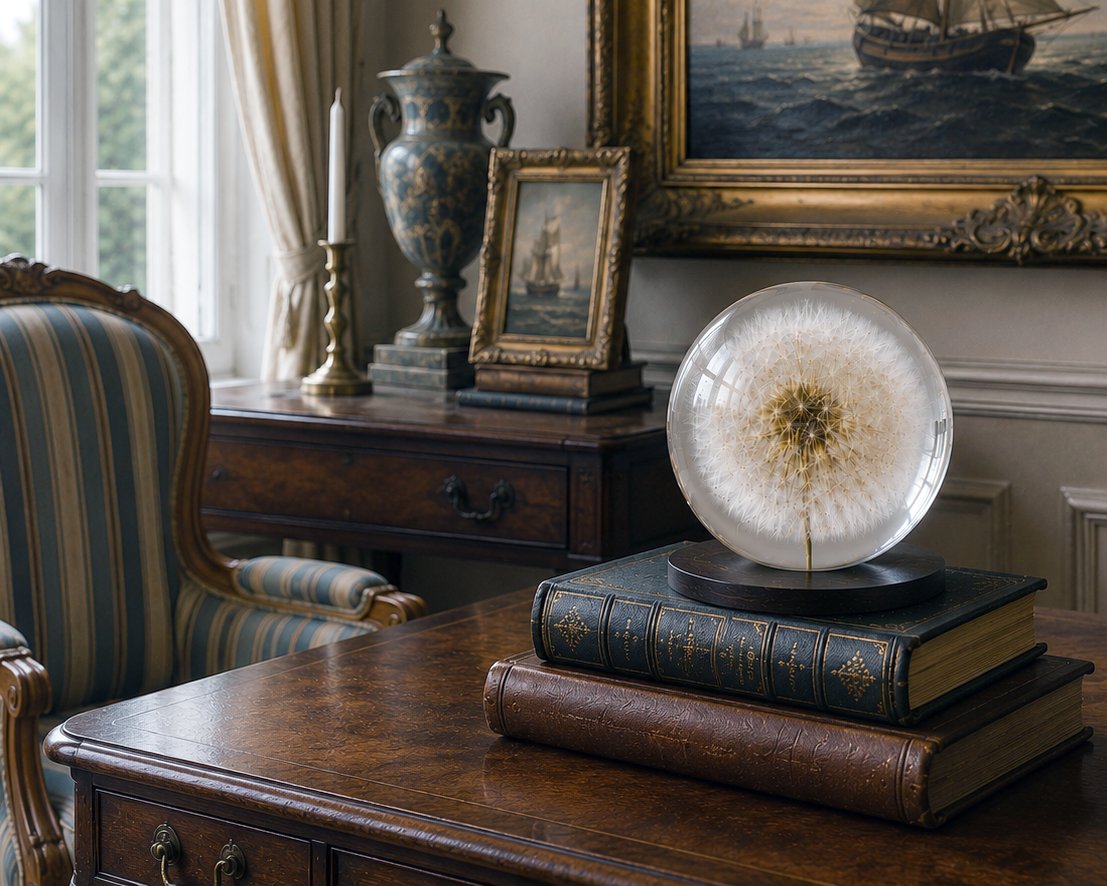
Beyond the Mundane: The Workspace as a Sanctuary for Thought
The desk is more than a surface. It is a landscape. A quiet geography of the mind, where thoughts are given space to unfold and ideas take form. For too long, this personal territory has been defined by the cold lexicon of the office supplier. Plastic trays. Metal organisers. Objects of pure function, devoid of soul. We propose a gentle turning away from this sterile mentality, towards a more considered, more human approach.
In the constant flow of digital noise, the eye and the mind seek a place to rest. A quiet centrepiece. An object that does not demand attention, but rather, invites contemplation. This is the psychological importance of curating your workspace with intention. It is about creating a focal point for stillness, a visual anchor that brings you back to the present moment. By inviting the quiet artistry of nature into this space, we build a bridge between our inner world and the world outside. Between the screen’s flat glow and the meadow’s deep dimension. In a world that moves with relentless speed, nature’s patient forms remind us of a different, more enduring rhythm.
The Poetry of the Everyday Workspace
To transform a simple surface into a curated gallery of seconds. This is the quiet ambition. It is not about accumulation, but about selection. A single, thoughtfully chosen statement object can recalibrate the energy of an entire room, turning a place of labour into a haven for reflection. It becomes a silent partner in your work, a companion for the deep hours of focus.
Choosing this object is an act of choosing stillness. It is a declaration that amongst the noise and the deadlines, there will be a space for beauty. A space for a quiet breath. An object that holds a story, a fragment of a memory, or a piece of the wild, can ground us in a way that functional items never could. It whispers of a world beyond the immediate task, enriching our thoughts and calming our minds.
A Dialogue Between Nature and Space
There is a profound and calming effect that organic forms have on our cognitive load. The gentle curve of a stone, the intricate pattern of a leaf, or the perfect sphere of a dandelion seed head—these shapes speak a language older than words. They soothe the part of our brain that is overstimulated by the hard lines and sharp angles of the modern world. They do not shout for our focus; they earn it with their silent, complex beauty.
To sit at a screen whilst in the presence of such an object is to find beauty in impermanence. It is a small, daily meditation on the fleeting and the eternal. The desk, then, becomes a place for both production and reflection. It is where the day’s work is done, but also where the mind can wander, dream, and reconnect with the simple, profound truths of the natural world. It is a sanctuary built not of walls, but of intention.
The Art of Selection: Choosing a Statement Object with Soul
The process of choosing a unique desk object should be led by the heart, not just the head. It is a search for emotional resonance, a quality that transcends mere functional utility. The right piece is not simply something to look at; it is something that makes you feel. It should evoke a sense of calm, a flicker of wonder, or a gentle pull towards a cherished memory. It is an intuitive process, a quiet conversation between you and the object.
Consider the interplay of light within your space. A piece that is transparent or translucent engages in a constant, subtle dance with the changing light of the day. In the morning, it may catch the sun’s first rays, casting a soft glow. In the afternoon, it might hold the light within itself, a quiet, luminous presence. The clarity and form of an object can fundamentally alter a desk’s mood, transforming it from a static surface into a dynamic stage for light and shadow.
Tactile storytelling is another vital consideration. In a world dominated by the smooth, cold glass of screens, an object that invites a moment of touch can be a powerful anchor to the physical world. The weight of it in your palm, the coolness of its surface, the smoothness of its form—these sensory details provide a brief, meditative escape. Select materials that speak to you, that feel good in your hand, and that offer a moment of grounding when you need it most.
Finally, reflect on temporal meaning. Why do objects that capture a fleeting moment feel so much more profound? A dandelion seed head, poised for flight but held in perfect stillness, tells a story of potential, of wishes, of the delicate balance between a single moment and eternity. An object that embodies such a story brings a layer of philosophical depth to your workspace, serving as a constant reminder of the beauty of the brief and the power of the permanent.
Criteria for a Timeless Collector’s Piece
When selecting a piece to last a lifetime, certain criteria guide the discerning eye. Authenticity is paramount. There is a profound difference between a mass-produced replica and a preserved natural wonder. An authentic botanical specimen, chosen with an artist’s care, carries with it the genuine story of its moment in the sun. It is a true fragment of the natural world, not an imitation.
Sculptural integrity is equally essential. A true collector’s piece must be beautiful from every conceivable angle. It should invite you to turn it over in your hands, to observe it from above and below, discovering new intricacies with each view. The form should be balanced, the composition harmonious, and the overall effect one of effortless elegance. It must command its space with quiet confidence.
Longevity, too, is a hallmark of a worthy investment. The materials used to preserve and present the natural element must be of the highest quality, chosen to honour nature’s design for years, even generations, to come. This commitment to permanence ensures that the fleeting moment it captures will not fade, but will remain a source of wonder and contemplation indefinitely.
Harmonising with Your Existing Interior Accent
A statement object should not exist in isolation; it should enter into a dialogue with its surroundings. Consider the balance of textures. A smooth, clear botanical sculpture, for instance, creates a beautiful contrast when placed on a surface of raw, knotted wood or cool, veined stone. This interplay of textures adds a layer of sensory richness to your space.
Allow your unique desk object to breathe. The Japanese concept of Ma—the beauty of negative space—is a powerful principle in curation. Resist the urge to clutter. By giving a singular, beautiful object its own space, you amplify its presence and its power to hold your focus. It becomes a point of stillness in a calm sea.
Ultimately, you are creating a narrative. The objects you choose to live with tell a story about who you are and what you value. A botanical orb, a favourite leather-bound journal, a single, elegant pen—together, they create a composition, a small poem of stillness and intent upon your desk.
Taraxacum Orbis: A Fleeting Moment Held in Eternal Clarity
We introduce the Taraxacum Orbis. A museum-quality nature object, and a quiet companion for deep work. It is the fragile architecture of a summer dandelion, captured at the peak of its ephemeral beauty. Each delicate seed, a tiny vessel of possibility, is held in a state of perfect, weightless stillness. It is a fragment of a meadow, a breath of country air, brought into the sanctuary of your workspace.
The creation of each piece is a form of quiet alchemy. It is a process that transforms a fleeting second—the moment just before the wind carries the seeds away—into a permanent and timeless sculpture. This is not merely preservation; it is a meditation on time itself. The botanical orb serves as a constant, gentle reminder of the world’s delicate beauty, offering a focal point for mindfulness amidst the demands of a busy day.
What is a Botanical Sculpture?
A botanical sculpture is a marriage of a perfect natural specimen and its crystal-clear preservation, creating a singular art object that elevates nature to a gallery standard. The common dandelion, so often overlooked, is a powerful symbol of wishes, resilience, and childhood wonder. To see its intricate structure held in perfect clarity is to see it anew, to appreciate the profound artistry inherent in even the most humble of wildflowers. For this reason, a botanical orb is the ultimate conversation piece for a refined desk, sparking curiosity and inviting a closer look.
The Artisan’s Touch in Every Sphere
The journey of each Taraxacum Orbis begins in the field. It is a patient search for the perfect specimen, a meticulous process of selecting each individual dandelion head for its symmetry, completeness, and ethereal beauty. Only the most flawless are chosen. This careful selection is the foundation of the piece’s soul.
Achieving the “alchemy of stillness” is the work of an expert artisan. It requires a deep understanding of the delicate specimen and a mastery of the preservation process, ensuring that every seed remains perfectly in place, creating the illusion of a moment frozen in time. This is why each sphere is a true collector’s piece, an object that transcends the category of simple desk accessories and enters the realm of fine botanical art. You can learn more about this philosophy in our journal entry, The Poetry of Preservation.

Curating the Serene Desk: A Roundup of Thoughtful Pairings
The true art of curating a serene workspace lies in the thoughtful pairings of objects. A Taraxacum Orbis, with its organic, spherical form, sits in beautiful harmony with the clean, spare lines of minimalist stationery. Imagine it beside a simple stack of cream-coloured note cards or a single, weighty fountain pen. The contrast between the wild, natural form and the structured, human-made tools creates a compelling visual and intellectual balance.
Light is your most important collaborator. Position your botanical orb where it can catch the morning sun. As the light streams through it, the intricate details of the seed head are illuminated, casting delicate shadows and refracting the light in a thousand tiny ways. This daily play of light brings the object to life, making it a dynamic and ever-changing presence on your desk.
Even in a modern, tech-heavy setup, a handmade nature sculpture can serve as a vital point of softness and humanity. Placed beside a sleek monitor or a minimalist keyboard, it offers a moment of organic reprieve, a reminder of the analogue world. It can also help to create a “Zen Zone” on your desk—a small, dedicated area for quiet reflection, a place to rest your eyes and your mind during the transitions between tasks.
Objects in Dialogue: Creating a Visual Narrative
To create a truly captivating desk landscape, consider layering objects of different heights and textures. A low, smooth botanical cube might sit in front of a taller, leaner vase holding a single dry stem. This variation creates visual interest and guides the eye around the space. Use a botanical interior accent to soften the hard lines of a monitor or the sharp corner of a desk, introducing a curve where one is needed.
Select a favourite journal or a treasured book to sit alongside your nature art object. The pairing of a physical story—the dandelion’s—with the potential stories held within the blank pages of a notebook creates a powerful symbolic connection. It is an invitation to write, to think, to dream. For more on this, explore our thoughts on A Dialogue Between Nature and Space.
Meaningful Gifts for the Inspired Professional
A dandelion sphere is a profoundly memorable gift for a significant professional milestone, such as a promotion, a new venture, or a graduation. It moves beyond the conventional, offering a gesture that is both beautiful and deeply symbolic. It speaks of new beginnings and the potential for growth.
The symbolism of the dandelion is one of seeding new ideas and watching them take flight. To give such an object is to offer a wish for the recipient’s own ideas and ambitions to travel far and find fertile ground. It is a sophisticated, thoughtful gift that will be treasured for a lifetime, serving as a constant source of inspiration on their desk. For further inspiration on selecting such a gift, we invite you to read The Poetry of Giving.
A Legacy of Stillness: Inviting Nature’s Artistry Home
To invest in a museum-quality nature object is to invest in a legacy of stillness. It is an acknowledgement that the objects we surround ourselves with have a profound impact on our state of mind. A serene desk, anchored by a piece of nature’s quiet artistry, can lead to a more mindful, more creative, and more fulfilling working life. It is not an extravagance; it is an essential element of a well-considered life.
The Taraxacum Orbis is more than a beautiful object. It is a fragment of summer, held forever on your desk. It is the memory of a sunlit meadow, the feeling of a gentle breeze, the silent wish made on a puff of white. It is a conclusion that is also a beginning—a reflection on the profound beauty of the brief and the quiet power of the permanent.
Beyond the Office: A Timeless Decorative Object
The beauty of a truly timeless piece is its versatility. While it may begin its life as a focal point for your workspace, its story does not end there. A botanical sculpture can transition effortlessly to become a centrepiece on a living room mantel, a point of interest on a bookshelf, or a quiet companion on a bedside table. Its serene presence enhances any space it inhabits.
As your life and home evolve, so too will the role of this object. It is a piece to be passed down, a story to be shared. It embodies the enduring appeal of nature preserved in its most delicate and perfect state. To learn more about incorporating such pieces throughout your home, you may find inspiration in our guide for The Botanical Art Collector.
Your Invitation to Reflection
We invite you to pause. To take a breath. To look closely and observe the intricate, miraculous details of the natural world. A single object can be a gateway to this state of mindfulness, a reminder of the complex beauty that exists all around us, waiting to be noticed.
There is a deep and lasting connection between memory, objects, and focus. The right object can hold our stories, ground our thoughts, and inspire our best work. It is a quiet companion on the journey.
Explore our collection and find the quiet companion for your workspace.
Frequently Asked Questions
**What makes a desk object truly unique for a workspace?
** A desk object becomes truly unique when it transcends function and resonates on an emotional or philosophical level. Uniqueness lies in its authenticity—such as a real, preserved botanical specimen—its artisanal quality, and its ability to serve as a focal point for mindfulness, rather than just another piece of equipment.
**How do I choose between a botanical orb and a botanical cube?
** The choice is one of personal aesthetic preference. The orb, with its spherical, lens-like quality, offers a complete, world-unto-itself view of the specimen from all angles. The cube provides a more architectural, grounded presence, creating six distinct windows onto the botanical within. Consider the shapes that dominate your workspace and choose the form that provides the most pleasing contrast or harmony.
**Can a botanical sculpture help with focus and productivity?
** Yes, in a subtle but profound way. A botanical sculpture acts as a meditative anchor. During moments of mental fatigue or distraction, allowing your gaze to rest on its intricate, natural form can help calm the mind, reduce cognitive load, and gently bring your focus back to the present moment, creating a better state for deep work.
**Is a dandelion sphere suitable for a minimalist office setup?
** A dandelion sphere is exceptionally well-suited to a minimalist interior. In a spare, uncluttered environment, its intricate complexity and organic form stand out as a singular point of beauty and interest. It complements the minimalist ethos of “less but better,” offering maximum visual and emotional impact with a minimal footprint.
**How should I clean and care for my museum-quality nature object?
** Care is simple and requires only a gentle touch. To clean your botanical sculpture, use a soft, microfibre cloth to lightly dust its surface. Avoid using any chemical cleaners or abrasive materials, as these can damage the pristine clarity of the object. Keep it out of prolonged, direct sunlight to ensure its longevity.
**What is the meaning behind giving a dandelion as a desk gift?
** Giving a preserved dandelion is a poetic and meaningful gesture. It symbolises the seeding of new ideas, the fulfillment of wishes, and the courage to begin a new chapter. As a desk gift, it serves as a constant, beautiful reminder of potential, growth, and the successful launch of a new venture or career path.
**How does light affect the appearance of a clear botanical sphere?
** Light is a dynamic partner to a botanical sphere. The clear material captures and refracts light, creating a luminous effect that changes throughout the day. Direct sunlight can illuminate every delicate seed, making the sphere glow from within, while softer, ambient light gives it a more serene and contemplative presence.
**Where is the best place to position a statement object on a desk?
** Position your statement object within your line of sight, but not in a place of primary distraction. A corner of the desk or a space just to the side of your monitor is ideal. This allows it to be a calming peripheral presence you can turn to intentionally, rather than something that constantly competes for your attention. Consider a location where it will interact beautifully with a natural light source.
Disclaimer
The content on this website is provided for inspiration and informational purposes only. Articles reflect the philosophy and storytelling of Dandelion Sphere and are not intended as professional advice. While every effort is made to ensure accuracy, no guarantees are given regarding completeness or current applicability.


