
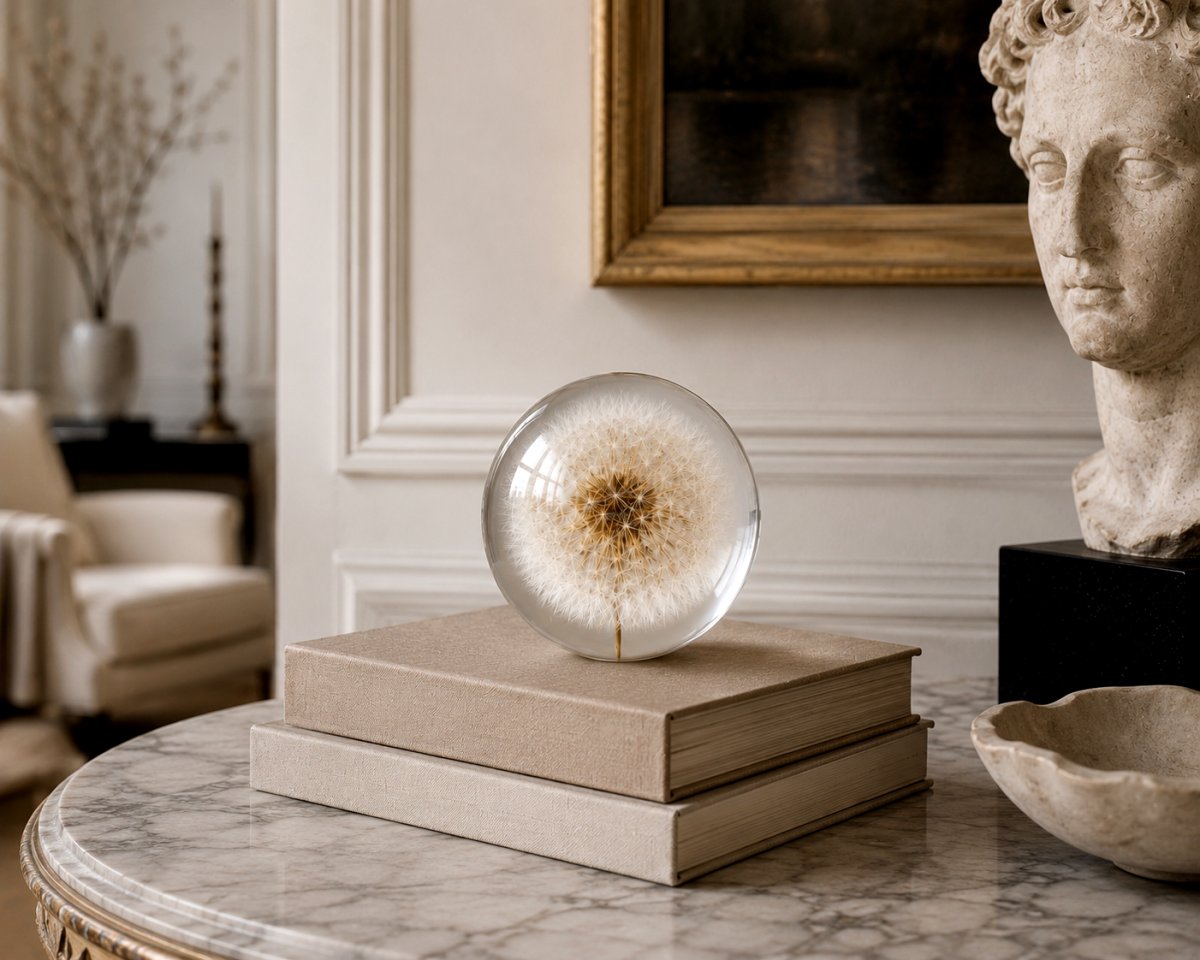
Understanding Natural Specimen Art as a Fragment of Summer
There is a quiet language spoken in the heart of a British meadow. It is a language of fleeting moments, of sunlight dappling through tall grasses, of a seed head waiting for a breath of wind. To engage with natural specimen resin art is to learn this language; it is to hold a dialogue with the eternal. This art form is not about capturing a thing, but a feeling. A single, perfect second of summer, held forever.
We must move beyond the simple idea of a souvenir. A postcard captures a place; a shell recalls the sea. But a true nature’s art object captures time itself. It invites us to consider the philosophy of the fleeting moment—the profound beauty found only in that which is destined to disappear. The dandelion seed head, or Taraxacum, represents the ultimate expression of this philosophy. Its architecture is a masterpiece of fragility, designed for dispersal, for an ending that is also a beginning. To preserve it whole is to challenge the very nature of its existence, creating a quiet paradox of eternal impermanence.
The Poetry of the Suspended Second
Imagine the pause. The held breath of a dandelion clock just before a wish is made. This is the moment captured within a botanical sculpture. It is the silent, weightless potential of a thousand journeys held in perfect stillness. The emotional resonance of such an object is profound. It is a memory of childhood afternoons, of endless skies, of the simple, potent magic of the wild. It makes the intangible tangible. A botanical sculpture is a bridge between the temporal world of seasons and the eternal realm of art.
From Wildflower to Fine Botanical Art
The journey from a wild specimen to a collector’s piece is one of reverence and restraint. An artisan does not seek to improve upon nature, but to provide a silent, invisible stage for its quiet artistry. In the world of minimalist aesthetics, the botanical orb is favoured as a centrepiece. Its perfect, uninterrupted form draws the eye inward, to the delicate universe suspended within. Placed amongst a curated space, the quiet authority of a single seed head can anchor a room, offering a focal point for contemplation and calm. It does not shout for attention; it waits to be noticed.
The Delicate Anatomy of a Museum-Quality Nature Object
To truly honour nature’s design, the medium that holds it must achieve absolute clarity. It must become an absence, a transparent whisper that allows the specimen to exist as if floating in air. This is the defining characteristic of museum-quality seed head art. It demands to be viewed from every angle, turned over in the hand, studied in the changing light of day. The crystal-clear medium is not merely a container; it is the canvas. It creates the illusion of a world without boundaries, where the delicate filaments of the dandelion are suspended in nothing but light itself.
The way light interacts with the piece is a crucial part of its dialogue. Sunlight, or the soft glow of a lamp, can travel through the sphere, illuminating the intricate geometry of the seed head. It reveals the fine, silken parachutes, the precise arrangement of each seed, the ghost of the life-giving stem. It is a performance of light and shadow, form and fragility.
Clarity as a Canvas for Nature
The mark of a true artisan’s touch is found in what is not there. The absence of bubbles, of distortions, of the slightest imperfection. This pursuit of purity ensures that nothing stands between the observer and the observed. A botanical sculpture thus becomes a lens, a way of seeing the natural world with heightened awareness. It magnifies the details we so often overlook: the perfect symmetry, the delicate engineering, the story of survival and propagation written into every fibre. The creation of a perfect, undistorted sphere is a testament to patience and a deep respect for the specimen it is destined to hold.
Preserving the Fragile Architecture of the Dandelion
Within the orb, the structural integrity of the dandelion is absolute. The seeds, forever poised for flight, will never scatter. They are suspended in a timeless state, their fragile architecture protected from the pressures of the world. Through this preservation, nature’s quiet artistry is revealed in breathtaking detail. One can spend hours discovering the subtle complexities that the naked eye might miss in the wild. The intricate geometry of the Taraxacum Orbis reveals a universe in miniature, a silent explosion of natural design held in a perfect, unending moment.
Choosing Your Collector’s Piece: Clarity, Form, and Meaning
In a world of mass-produced items, the act of choosing a handcrafted botanical art object is a deeply personal one. It is about recognising the difference between a product and a presence. A true collector’s piece possesses a spirit; it is the echo of the artisan’s intention and the unique character of the individual specimen. When selecting your piece, look beyond the form and evaluate the life within the orb. Does it feel serene? Does it hold a sense of wildness? Does it speak to a memory or a feeling you wish to keep close?
The form of the object also carries significance. The sphere, a universal symbol of unity and wholeness, offers a different experience to the sharp, defined lines of a cube. Consider how the shape will interact with your space and your spirit. Ultimately, you are selecting a piece that will become a part of your story, a quiet companion that resonates with a personal milestone, a cherished memory, or a future aspiration.
Spheres of Serenity vs Geometric Cubes
The sphere is a symbol of the infinite. It has no beginning and no end, reflecting the cyclical nature of life, death, and rebirth. A botanical orb, therefore, often brings a sense of calm and continuity to a space. It can soften the hard lines of a modern interior, introducing a gentle, organic element that feels both grounded and otherworldly. The cube, by contrast, offers a more structured frame for the specimen. It can feel architectural and deliberate, highlighting the contrast between nature’s wildness and the order of human design. Choosing a form is about deciding which conversation you wish to have with the piece and how it will complement your existing collection of nature art for your interior.
The Weight of a Meaningful Gift
To give a botanical sculpture is to give something more than an object; it is to offer a moment of wonder. A memorable gift should evoke a feeling, a memory, a wish. The dandelion, for centuries a symbol of hope, resilience, and the fulfilment of wishes, carries a potent and beautiful meaning. It speaks of new beginnings, of letting go, and of the persistent beauty that can be found in the most humble of places. It is a profound gesture for a housewarming, an anniversary, or a moment of remembrance. It is a piece of poetry, made tangible. To learn more about this philosophy, explore our guide to selecting a unique botanical gift.

Placing Fine Botanical Art Amongst Your Interior Spaces
A piece of fine botanical art is not merely placed; it is curated. Its presence in a room is a dialogue with light and space. Consider where the sun falls throughout the day. A botanical interior accent placed on a windowsill in the morning can catch the low, golden light, creating a radiant display. On a bookshelf or mantlepiece, it becomes a point of quiet intrigue, inviting closer inspection. The goal is to create a museum feel in your own home, where each object is given the space and light it needs to tell its story. Organising a collection of these natural wonders is not about accumulation, but about creating moments of stillness and beauty throughout your home.
The Serene Workspace and the Desk’s Quiet Companion
In our increasingly digital lives, the need for a tangible connection to the natural world is more important than ever. Placed on a minimalist desk, a botanical orb can serve as a Zen focal point, a small sphere of serenity to rest your eyes upon during a busy day. It is a reminder to breathe, to pause, to reconnect with the simple, quiet rhythms of nature. The interplay between the natural light from a nearby window and the suspended moment within the orb can transform a workspace into a sanctuary for focus and contemplation. It is the perfect, unique desk decor piece for a mindful approach to work.
A Dialogue Between Nature and Space
A statement object, such as a large botanical sculpture, can anchor the design of an entire room. Placed on a coffee table or a central console, it becomes a natural conversation piece. It invites guests to lean in, to ask questions, to share their own memories of dandelions and summer fields. This is the power of art that is born from nature. It connects us to a shared experience, a collective memory. The piece does not dominate the space; rather, it enters into a gentle dialogue with it, creating an atmosphere of reflection and quiet wonder. It becomes more than an object; it is an experience to be shared.
The Taraxacum Orbis: A Masterpiece of Nature Suspended in Time
The Taraxacum Orbis represents the pinnacle of natural specimen art. It is the culmination of a patient journey, from the careful selection of a perfect seed head in a sunlit meadow to its final, flawless preservation as a botanical sculpture. This is not a process of manufacturing, but an act of collaboration with nature. The artisan’s commitment is to capture the alchemy of stillness—to honour the specimen by creating a world for it that is as pure and perfect as the air in which it was destined to fly. To invite a Taraxacum Orbis into your home is to invite a fragment of summer to stay with you, forever.
The Legacy of the Bloom
Why is the Taraxacum Orbis considered a botanical art collector piece? Because it embodies a philosophy. It is a meditation on time, fragility, and the enduring power of beauty. Each piece is a singular achievement, a moment that can never be replicated. The bloom will never fade, its colour will never diminish, its form will never alter. It is a legacy of a single, perfect day, preserved for generations to admire and contemplate. For those looking to begin a collection, understanding this legacy is the first step toward curating eternal stillness in their own lives.
Your Invitation to Stillness
We live in a world of noise and haste. The beauty of the brief, the power of the small, the poetry of the overlooked—these are the things we so often miss. A piece of fine botanical art is an invitation to slow down. To look closely. To appreciate the profound elegance of a single dandelion seed head, a universe of potential held in a silent, perfect sphere. We invite you to begin your own journey as a collector of these quiet moments, to find the piece that speaks to your story.
Discover the current collection of Dandelion Spheres.
Frequently Asked Questions
- Is the dandelion inside the botanical orb real? Yes. Each sculpture holds a genuine Taraxacum seed head, carefully selected from a British meadow at the perfect moment of its bloom. It is a real fragment of nature.
- Will the seeds within the botanical sculpture scatter over time? No. The seeds are held in an eternal, gentle pause. The preservation process ensures their delicate structure remains perfectly intact, suspended in time forever.
- How should I clean and maintain my collector’s piece to ensure clarity? As with any piece of fine art, gentle care is best. A soft, microfibre cloth, used lightly, is all that is required to maintain the piece’s luminous clarity.
- Can I place my nature’s art object in direct sunlight? To preserve the absolute, crystal-clear quality of your piece for a lifetime, we recommend placing it in a location where it can enjoy soft, indirect light rather than prolonged, direct sunlight.
- Why is the dandelion chosen as a natural specimen for this art form? The dandelion is a powerful symbol of wishes, resilience, and the beauty of fleeting moments. Its fragile, intricate form represents the ultimate challenge and the highest poetry of preservation.
- What makes the Taraxacum Orbis different from a standard paperweight? A paperweight is an object of utility, designed to hold down papers. A Taraxacum Orbis is a botanical sculpture, an object of contemplation designed to hold a moment in time. It serves no function other than to be a source of beauty and reflection.
- Is each botanical orb unique or are they mass-produced? Each piece is entirely unique. Nature never repeats itself, and so every dandelion is a singular creation. Each botanical orb is prepared by an artisan, one at a time, honouring the individuality of the specimen within.
- How does the preservation process honour the poetry of nature? It honours nature by listening. By waiting for the perfect moment. By seeking not to alter the specimen, but to provide a silent, invisible sanctuary where its fleeting beauty can achieve permanence.
Disclaimer
The content on this website is provided for inspiration and informational purposes only. Articles reflect the philosophy and storytelling of Dandelion Sphere and are not intended as professional advice. While every effort is made to ensure accuracy, no guarantees are given regarding completeness or current applicability.


